
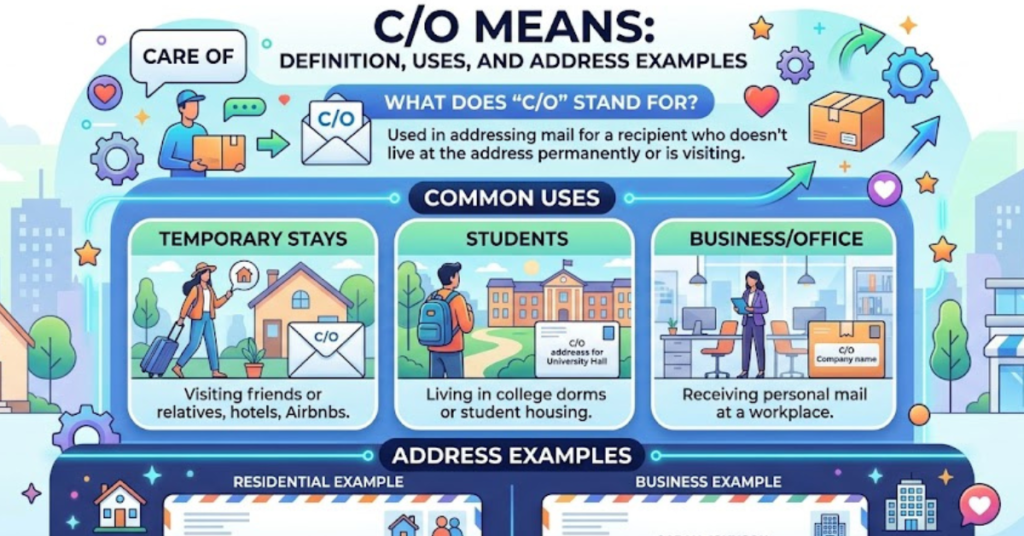
Have you ever seen “c/o” written before someone’s name on an envelope and wondered what it actually means? It’s a small abbreviation, but it plays an important role in making sure mail reaches the right person.
If you’ve searched for c/o means, you’re likely trying to understand how this abbreviation works, when to use it, and whether it’s still relevant today. In this guide, you’ll learn the meaning of c/o, where it belongs in an address, common real-life situations where it’s used, and mistakes to avoid. By the end, you’ll know exactly when and how to use it with confidence.
What Does C/O Mean?
The abbreviation c/o stands for “care of.”
It is used in a mailing address to indicate that a letter or package should be delivered to someone through another person, organization, or business rather than directly to the recipient’s own address.
In simple terms, it tells the postal service:
“Deliver this mail to the person or business listed after ‘c/o,’ who will then pass it on to the intended recipient.”
This makes c/o especially useful when the recipient:
- Doesn’t receive mail at their own address
- Is temporarily staying somewhere else
- Lives with another person
- Receives mail through their workplace
- Is using someone else’s mailing address
Why Is C/O Used?
The primary purpose of care of (c/o) is to ensure mail reaches someone safely when they don’t regularly receive mail at the delivery address.
Using c/o helps:
- Prevent returned mail
- Improve delivery accuracy
- Inform postal workers who should accept the mail
- Clarify the relationship between the recipient and the address
Even in today’s digital world, government agencies, businesses, universities, and individuals continue to use c/o whenever necessary.
How to Write an Address Using C/O
Writing an address with c/o is straightforward.
Standard Format
Recipient's Name
c/o Person or Business Name
Street Address
City, State ZIP Code
Country (if applicable)
Example 1: Staying With Family
Emily Johnson
c/o Michael Johnson
456 Oak Street
Austin, TX 78701
USA
Emily is staying at Michael’s home, so the mail is delivered to Michael’s address.
Example 2: Workplace Address
David Wilson
c/o Bright Solutions Ltd.
890 Corporate Avenue
Chicago, IL 60611
USA
David receives his mail through his employer.
Example 3: Student Living Temporarily
Sarah Brown
c/o Linda Brown
123 Pine Road
Seattle, WA 98109
USA
Sarah is temporarily living with her mother.
When Should You Use C/O?
There are many situations where using c/o makes perfect sense.
Temporary Living Arrangements
If you’re staying with relatives, friends, or a host family for a short period, you can have important mail sent using c/o.
Example:
- Vacation stays
- Temporary work assignments
- Medical recovery
- Student housing
Receiving Mail at Work
Many professionals receive business correspondence at their office.
Instead of using a home address, they write:
c/o Company NameThis tells the postal service the company will receive the mail on their behalf.
Sending Mail to Someone Without a Permanent Address
Some individuals don’t have a permanent mailing address.
Instead, they may receive mail through:
- Family members
- Friends
- Shelters
- Legal representatives
Using c/o ensures the mail reaches a reliable contact.
Sending Mail to Children
Parents sometimes receive mail for their children.
Example:
Emma Davis
c/o Jennifer Davis
This indicates Jennifer will receive the mail for Emma.
Legal or Business Correspondence
Law firms, accountants, financial advisors, and other professionals frequently use c/o when representing clients.
For example:
John Smith
c/o Smith & Associates LLP
Is C/O Still Used Today?
Yes.
Although email and digital communication have reduced traditional mail, c/o remains widely recognized by:
- USPS (United States Postal Service)
- Royal Mail
- Canada Post
- Australia Post
- Courier companies
- Government agencies
- Financial institutions
- Universities
Many official forms also allow mailing addresses that include “care of.”
Difference Between C/O and Other Address Terms
Understanding similar address abbreviations helps avoid confusion.
| Term | Meaning | Purpose |
| c/o | Care of | Mail delivered through another person or organization |
| Attn | Attention | Direct mail to a specific department or individual within a company |
| P.O. Box | Post Office Box | Mail stored at a postal box |
| Suite | Office number | Identifies a particular office location |
| Apt | Apartment | Identifies a residential unit |
While Attn directs mail internally within an organization, c/o indicates who should receive the mail first.
C/O vs. ATTN: What’s the Difference?
People often confuse these abbreviations.
C/O (Care Of)
Used when the recipient does not normally receive mail at the address.
Example:
Sarah Adams
c/o Robert Adams
Robert receives the mail first.
ATTN (Attention)
Used when sending mail to a company but wanting a specific department or employee to receive it.
Example:
ABC Corporation
ATTN: Human ResourcesCan You Use C/O for Packages?
Absolutely.
Courier services such as:
- UPS
- FedEx
- DHL
- USPS
all recognize care-of addresses, provided the complete address is accurate.
When shipping valuable items, always verify that the person listed after c/o is available to accept the delivery.
Common Mistakes to Avoid
Even though using c/o is simple, people occasionally make errors.
1. Putting C/O Before the Recipient’s Name
Incorrect:
c/o Michael Johnson
Emily Johnson
Correct:
Emily Johnson
c/o Michael Johnson
2. Using the Wrong Address
The address should belong to the person or organization listed after c/o.
3. Omitting the Recipient’s Name
Always include both names.
Without the recipient’s name, it may be unclear who the mail is intended for.
4. Using an Outdated Temporary Address
If the recipient has moved, update the mailing address to avoid delays or returned mail.
Practical Examples of C/O in Everyday Life
Here are a few common scenarios where c/o is useful:
Example 1: Traveling Abroad
Alex is spending three months with relatives in Canada.
Mailing address:
Alex Carter
c/o Susan Carter
Example 2: Internship
A college student receives official documents at the company where they’re interning.
Emily Brown
c/o Horizon Tech Inc.
Example 3: Elderly Parent
An elderly person has mail delivered to their adult child’s home.
Margaret Lee
c/o Daniel Lee
Example 4: Business Consultant
A consultant temporarily working at a client’s office may receive mail through that business.
Is C/O Required on Official Documents?
Sometimes.
Government agencies, banks, insurance companies, and employers often allow mailing addresses that include c/o.
It’s particularly useful when:
- Receiving tax documents
- Banking correspondence
- Legal notices
- University admissions letters
- Medical records
Always follow the address formatting instructions provided on the form.
Benefits of Using C/O
Using care of offers several advantages:
- Helps mail reach the intended recipient
- Reduces delivery errors
- Useful during temporary moves
- Accepted by postal services worldwide
- Ideal for workplace and family addresses
- Provides flexibility without changing your permanent address
Key Takeaways
- C/O means “care of.”
- It indicates that mail should be delivered through another person or organization.
- It’s commonly used for temporary addresses, workplaces, and shared residences.
- The recipient’s name always appears before c/o.
- Most postal and courier services recognize care-of addresses.
- Proper formatting improves delivery accuracy.
Frequently Asked Questions
What does c/o mean in an address?
C/O means “care of.” It tells the postal service to deliver the mail to another person or organization that will pass it along to the intended recipient.
Is c/o the same as attention (ATTN)?
No. Care of is used when someone receives mail through another person or business, while ATTN directs mail to a specific individual or department within an organization.
Can I use c/o for personal mail?
Yes. Many people use c/o when staying with friends, relatives, or at temporary residences. It’s a common and accepted way to receive mail at someone else’s address.
Does USPS accept c/o addresses?
Yes. USPS recognizes properly formatted care of addresses, as do many other postal services and courier companies around the world.
Where should c/o be placed in an address?
Write the recipient’s name first, followed by c/o and the name of the person or organization receiving the mail. Then include the street address, city, state, and ZIP code.
Can businesses use c/o?
Absolutely. Businesses frequently use c/o when employees, consultants, attorneys, or clients receive mail through a company’s office or another organization.
Conclusion
Understanding c/o means more than simply knowing that it stands for “care of.” It’s a practical mailing tool that helps ensure letters and packages reach people who receive mail through someone else, whether they’re staying temporarily with family, working at a different location, or using a shared mailing address.
By formatting a care-of address correctly and using it in the right situations, you can reduce delivery issues and make sure important correspondence arrives where it’s needed. Keep these guidelines in mind the next time you address an envelope, and you’ll be able to use c/o confidently and correctly.