
Have you ever booked a train ticket and noticed PQWL instead of the usual WL or RAC status? If you’re wondering PQWL means and whether your ticket will get confirmed, you’re not alone. Many railway passengers come across this code without fully understanding its significance.
In this guide, you’ll learn what PQWL is, how it differs from other waiting list types, how confirmation works, and what your chances are of getting a confirmed seat. Whether you’re a first-time traveler or a frequent train passenger, this article will help you make informed booking decisions.
What Does PQWL Mean?
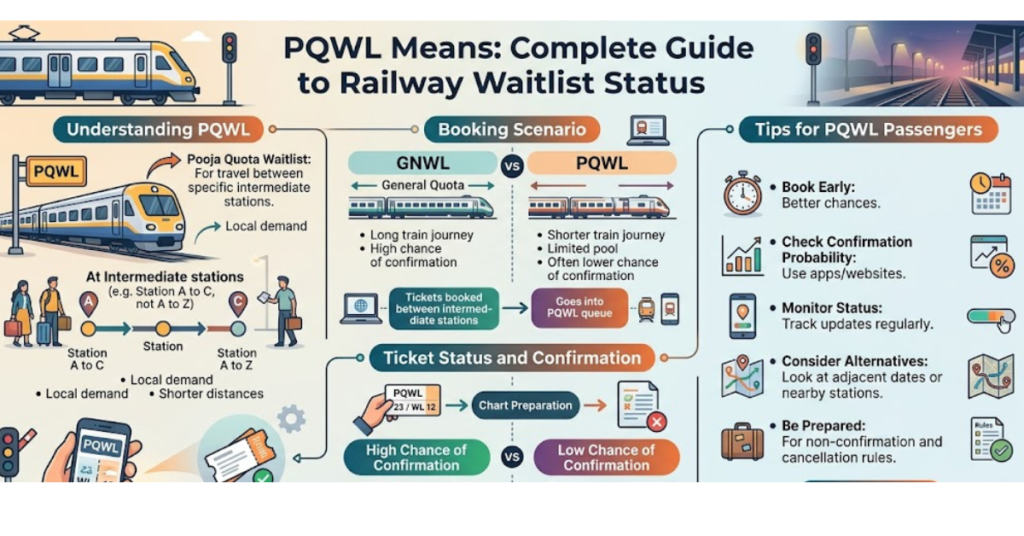
PQWL stands for Pooled Quota Waiting List.
It is a type of waiting list used by Indian Railways for passengers traveling between intermediate stations rather than from the train’s origin to its final destination.
Unlike the General Waiting List (GNWL), PQWL tickets are issued under a separate quota allocated for specific station pairs. Because this quota is limited, confirmation chances are usually lower.
Example
Suppose a train travels from Delhi to Chennai.
- Passenger A books from Delhi to Chennai (General Quota).
- Passenger B books from Agra to Nagpur (Pooled Quota).
Passenger B may receive a PQWL status because the journey falls under the pooled quota instead of the general reservation quota.
How the Pooled Quota Works
Indian Railways reserves seats under different booking categories to efficiently manage demand.
The pooled quota is created for passengers traveling between selected intermediate stations.
Instead of allocating seats individually for every station combination, Indian Railways pools them together into one quota.
This system helps accommodate passengers traveling shorter distances without affecting the main quota significantly.
Why Does PQWL Exist?
The primary purpose of PQWL is to:
- Serve passengers boarding and deboarding at intermediate stations
- Balance seat allocation across different route segments
- Improve reservation efficiency
- Prevent all seats from being occupied only by end-to-end travelers
Without pooled quotas, passengers traveling shorter routes would find it much harder to get reservations.
How PQWL Confirmation Works
Confirmation depends on seat availability within the pooled quota.
A PQWL ticket gets confirmed only when:
- Another passenger holding a confirmed pooled quota ticket cancels.
- Additional seats become available in the pooled quota.
- Railway authorities release reserved seats before chart preparation.
Unlike General Waiting List tickets, PQWL does not depend on cancellations in the general quota.
What Determines Confirmation Chances?
Several factors influence whether your PQWL ticket gets confirmed.
1. Number of Available Pooled Quota Seats
Some station pairs have very limited pooled quota allocations.
Fewer seats generally mean lower confirmation chances.
2. Passenger Cancellations
Confirmation mainly occurs when existing pooled quota passengers cancel their tickets.
If cancellation rates are low, movement remains limited.
3. Travel Season
Demand increases during:
- Festivals
- Summer vacations
- Long weekends
- School holidays
During these periods, PQWL confirmation becomes less likely.
4. Train Popularity
Premium and high-demand trains often have:
- Smaller pooled quotas
- Longer waiting lists
- Lower confirmation rates
5. Route Demand
Busy routes between major cities usually experience more competition for pooled quota seats.
PQWL vs GNWL
Understanding the difference helps set realistic expectations.
| Feature | PQWL | GNWL |
| Full Form | Pooled Quota Waiting List | General Waiting List |
| Applicable For | Intermediate stations | Origin station bookings |
| Confirmation Chances | Lower | Higher |
| Depends On | Pooled quota cancellations | General quota cancellations |
| Priority | Lower | Higher |
In most cases, GNWL tickets enjoy significantly better confirmation rates.
PQWL vs RAC
Many travelers confuse PQWL with RAC.
Here’s the difference.
| PQWL | RAC |
| Waiting list only | Reservation Against Cancellation |
| No confirmed seat | Partial confirmation available |
| Confirmation uncertain | Passenger can travel |
| May get automatically canceled if not confirmed | Travel allowed with shared berth |
An RAC ticket allows travel, whereas a PQWL ticket generally requires confirmation before boarding.
PQWL vs RLWL
Another commonly seen waitlist is RLWL.
RLWL (Remote Location Waiting List)
- Applies to important intermediate stations.
- Separate reservation quota.
- Confirmation depends on cancellations at remote stations.
PQWL
- Covers pooled station combinations.
- Usually has fewer seats.
- Confirmation can be comparatively lower.
Can You Travel with a PQWL Ticket?
If you booked an e-ticket and your PQWL status remains waitlisted after chart preparation:
- The ticket is automatically canceled.
- Refund is generally processed according to railway rules.
- You cannot legally travel in reserved coaches using an unconfirmed e-ticket.
For certain counter tickets, different rules may apply, so always verify the latest railway guidelines before traveling.
How to Check PQWL Status
You can monitor your booking status through:
- IRCTC website
- IRCTC Rail Connect app
- National Train Enquiry System (NTES)
- Railway reservation counters
- SMS alerts
- PNR status inquiry services
Checking your PNR regularly helps you stay updated on movement in the waiting list.
What Is a Good PQWL Number?
Generally speaking:
- PQWL 1–5: Better chances
- PQWL 6–15: Moderate chances
- PQWL 15+: Lower chances
However, actual confirmation depends on:
- Route
- Train
- Season
- Cancellation trends
- Seat availability
No waiting list number guarantees confirmation.
What Happens During Chart Preparation?
Indian Railways prepares the reservation chart before train departure.
At this stage:
- Final cancellations are processed.
- Available seats are allocated.
- Waiting lists move accordingly.
- Remaining waitlisted e-tickets are canceled automatically.
This is the final stage for seat confirmation.
Tips to Improve Your Chances
If you receive a PQWL ticket, consider these practical strategies.
Book Early
Early reservations often reduce the risk of landing in the waiting list.
Choose Alternative Trains
Different trains may have better seat availability.
Check Nearby Stations
Changing your boarding or destination station can sometimes improve confirmation chances.
Consider Flexible Travel Dates
Traveling one or two days earlier or later may increase seat availability.
Monitor Your PNR
Keep checking for movement, especially as the departure date approaches.
Common Myths About PQWL
Myth 1: Every PQWL Ticket Gets Confirmed
False.
Many remain waitlisted, especially during peak travel periods.
Myth 2: PQWL Is the Same as GNWL
Incorrect.
Both belong to different reservation quotas and follow different confirmation rules.
Myth 3: A Low PQWL Number Guarantees Confirmation
Not necessarily.
Even PQWL 2 or PQWL 3 may remain unconfirmed if there are no cancellations.
Myth 4: RAC and PQWL Are Identical
No.
RAC passengers can usually travel, while PQWL passengers require full confirmation.
Real-World Example
Imagine you’re traveling from Kanpur to Bhopal on a train that starts from Lucknow and ends in Mumbai.
Since you’re traveling between intermediate stations, your booking may fall under the pooled quota.
If your ticket shows PQWL 8, confirmation depends entirely on cancellations within that pooled quota—not on passengers canceling full-route tickets.
Key Takeaways
- PQWL means Pooled Quota Waiting List.
- It applies mainly to passengers traveling between intermediate stations.
- Confirmation chances are generally lower than GNWL.
- Seat allocation depends on pooled quota cancellations.
- Unconfirmed e-tickets are typically canceled after chart preparation.
- Booking early and choosing flexible travel options can improve your chances.
Frequently Asked Questions
What does PQWL mean in railway booking?
PQWL means Pooled Quota Waiting List, a reservation category used by Indian Railways for passengers traveling between certain intermediate stations. Confirmation depends on cancellations within the pooled quota.
Is PQWL better than GNWL?
Generally, no. GNWL usually has higher confirmation chances because it serves passengers traveling from the train’s originating station.
Can I board a train with a PQWL ticket?
If your e-ticket remains waitlisted after chart preparation, you cannot travel in the reserved coach. Always check your final PNR status before departure.
Does PQWL automatically become RAC?
No. A PQWL ticket does not automatically convert into RAC. Confirmation depends on seat availability within the pooled quota.
How can I improve my PQWL confirmation chances?
Book tickets early, consider alternative trains or travel dates, monitor your PNR regularly, and choose routes with lower demand when possible.
Is PQWL confirmation possible during peak seasons?
Yes, but the chances are generally lower due to higher demand and fewer cancellations. Festival periods and holidays often see longer waiting lists.
Conclusion
Understanding PQWL means can help you avoid confusion when booking train tickets with Indian Railways. Since it represents the Pooled Quota Waiting List, its confirmation process differs from the General Waiting List and depends on a separate pool of reserved seats. While confirmation isn’t guaranteed, booking early, checking alternative routes, and monitoring your PNR can improve your chances of securing a confirmed reservation.
The next time you see a PQWL status, you’ll know exactly what it means, how it works, and what steps you can take to plan your journey more confidently.