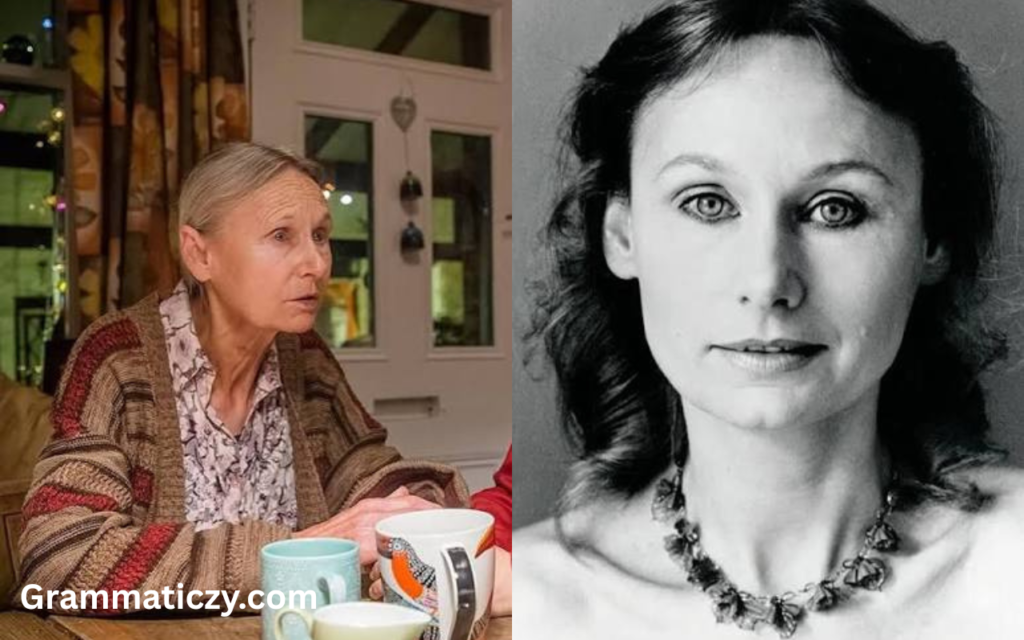
Angela Pleasence had the kind of screen presence that was difficult to forget. With her striking pale-blue eyes, distinctive appearance, and quietly intense performances, she could transform even a supporting role into something audiences remembered long after the credits rolled. Her career stretched across British television, cinema, theatre, radio and literary drama, taking her from Shakespeare and historical productions to cult horror, Doctor Who, Gangs of New York and Happy Valley. She was also the daughter of celebrated actor Donald Pleasence, but her career ultimately developed into something much more individual than simply being known as the daughter of a famous performer.
Born in Chapeltown, Yorkshire, in 1941, Pleasence entered the profession during an era when British acting was strongly connected to theatre training and repertory performance. She studied at the Royal Academy of Dramatic Art, graduating in 1963, and began building a career that would eventually encompass more than five decades. Her performances were particularly effective in stories requiring atmosphere, emotional restraint and a sense of mystery, qualities that made her equally convincing in historical dramas, literary adaptations and horror films.
What makes Angela Pleasence’s story especially interesting is the balance between family legacy and individual achievement. Her father became internationally famous through films such as The Great Escape and Halloween, yet Angela established her own professional identity through a long series of character roles. From Catherine Howard in The Six Wives of Henry VIII to Elizabeth I in Doctor Who, her work demonstrated an ability to move between genres and generations without becoming confined to one particular type of character.
Angela Pleasence Quick Facts
Angela Pleasence was born Angela Daphne Anne Pleasence on September 17, 1941, in Chapeltown, Yorkshire, England. She was the daughter of actor Donald Pleasence and his first wife, Miriam Raymond. Her professional career began in the 1960s, and she remained active on screen and stage for decades before her final recorded screen appearance in Happy Valley in 2016.
She died on April 6, 2026, at the age of 84. Her career included more than 40 television and film credits, according to TV Guide, while IMDb lists more than 60 acting credits. These figures differ according to how individual productions and appearances are counted, but both demonstrate the breadth of her professional work.
| Fact | Details |
|---|---|
| Full name | Angela Daphne Anne Pleasence |
| Date of birth | September 17, 1941 |
| Place of birth | Chapeltown, Yorkshire, England |
| Date of death | April 6, 2026 |
| Age at death | 84 |
| Profession | Actress |
| Father | Donald Pleasence |
| Mother | Miriam Raymond |
| Education | Royal Academy of Dramatic Art |
| RADA graduation | 1963 |
| Known for | The Six Wives of Henry VIII, From Beyond the Grave, The Barchester Chronicles, Doctor Who, Happy Valley |
| Spouse | Michael Cadman |
| Marriage | 1964–1970 |
| Children | One son |
| Career | 1964–2016 |
| Height | Approximately 5 ft 5 in |
| Net worth | No reliably verified public figure |
| No verified official account identified | |
| X/Twitter | No verified official account identified |
| No verified official account identified |
The absence of verified financial and social-media information is important. Numerous celebrity websites publish estimated net-worth figures, but there is no authoritative public record establishing a precise amount for Pleasence. Likewise, there is no reliable evidence that she maintained official Instagram, X/Twitter or LinkedIn accounts. A responsible biography should distinguish documented facts from internet speculation.
Early Life and Family Background
Angela Pleasence grew up in a family deeply connected with acting. Her father, Donald Pleasence, became one of Britain’s most recognizable character actors, while her mother, Miriam Raymond, was also an actress. Being raised around performers inevitably meant that theatre and acting were familiar subjects from an early age, although Angela would eventually have to establish her own reputation in a profession where her father’s name was already highly recognizable.
Her family also included siblings and half-siblings from Donald Pleasence’s later relationships. IMDb identifies Jean Pleasence as her sister and Polly Jo, Lucy and Miranda Pleasence among her half-siblings. Miranda Pleasence would also pursue acting, continuing the family’s connection with the performing arts. The Pleasence name therefore became associated with several performers, although Donald and Angela developed distinctly different professional identities.
Growing up in an acting family did not guarantee an easy path. Angela’s own career was shaped by formal training and professional experience rather than simply by family connections. Later accounts have described her as shy in her early years, and the Guardian noted that she gradually developed a substantial career across stage, television and film. Her eventual success suggests a performer who learned to turn an initially reserved personality into a strength on screen.
Education at RADA and the Beginning of Her Career
Angela Pleasence attended the Royal Academy of Dramatic Art, widely known as RADA, and graduated with an acting diploma in 1963. Her formal training placed her within a long British theatrical tradition emphasizing voice, movement, text, character development and disciplined performance. It was a significant step toward creating a professional identity separate from her father’s reputation.
After completing her training, Pleasence began professional work in the theatre. Her early stage experience included Shakespeare and serious dramatic material, helping her develop the controlled acting style that would later become recognizable on television. She was not an actress whose career depended entirely on conventional glamour; instead, her individuality and ability to create atmosphere became some of her greatest professional assets.
The theatrical foundation remained visible throughout her career. Even when working in television or film, Pleasence approached characters with the discipline of a stage performer. This helped her move naturally between historical drama, literary adaptations, supernatural stories and contemporary television. Her training also gave her the versatility required to work consistently over several decades.
Breakthrough in The Six Wives of Henry VIII
One of Angela Pleasence’s most important early achievements came in 1970 when she played Catherine Howard in the BBC drama series The Six Wives of Henry VIII. The production consisted of six television plays, each focusing on one of Henry VIII’s marriages. Pleasence appeared as Catherine Howard, the fifth wife of the Tudor king.
The series became an important historical television production, presenting the lives of Henry VIII and his wives through dramatized accounts of their personal and political circumstances. Pleasence’s portrayal of Catherine Howard gave her a particularly memorable role at a relatively early stage of her career. The historical setting suited her ability to convey vulnerability, emotional complexity and tension without excessive theatricality.
Her performance also established a connection between Pleasence and British period drama that would continue throughout her career. She later appeared in productions such as The Barchester Chronicles, Silas Marner, Mansfield Park and Les Misérables. Historical and literary television became an important part of her professional identity, allowing her to work with complex characters and richly developed stories.
From Beyond the Grave and Her Horror Career
Although Angela Pleasence worked in many genres, horror audiences have particularly strong memories of her performances. Her film credits include From Beyond the Grave, Symptoms and The Godsend, productions that helped establish her as a recognizable figure within British genre cinema.
Her appearance in From Beyond the Grave was especially notable because she acted alongside her father, Donald Pleasence. The film became part of the British horror tradition associated with Amicus Productions and anthology-style supernatural storytelling. Angela’s distinctive appearance and restrained performance style made her well suited to the unsettling atmosphere of the production.
Symptoms, released in 1974, was another important horror credit. The film has developed a cult reputation and is frequently discussed by enthusiasts of psychological and atmospheric British horror. Pleasence’s involvement in such productions helped create an unusual dual identity for her career: she could appear in respected literary and historical television while simultaneously becoming a familiar face to cult-film audiences.
Television Success and British Drama
Television became one of the most consistent elements of Angela Pleasence’s career. Her credits included productions such as The Barchester Chronicles, Silas Marner, Midsomer Murders, Agatha Christie’s Poirot, Marple, The Bill, Casualty, Whitechapel and Doctors.
Her work in British television demonstrates how successfully she adapted to changing eras of production. She began during the period of large-scale BBC drama productions and continued appearing in modern crime and mystery series. Rather than being identified with only one decade, she remained a working character actress whose experience could be used by productions across different generations.
The breadth of her television work also reveals why her career is difficult to summarize with a single defining role. Catherine Howard may have been one of her best-known performances, while horror fans remember From Beyond the Grave and Symptoms. Doctor Who viewers know her as Elizabeth I, and later audiences encountered her through Happy Valley. Each generation could discover a different side of her work.
Angela Pleasence in Doctor Who
In 2007, Angela Pleasence appeared in Doctor Who in the episode “The Shakespeare Code,” playing Queen Elizabeth I. The casting had an interesting historical connection because Pleasence had already played Catherine Howard in The Six Wives of Henry VIII decades earlier. Her later portrayal of another Tudor monarch gave her career an unusual connection with British royal history.
“The Shakespeare Code” was built around William Shakespeare and the Elizabethan period, making Pleasence’s casting particularly appropriate. Her experience in historical drama gave her the authority needed for a character such as Queen Elizabeth I, while the science-fiction setting allowed her to participate in a very different style of storytelling.
The role also introduced her to a younger generation of viewers. Doctor Who has an unusually broad international fan base, and its ability to bring established British actors into individual episodes has helped preserve their work for new audiences. Pleasence’s appearance therefore became another bridge between her earlier television career and contemporary popular culture.
Other Major Film and Television Roles
Angela Pleasence’s filmography extended far beyond horror. She appeared in Hitler: The Last Ten Days, Stealing Heaven, The Search for John Gissing, Gangs of New York, The Gigolos and other productions. Her screen work included both British projects and internationally recognized films.
Her appearance in Martin Scorsese’s Gangs of New York in 2002 was a notable later-career film credit. The film starred Leonardo DiCaprio, Daniel Day-Lewis and Cameron Diaz and presented a large-scale historical vision of nineteenth-century New York. Pleasence’s role was small, but it reflected the kind of character work that had defined much of her career.
She also played the Ghost of Christmas Past in the 1984 television adaptation of A Christmas Carol. The role was particularly compatible with her ethereal screen presence and demonstrated her ability to bring a sense of mystery to a fantastical character. Her filmography ultimately became a record of an actor who could move comfortably between realism, history, literature, horror and fantasy.
Theatre Work and Stage Experience
Although many audiences know Angela Pleasence primarily from television and film, theatre was an essential foundation of her professional life. Her training at RADA prepared her for stage performance, and she worked in productions of serious dramatic and classical material. Her theatre credits included George Bernard Shaw’s Saint Joan, a demanding play requiring considerable verbal and emotional control.
Stage work gave Pleasence a different environment from television. Theatre requires an actor to sustain a character across an entire performance, often without the editing and close-ups available to screen performers. This kind of discipline helped shape the controlled quality that later became one of Pleasence’s recognizable screen characteristics.
Her theatre background also explains why she could transition comfortably between different kinds of acting. Rather than relying on one screen persona, she possessed the technical foundation to interpret different characters according to the demands of the material. This versatility became one of the strongest features of her long career.
Personal Life, Marriage and Children
Angela Pleasence married actor Michael Cadman in 1964. The marriage lasted until 1970, and the couple had one child. Public information about her private life remained relatively limited compared with that of many modern celebrities, and she generally maintained a lower public profile outside her professional work.
Her relationship with her father naturally attracted attention because Donald Pleasence was such a famous actor. The two worked together in productions including From Beyond the Grave and The Barchester Chronicles. Their shared appearances are interesting not only because they were father and daughter, but because both developed reputations as distinctive character actors.
Despite being part of a famous acting family, Angela did not appear to build her public identity around celebrity culture. There is comparatively little reliable information about her daily routine, private beliefs, personal interests or social-media activity. That privacy is worth respecting rather than replacing with unsupported claims. Her professional record provides far more reliable insight into her character than speculation about aspects of her life that she chose not to publicize.
Angela Pleasence Net Worth and Sources of Income
There is no trustworthy, independently verified figure for Angela Pleasence’s net worth. Online celebrity-estimation websites sometimes publish numbers, but these are generally based on assumptions rather than publicly available financial records. Because of that, it would be misleading to state a specific dollar amount as though it were confirmed.
Her professional income would have been generated primarily through acting work. Over more than five decades, that included theatre productions, television dramas, feature films, radio work and other screen appearances. Her career was therefore based on sustained professional employment rather than the modern influencer economy of sponsorships, social-media advertising and personal-brand partnerships.
The most meaningful measure of her professional success is consequently not a speculative financial estimate but the longevity of her career. Remaining active from the 1960s into the 2010s while appearing across such a wide range of productions represents a substantial achievement for any actor.
Social Media and Public Image
Angela Pleasence belonged to a generation of performers whose careers were established long before Instagram, Facebook, YouTube and X existed. There is no reliable evidence of a verified personal Instagram, X/Twitter or LinkedIn account operated by her. Her public presence instead came through television appearances, film performances, theatre work and occasional interviews or archival material.
This makes her relationship with audiences very different from that of today’s celebrities. Modern performers can communicate directly with followers every day, while actors of Pleasence’s generation often allowed their work to speak for them. Her audience connection was created through characters rather than constant personal updates.
Today, her digital legacy exists mainly through film databases, streaming platforms, television archives, fan communities and articles revisiting classic British productions. That form of recognition can be remarkably durable. A viewer discovering Symptoms, From Beyond the Grave, The Six Wives of Henry VIII or Doctor Who can encounter Pleasence’s work decades after she first performed it.
Final Years and Happy Valley
Angela Pleasence remained involved in screen acting well into the twenty-first century. Her later credits included appearances in productions such as Whitechapel, The Sarah Jane Adventures, Your Highness and Happy Valley. These roles demonstrated that her career remained active even after decades in the industry.
Her final listed screen appearance came in the BBC drama Happy Valley in 2016, where she played Winnie. The series was widely acclaimed and represented another example of Pleasence appearing in a modern British drama after having begun her career during a very different television era.
The fact that her career extended from early 1960s theatre and television into productions released more than fifty years later is one of the clearest measures of her professional longevity. She witnessed enormous changes in the entertainment industry, from traditional stage and broadcast television to modern serialized drama, yet continued to contribute to the craft throughout multiple generations.
Death and Legacy in 2026
Angela Pleasence died on April 6, 2026, aged 84. Her death prompted renewed coverage of her career and encouraged audiences to revisit the performances that had defined her professional life. The Guardian described her as an actress with a haunting and distinctive screen presence, while other retrospective coverage emphasized her work across British drama, horror and television.
Her death also highlighted the difference between fame and legacy. Pleasence was never one of the most heavily publicized celebrities of her generation, but she accumulated a remarkable body of work. Her performances remain accessible through classic television, cult cinema and major productions, allowing new audiences to discover her without having experienced her career in real time.
Perhaps the most enduring part of Angela Pleasence’s legacy is her individuality. She carried one of British cinema’s famous acting surnames, but she did not simply live in the shadow of her father. Through formal training, stage experience, television drama, horror cinema and memorable character performances, she established a professional identity that belonged to her.
What Made Angela Pleasence Stand Out?
Angela Pleasence possessed a screen quality that casting directors could use in many different ways. Her pale-blue eyes and distinctive appearance gave her an immediately recognizable presence, but appearance alone cannot explain a career lasting more than five decades. Her ability to communicate vulnerability, sadness, mystery and quiet intensity made her particularly effective in dramatic material.
Another important quality was restraint. Pleasence rarely needed to dominate a scene through exaggerated performance. Instead, she could create a character through expression, voice, posture and carefully measured emotional detail. That approach made her especially effective in literary adaptations and historical dramas, where subtle characterization can be more powerful than obvious theatricality.
Her versatility was perhaps her greatest strength. She could play Catherine Howard in a prestigious historical production, appear in cult horror, become the Ghost of Christmas Past, portray Elizabeth I in Doctor Who, appear in a Scorsese film and later work on Happy Valley. That range makes her career valuable not only as entertainment history but also as an example of how character actors can remain professionally relevant for generations.
Final Thoughts on Angela Pleasence
Angela Pleasence’s life and career offer a compelling lesson about the difference between recognition and lasting artistic value. She was born into a famous acting family, but she did not depend entirely on that legacy. Instead, she trained professionally, built stage experience and developed a screen identity that audiences could recognize as distinctly her own. Her journey from RADA graduate to established British character actress demonstrates the importance of preparation, persistence and adaptability.
Her filmography is also a reminder that meaningful careers are not always built around blockbuster leading roles. Some performers leave their mark by making supporting characters unforgettable. Pleasence repeatedly did exactly that, whether she was portraying a historical figure, a mysterious woman in a horror film, a literary character, a royal figure or an ordinary person in a contemporary television drama.
As audiences continue to rediscover classic British television, cult horror and character-driven drama, Angela Pleasence’s work is likely to remain part of that cultural conversation. Her story stands as a reminder that perseverance, professional training, versatility and individuality can create a meaningful artistic legacy. She may have inherited a famous surname, but the performances she left behind were unmistakably her own—and that is ultimately what gives Angela Pleasence’s career its enduring value.