
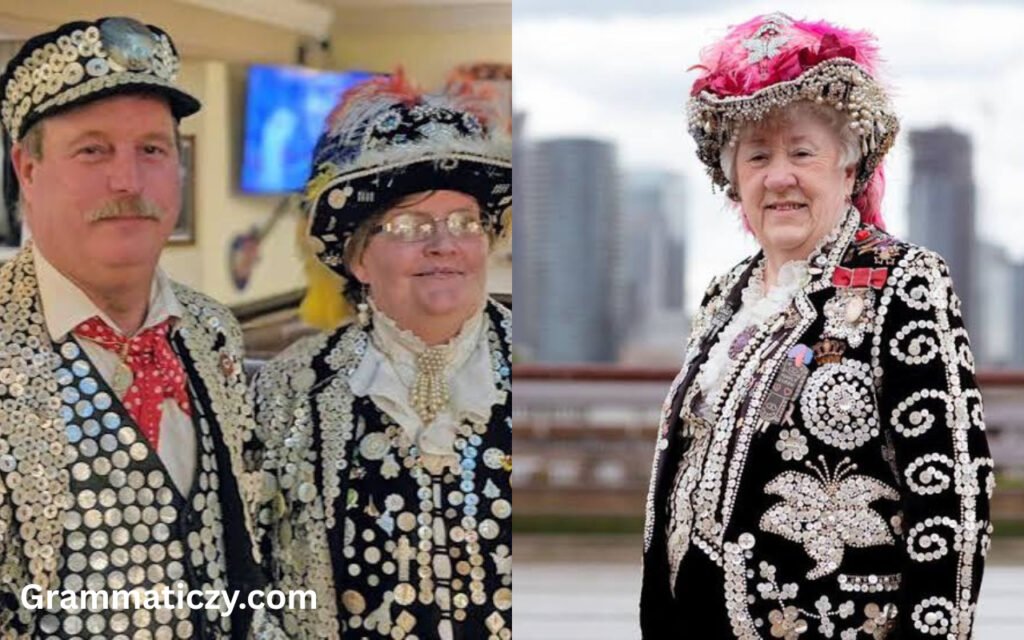
There are few sights more unmistakably London than a man or woman dressed from head to toe in sparkling mother-of-pearl buttons, walking through a crowded street surrounded by music, celebration and curious onlookers. The Pearly Kings and Queens may look like extravagant members of a royal court, but their crown is symbolic, their palace is the street, and their greatest responsibility is charity. For more than a century, these extraordinary figures have represented working-class London, Cockney culture, local pride and the belief that communities become stronger when people help one another. The tradition emerged from the world of Victorian street traders and gradually developed into one of London’s most distinctive living cultural institutions.
Unlike conventional royalty, the Pearly Kings and Queens did not inherit fortunes or political power. Their influence came from their communities and their willingness to devote time to charitable causes. The tradition is generally traced to the 1870s and especially to Henry Croft, a Victorian road sweeper and rat catcher who transformed an ordinary suit into a spectacular garment covered with pearl buttons so that he could attract attention while fundraising. His idea proved so successful that other costermongers adopted the style, creating a tradition that eventually spread throughout London.
Today, the Pearlies remain more than a colourful piece of London’s past. They continue to attend public celebrations, charity events, cultural festivals and community gatherings, while their elaborate costumes have become recognised examples of British folk fashion. Their story is ultimately about creativity, resilience, family and generosity. From the streets of Victorian London to major modern events and charity campaigns, the Pearly Kings and Queens have demonstrated how an idea created by working people can survive for generations and become part of a city’s identity.
Pearly Kings and Queens Facts at a Glance
| Fact | Details |
|---|---|
| Name | Pearly Kings and Queens, commonly called the Pearlies |
| Tradition began | 1870s, commonly dated to 1875 |
| Founder traditionally credited | Henry Croft |
| Henry Croft | Victorian road sweeper and rat catcher |
| Birthplace of Henry Croft | St Pancras, London |
| Birth year | Historical sources vary between 1861 and 1862 |
| Death | 1930 |
| Cultural background | Working-class London, costermongers and Cockney culture |
| Signature clothing | Suits, dresses, hats and accessories decorated with mother-of-pearl buttons |
| Main purpose | Charity fundraising and preservation of London heritage |
| Titles | Pearly King, Pearly Queen, Prince and Princess |
| Titles inherited? | Traditionally passed through families, although exceptions exist |
| Education of Henry Croft | Raised in a Victorian workhouse orphanage; detailed formal education is not documented |
| Parents | Historical records about his parents are limited |
| Siblings | No reliable complete public list |
| Net worth | Not applicable as a collective tradition; Pearly work is primarily charitable |
| Current activity | Charity events, festivals, public appearances and cultural preservation |
| Social media | Various Pearly organisations maintain online and social media presences |
| Major cultural appearance | London 2012 Olympic Games opening ceremony |
| Charity status | Multiple Pearly organisations operate separately, including registered charities |
| Official organisations | The Original Pearly Kings and Queens Association and London Pearly Kings and Queens Society |
Because Pearly Kings and Queens describe a collective tradition rather than one celebrity, conventional biography information such as age, personal net worth, parents and siblings cannot honestly be assigned to the group as a whole. The historical figure most closely associated with its beginnings is Henry Croft. The London Museum identifies Croft as the first Pearly King, while Pearly organisations commonly place the origins of their tradition in 1875. There are small differences in historical dates and biographical details between sources, so the safest description is that the tradition developed during the 1870s.
Who Are the Pearly Kings and Queens?
The Pearly Kings and Queens are representatives of different London communities who combine traditional dress, public performance and charitable work. Their names are connected with specific areas of the capital, and their elaborate costumes often incorporate designs representing their boroughs, families or personal identities. The London Museum describes them as working-class London icons whose roots reach back to nineteenth-century London. Their appearance may seem theatrical, but their original purpose was practical: attracting attention and encouraging people to contribute to charity.
The word “Pearly” comes from the enormous number of mother-of-pearl buttons decorating their clothing. Jackets, waistcoats, trousers, dresses, hats and other garments can feature intricate arrangements of buttons, symbols, lettering and patterns. Some costumes are so densely decorated that almost every available section of fabric is covered. The effect is deliberately spectacular, creating a visual identity that allows the wearer to stand out immediately in a busy crowd.
The title of Pearly King or Pearly Queen also carries a sense of responsibility. Traditionally, these titles have been passed from generation to generation, with children growing up around Pearly customs and eventually taking on family responsibilities. However, the system has never been exactly the same everywhere, and some individuals have received titles because of their demonstrated commitment to charitable work. This combination of inheritance, community recognition and service has allowed the Pearly tradition to remain both personal and collective.
Henry Croft and the Birth of the Pearly Tradition
Henry Croft is the name most closely associated with the beginning of the Pearly Kings and Queens. Historical sources identify him as an orphan who grew up in a Victorian workhouse environment in St Pancras. After leaving institutional care as a teenager, he became a road sweeper and rat catcher. His occupation placed him in the everyday world of working-class London, where he became familiar with the colourful community of costermongers who sold goods from street stalls and carts.
The costermongers were much more than street traders. They developed strong community networks and distinctive customs, including colourful clothing, local leadership and a tradition of helping members who fell on hard times. The London Museum notes that costermonger groups could nominate King and Queen families to represent their communities and defend their interests. Their culture therefore already contained many of the social ingredients that would later become associated with the Pearly monarchy.
Croft appears to have understood the power of this community spirit and combined it with visual spectacle. In the mid-to-late 1870s, he covered his suit with mother-of-pearl buttons, creating a costume that immediately attracted attention. His clothing included patterns, symbols and charitable slogans, including “All for Charity.” By transforming himself into a walking advertisement for charitable giving, Croft created an idea that other costermongers could adopt.
Early Life and the Working-Class London That Shaped the Pearlies
Henry Croft’s childhood took place during a period when London was experiencing enormous social and economic change. Victorian London was a city of extreme contrasts, with wealthy districts existing alongside overcrowded working-class neighbourhoods. For children growing up in poverty, institutional care could become part of everyday life. Croft’s experience in a workhouse orphanage therefore gave him a close connection with the social realities that later shaped the charitable purpose of his work.
Detailed information about Croft’s parents, siblings and formal education is limited, and responsible biographies should avoid filling those gaps with speculation. What can be established is that his life was shaped more by practical experience and working-class London than by privilege or academic opportunity. His later success is consequently striking: he did not need wealth, social status or formal authority to create something that would become a recognised part of London’s cultural heritage.
The environment around Croft also introduced him to the language and customs of Cockney London. Costermongers developed a distinctive culture that included humour, resilience and Cockney rhyming slang. The London Museum describes Cockney resilience and dialect as intrinsic elements of Pearly culture. This connection explains why the Pearlies became more than charity collectors: they also became visual representatives of a particular London identity.
Costermongers, Cockney Culture and Community Spirit
The costermongers were central to the development of the Pearly tradition. These market and street traders sold fruit, vegetables, fish and other goods directly to London residents. Their lives were often financially uncertain, but they developed strong networks of cooperation. If one member of the community experienced hardship, others could organise a collection, sometimes called a “whip round,” to provide assistance.
Their clothing also became an important part of their identity. Costermongers decorated their work clothes with rows of pearl buttons, including the sides of trousers, waistcoat pockets and caps. These decorations were relatively simple compared with later Pearly costumes, but they established the visual language from which Croft developed his much more elaborate style.
The Pearlies therefore emerged from an existing culture rather than appearing from nowhere. Croft combined the costermongers’ fashion, community loyalty and charitable traditions with his own flair for attracting attention. This is one reason the tradition has remained so meaningful: its foundations are not merely decorative but social. The buttons tell a story about working people creating identity and dignity within a rapidly changing city.
The Famous Pearly Costume and Its Symbolism
The Pearly costume is arguably the most recognisable part of the entire tradition. A traditional outfit can include a dark tailored jacket, waistcoat, trousers and top hat for men, while Pearly Queens may wear elaborately decorated dresses, coats and accessories. The garments are covered with mother-of-pearl buttons arranged into flowers, stars, hearts, letters, symbols and other motifs. The craftsmanship involved in creating these designs can be considerable.
The buttons are not simply there to make the wearer sparkle. Designs can communicate information about the individual’s borough, family or charitable identity. A Pearly suit may effectively function as a visual biography, with its symbols revealing something about the person wearing it. This is one reason surviving Pearly garments are valuable to museums and historians: they preserve information about London communities through fashion.
The costumes also demonstrate how working-class Londoners could create their own form of glamour. The Pearlies look royal without belonging to the aristocracy. Their clothes borrow the visual drama of ceremonial dress while remaining firmly connected to markets, streets and working-class humour. That combination of grandeur and accessibility is perhaps the secret of their enduring appeal.
Charity Work and the Growth of the Pearly Movement
Charity was central to Henry Croft’s idea from the beginning. The London Museum explains that Croft used his button-covered clothing to raise money for orphanages and hospitals, and his success encouraged other costermongers to adopt similar costumes. Once more people became involved, the Pearly identity developed into a network of families representing different London communities.
By the early twentieth century, the movement had expanded dramatically. The London Museum records that by 1911 all 28 London boroughs had a Pearly family, representing around 300 people. This demonstrates how rapidly a simple idea could spread when it matched the existing social structures of London’s costermonger communities. The Pearly King and Queen became local representatives as well as charity fundraisers.
Charitable work continues to define the movement today. The London Pearly Kings and Queens Society says it attends hundreds of events each year and helps raise awareness for charities. Its current fundraising activities include events in which money is distributed among numerous charities in and around London. In June 2026, the society reported that its annual charity boat trip raised £5,400 for London and home-counties charities.
Family Tradition and the Pearly Royal Titles
One of the most fascinating aspects of the Pearlies is the way the tradition moves through families. Becoming a Pearly King or Queen is not simply a matter of buying a decorated suit and adopting a title. The London Museum explains that titles are traditionally inherited, with children raised within the Pearly culture eventually being crowned with their parents’ title. In some circumstances, titles can pass to cousins or other relatives.
The Baxter family provides an excellent illustration of this intergenerational structure. Members of the family have held several Pearly titles, with children growing up wearing Pearly suits and participating in charitable activities. Their family history shows how titles can move between generations and locations while maintaining a continuing commitment to fundraising.
This family dimension helps explain why the Pearlies have survived for so long. A tradition that depends entirely on occasional public performances can disappear quickly, but a tradition taught inside families can reproduce itself naturally. Parents pass on stories, costumes, customs and responsibilities, while younger family members develop their own relationship with the tradition. The result is a living form of heritage rather than a historical reenactment.
Major Events, Recognition and Cultural Influence
The Pearly Kings and Queens have appeared at some of London’s most significant public celebrations. Their presence at jubilees, royal weddings and other major occasions has helped turn a local working-class custom into a symbol of London itself. Perhaps one of their most recognisable modern appearances came during the opening ceremony of the 2012 London Olympics, when the Pearlies were presented to an international audience.
Their cultural influence also extends into fashion. Pearly clothing has been preserved in museum collections, allowing modern audiences to study the craftsmanship and symbolism of historic costumes. The London Museum even highlights an Alexander McQueen suit influenced by Pearly clothing, demonstrating that the visual language of working-class London could inspire one of Britain’s most internationally recognised fashion designers.
Photography has played another important role in preserving their image. Historic photographs by Henry Grant document Pearly Kings and Queens at festivals, public gatherings and everyday moments. Images from the mid-twentieth century show that the Pearlies remained visible parts of London’s public culture long after the Victorian era. These photographs help connect today’s Pearlies with generations who wore the costumes decades ago.
Festivals, Performances and Life in Modern London
The Pearlies continue to combine charity with entertainment. Their public appearances can involve Cockney songs, dancing, parades and community gatherings. The atmosphere is often deliberately cheerful, reflecting the belief that fundraising does not have to be solemn. By creating a festive environment, Pearlies attract people who might otherwise walk past an ordinary charity collection.
Annual traditions remain particularly important. The Pearly Society continues to organise the Costermongers Harvest Festival, bringing together Pearly Kings and Queens, mayors, Chelsea Pensioners, musicians and other performers. The 2025 event included a procession, music, dancing, a traditional church service and further community celebrations. The society has announced another festival for September 20, 2026.
These events also demonstrate that Pearly culture is not frozen in the nineteenth century. Modern performers use contemporary venues, websites and social media while retaining traditional costumes and rituals. This balance between old and new may be essential to the future of the movement. The Pearlies can remain recognisably Victorian in appearance while using twenty-first-century methods to communicate with supporters and organise charitable work.
Pearly Kings and Queens Net Worth and Income
It is important to approach the subject of Pearly Kings and Queens net worth carefully because the term can create a misleading impression. The Pearlies are not a single celebrity whose personal wealth can be calculated. They are a collection of individuals, families and organisations, many of which operate around voluntary charitable activity. There is therefore no legitimate single net-worth figure for the Pearly Kings and Queens.
Individual members may have ordinary careers, businesses, pensions or other sources of personal income, but those finances are separate from their Pearly responsibilities. The London Pearly Kings and Queens Society describes its work in terms of raising money for charities, while its current website highlights charitable fundraising rather than personal financial gain.
The financial story of the Pearlies is therefore better measured by the money they help raise than by personal wealth. Their organisations support nominated charities and community causes, with some events generating thousands of pounds. This distinction is important because charity is not simply an occasional feature of Pearly life; it is the foundation on which the entire tradition was built.
Social Media and Connection With a New Generation
Although the Pearly Kings and Queens began long before the internet, modern organisations have embraced digital communication. Websites provide histories, photographs, event information and opportunities to contact Pearly groups for appearances or charitable events. This makes the tradition accessible to people who may know very little about London’s working-class heritage.
Social media also gives individual Pearly families a way to display their costumes and share information about appearances. In an age when younger audiences increasingly discover cultural traditions through photographs and short videos, the highly visual nature of Pearly clothing is particularly well suited to digital platforms. A traditional costume that once attracted attention on a Victorian street can now attract attention across an international online audience.
The challenge is to ensure that social media does not reduce the Pearlies to nothing more than colourful photographs. The deeper story—charity, family, Cockney identity, working-class history and community responsibility—is what gives the costumes their meaning. Digital platforms are most valuable when they introduce people to that story rather than simply presenting the Pearlies as a novelty.
Henry Croft’s Memorial and the Preservation of His Legacy
Henry Croft died in 1930, but his connection with the Pearly movement remains strong. His memorial history is itself a remarkable story. According to the Original Pearly Kings and Queens Association, a life-size statue of Croft was donated by hospitals, societies and charitable organisations that had benefited from his work. The statue was originally placed in Finchley Cemetery, where Croft was buried.
The statue was later vandalised repeatedly and remained damaged for years. Members of the Original Pearly Kings and Queens Association, working with supporters and the church, eventually arranged for it to be repaired. It is now displayed in the crypt of St Martin-in-the-Fields, where visitors can see Croft represented in his recognisable top hat and Pearly suit.
The memorial is important because it reflects the nature of Croft’s legacy. He did not leave behind a business empire or political dynasty. Instead, he left an idea that other people continued to develop. Every Pearly King or Queen who raises money for charity is, in a sense, extending the work begun by a Victorian street sweeper who discovered that an unusual suit could become a powerful instrument for helping others.
The Pearly Kings and Queens in 2026
The tradition remains active in 2026, proving that the Pearlies are not simply a historical curiosity. The London Pearly Kings and Queens Society continues to organise events and fundraising campaigns, while its June 2026 charity boat trip raised £5,400 for charities in London and the home counties. The event brought together around 180 people for an evening of music, dancing, food and fundraising.
The society is also preparing for its 2026 Costermongers Harvest Festival, scheduled for September 20. The continuation of such events shows that the movement still has an active public role. Rather than appearing only at heritage exhibitions, the Pearlies continue to meet audiences in real community settings and use those occasions to support charitable causes.
The future of the Pearlies will depend heavily on younger generations. The tradition has already demonstrated its ability to survive enormous social changes, but continued relevance requires families and organisations to make the heritage meaningful to modern audiences. As long as new generations remain willing to wear the costumes, learn the history, participate in fundraising and represent their communities, the Pearly Kings and Queens are likely to remain part of London’s cultural landscape.
Why the Pearly Kings and Queens Still Matter
The lasting importance of the Pearly Kings and Queens lies in the unusual combination of spectacle and service. Their clothes are flamboyant enough to attract attention, yet the purpose behind that attention is generosity. This combination has allowed the tradition to achieve something many charitable campaigns struggle to accomplish: turning a fundraising activity into a celebration of community identity.
Their history also challenges conventional ideas about royalty. The Pearlies do not represent inherited wealth, aristocratic privilege or political authority. Their “royalty” comes from the people around them. A Pearly King or Queen represents a neighbourhood, a family and a tradition, and their status is tied to their willingness to serve. In that sense, the Pearly monarchy is an unusually democratic form of cultural royalty.
Perhaps most importantly, the Pearlies demonstrate that heritage can remain alive when it continues to serve a purpose. Their costumes preserve the memory of costermongers and Victorian London, their family structures preserve generations of knowledge, and their charity work gives the tradition a reason to continue. They are not simply remembering the past—they are actively carrying it forward.
Conclusion: The Enduring Legacy of London’s Pearly Royalty
The story of the Pearly Kings and Queens is one of the most fascinating examples of grassroots culture in British history. What began in the working-class streets of Victorian London became a tradition that could cross generations, boroughs and social boundaries. Henry Croft’s remarkable decision to cover his suit with mother-of-pearl buttons transformed his appearance into a fundraising tool, and his example inspired countless others to do the same.
The Pearlies have survived because their identity is built on more than fashion. The buttons may be what people notice first, but behind them are stories of family, community, Cockney culture, charitable giving and working-class resilience. Their appearances at major London events, their museum collections, their annual festivals and their continuing fundraising activities show that the tradition still has meaning in the modern city.
As the Pearly Kings and Queens continue to represent London in 2026 and beyond, their journey offers a powerful lesson about legacy. A person does not need wealth or conventional fame to make an enduring difference. Henry Croft created something lasting from his circumstances, and generations of Pearlies have continued that work through service and community spirit. Their shimmering costumes may resemble crowns, but their greatest inheritance is the simple principle behind every button: use your visibility, your talent and your community to help someone else. That is why the Pearlies remain one of London’s most colourful—and most meaningful—living traditions.