
Have you ever received a job offer and wondered why the salary mentioned doesn’t match the amount you’ll actually receive in your bank account? You’re not alone. Many professionals, especially fresh graduates and job seekers, find salary packages confusing because of one important term: CTC means.
Understanding what CTC means is essential before accepting any job offer. It affects how you compare salaries, negotiate compensation, and plan your finances. In this guide, you’ll learn the full form of CTC, what it includes, how it’s calculated, how it differs from gross and take-home salary, and what to look for when reviewing a salary package.
What Does CTC Mean?
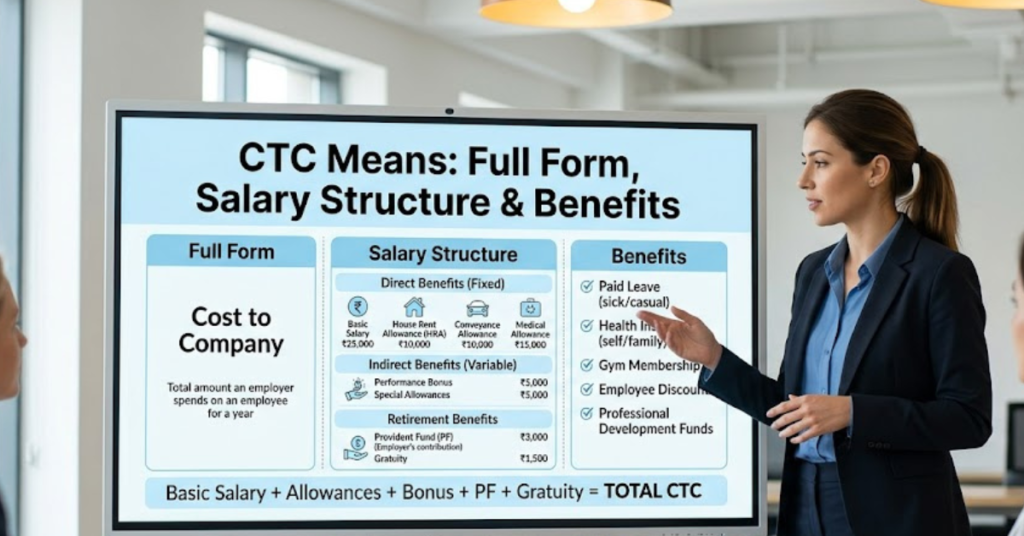
CTC stands for Cost to Company.
It represents the total annual amount a company spends on an employee, including direct salary, benefits, allowances, bonuses, retirement contributions, insurance, and other employment-related costs.
In simple words, CTC is not the amount you receive in your bank account. Instead, it reflects the employer’s total investment in employing you.
Simple Definition
CTC means the complete cost incurred by an employer to hire and retain an employee for one year.
Why Is CTC Important?
Whether you’re applying for your first job or switching companies, knowing your CTC helps you:
- Compare multiple job offers accurately
- Understand your actual earnings
- Plan taxes effectively
- Negotiate salary with confidence
- Avoid misunderstandings about take-home pay
Employers also use CTC because it provides a complete picture of employee compensation.
What Is Included in CTC?
A typical Cost to Company package consists of several components.
1. Basic Salary
Basic salary forms the foundation of your pay structure.
Many other salary components are calculated as a percentage of the basic salary, making it one of the most important elements.
2. House Rent Allowance (HRA)
HRA helps employees cover housing expenses.
The amount depends on factors such as:
- City of residence
- Company policy
- Basic salary
- Tax rules
3. Dearness Allowance DA
Some organizations, particularly government employers, include Dearness Allowance to offset inflation.
Private companies may or may not offer DA.
4. Special Allowances
Companies often include allowances such as:
- Internet allowance
- Mobile reimbursement
- Travel allowance
- Food coupons
- Uniform allowance
- Education allowance
5. Performance Bonus
Many organizations include:
- Annual bonus
- Quarterly incentives
- Sales commission
- Variable pay
Variable pay is usually linked to individual or company performance.
6. Provident Fund (PF)
Both employer and employee contribute to the Employee Provident Fund (EPF).
The employer’s contribution is included in your CTC even though it isn’t paid directly into your salary account.
7. Gratuity
Gratuity is a long-term employee benefit paid after meeting eligibility requirements under applicable employment laws.
Some employers include estimated gratuity in the total CTC.
8. Medical Insurance
Organizations frequently provide health insurance for employees and sometimes their families.
The premium paid by the employer forms part of the Cost to Company.
9. Other Employee Benefits
Depending on the employer, CTC may also include:
- Life insurance
- Wellness programs
- Relocation assistance
- Learning and development budgets
- Stock options (ESOPs)
- Paid leave benefits
Components of a Typical CTC
| Component | Included in CTC |
| Basic Salary | Yes |
| House Rent Allowance | Yes |
| Special Allowances | Yes |
| Performance Bonus | Usually |
| Employer PF Contribution | Yes |
| Gratuity | Often |
| Health Insurance | Yes |
| Other Benefits | May be included |
How Is CTC Calculated?
The general formula is:
CTC = Direct Salary + Indirect Benefits + Employer Contributions
Example
Suppose a company offers:
- Basic Salary: ₹5,40,000
- HRA: ₹2,10,000
- Special Allowance: ₹1,20,000
- Employer PF: ₹64,800
- Medical Insurance: ₹18,000
- Bonus: ₹75,000
- Gratuity: ₹26,000
Total CTC = ₹10,53,800 per year
However, your monthly in-hand salary will be lower after deductions.
CTC vs Gross Salary
Many people confuse these terms.
| CTC | Gross Salary |
| Total employer cost | Total earnings before deductions |
| Includes employer benefits | Excludes some employer expenses |
| Includes employer PF | Usually excludes employer-only costs |
| Higher amount | Slightly lower than CTC |
CTC vs Take-Home Salary
Take-home salary is the amount deposited into your bank account.
Take-home salary is calculated after deducting:
- Income tax (where applicable)
- Employee Provident Fund contribution
- Professional tax (if applicable)
- Other authorized deductions
As a result:
CTC > Gross Salary > Take-home Salary
Example Salary Breakdown
Suppose your offer letter states:
Annual CTC: ₹12,00,000
Possible breakdown:
- Basic Salary: ₹5,00,000
- HRA: ₹2,00,000
- Special Allowance: ₹2,20,000
- Employer PF: ₹60,000
- Bonus: ₹1,20,000
- Insurance: ₹20,000
- Gratuity: ₹80,000
Your actual monthly salary after deductions may be around ₹70,000–₹80,000 depending on taxes and company policies.
Why Is Take-Home Salary Lower Than CTC?
This surprises many employees.
Some reasons include:
- Employee PF deductions
- Income tax deductions
- Professional tax
- Employer contributions included in CTC
- Bonuses paid annually instead of monthly
- Insurance premiums
This explains why the advertised package differs from monthly earnings.
Fixed Pay vs Variable Pay
Most companies divide salary into two categories.
Fixed Pay
Guaranteed earnings include:
- Basic salary
- HRA
- Standard allowances
Employees receive these regularly.
Variable Pay
Variable compensation depends on:
- Individual performance
- Company performance
- Sales targets
- Business results
It is not always guaranteed.
What Should You Check Before Accepting a CTC Offer?
Never look only at the headline salary.
Instead, review:
- Basic salary percentage
- Monthly take-home amount
- Bonus conditions
- Variable pay percentage
- Employer PF contribution
- Insurance benefits
- Leave policy
- Gratuity inclusion
- Retirement benefits
Understanding these details helps you compare offers more accurately.
Common Misunderstandings About CTC
“CTC Is My Salary”
Not exactly.
CTC includes expenses the employer incurs that you may never receive directly.
“Higher CTC Always Means Better Pay”
Not necessarily.
A high CTC with large variable components or employer contributions may result in a lower monthly income than expected.
“Bonuses Are Guaranteed”
Performance bonuses often depend on meeting company or individual goals.
Always check the terms in your employment contract.
How to Compare Job Offers Using CTC
Instead of comparing only the total package, evaluate:
- Monthly take-home salary
- Fixed salary percentage
- Variable compensation
- Retirement benefits
- Insurance coverage
- Annual increments
- Work-life benefits
- Long-term incentives
A lower CTC with stronger fixed pay may be more valuable than a higher package heavily dependent on bonuses.
Practical Tips for Employees
- Always ask for a detailed salary breakup.
- Understand employer and employee deductions.
- Clarify bonus eligibility before accepting an offer.
- Compare fixed and variable pay separately.
- Estimate your monthly in-hand salary.
- Review tax implications each financial year.
Key Takeaways
- CTC stands for Cost to Company.
- It represents the employer’s total annual cost for an employee.
- CTC includes salary, allowances, bonuses, insurance, and employer contributions.
- It is different from gross salary and take-home salary.
- Understanding salary components helps you make informed career decisions.
- Always review the salary structure before accepting an offer.
FAQs
What does CTC mean in salary?
CTC means Cost to Company, which is the total amount an employer spends on an employee in a year. It includes salary, benefits, bonuses, and employer contributions.
Is CTC the same as take-home salary?
No. Take-home salary is the amount you receive after deductions, while CTC includes employer expenses and benefits that may not be paid directly to you.
Why is my in-hand salary lower than my CTC?
Your in-hand salary is lower because CTC includes employer PF contributions, insurance premiums, gratuity, bonuses, and statutory deductions that aren’t part of your monthly payout.
Does CTC include bonuses?
Yes, many employers include annual bonuses, performance incentives, or variable pay as part of the total Cost to Company. Check your offer letter to see whether these payments are guaranteed or performance-based.
Can I negotiate my CTC?
Yes. During salary negotiations, you can discuss the overall package as well as individual components such as basic salary, allowances, bonuses, and benefits. Understanding the salary breakdown helps you negotiate more effectively.
Is a higher CTC always better?
Not always. A higher CTC may include large variable components or employer-paid benefits that don’t increase your monthly income. Compare the fixed salary, take-home pay, and benefits before making a decision.
Conclusion
Understanding CTC means more than simply knowing its full form. It gives you a clearer picture of your total compensation, helps you compare job offers fairly, and prepares you for salary discussions with confidence. Rather than focusing only on the headline package, review the complete salary structure—including fixed pay, variable pay, employer contributions, and benefits—to understand your true earnings. By doing so, you’ll be better equipped to make informed career and financial decisions, whether you’re starting your first job or evaluating your next opportunity.