Have you ever typed a message, paused for a second, and wondered whether it should be hopeing or hoping? You’re not alone. This is one of those spelling questions that catches many English learners and even native speakers off guard.
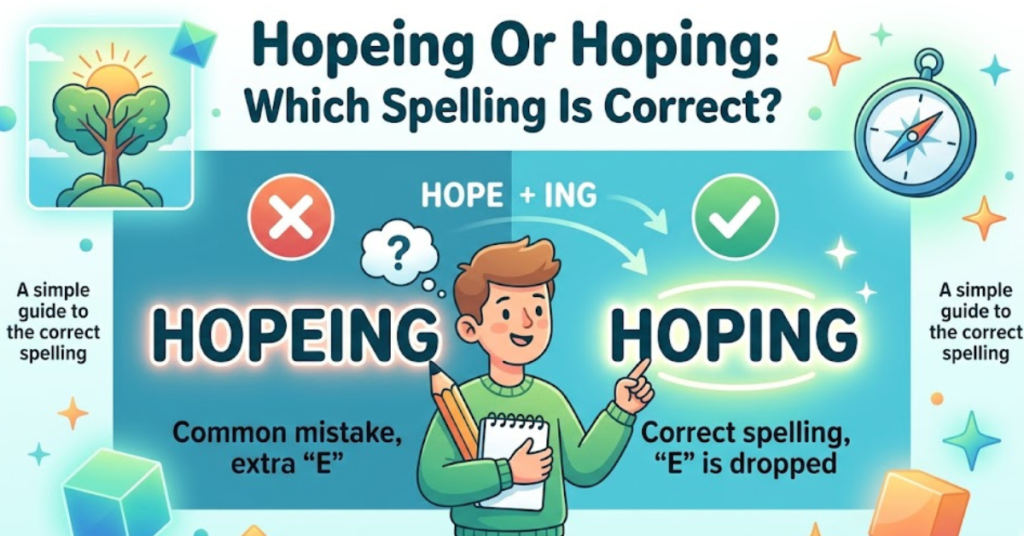
If you’ve searched for Hopeing Or Hoping, the short answer is simple: “hoping” is the correct spelling, while “hopeing” is incorrect. However, understanding why it’s correct can help you avoid similar mistakes with other English words.
In this guide, you’ll learn the grammar rule behind the spelling, see practical examples, discover common mistakes, and gain confidence in using the word correctly in everyday writing.
Understanding Hopeing Or Hoping
The confusion between hopeing and hoping usually arises when adding the suffix -ing to the verb hope.
The correct form is:
Hoping
Incorrect form:
Hopeing
Why Is “Hoping” Correct?
English spelling follows certain patterns when adding -ing to verbs ending in a silent e.
When a verb ends with a silent e, the e is typically dropped before adding -ing.
Examples:
| Base Verb | + ing Form |
|---|---|
| Hope | Hoping |
| Make | Making |
| Write | Writing |
| Dance | Dancing |
| Smile | Smiling |
Since hope ends with a silent e, the correct transformation is:
Hope → Hoping
Not:
Hope → Hopeing
The Grammar Rule Behind Hoping
Dropping the Silent “E”
One of the most common English spelling rules states:
When a verb ends in a silent “e,” remove the “e” before adding “-ing.”
Let’s look at more examples:
- Love → Loving
- Move → Moving
- Bake → Baking
- Share → Sharing
- Arrive → Arriving
The word hope follows this exact rule.
Exceptions to the Rule
English always has exceptions, but hope is not one of them.
For example:
- See → Seeing
- Agree → Agreeing
In these cases, the final e remains because removing it could create pronunciation confusion.
However, hope clearly becomes hoping, making the spelling straightforward once you know the rule.
What Does Hoping Mean?
The word hoping is the present participle and gerund form of the verb hope.
It means:
- Desiring something positive to happen
- Looking forward to a favorable outcome
- Expressing optimism about the future
Examples in Sentences
Here are some common examples:
- I am hoping for good weather this weekend.
- She is hoping to get accepted into her dream university.
- We are hoping the project finishes on time.
- They were hoping for better results.
- He keeps hoping things will improve.
In every example, hoping is the correct spelling.
Common Reasons People Write “Hopeing”
Understanding the mistake can help prevent it.
1. Following Pronunciation
Many people spell words based on how they sound.
Since “hope” is pronounced with a clear long vowel sound, some assume adding -ing should create:
hopeing
But English spelling doesn’t always mirror pronunciation.
2. Confusion With Other Words
Some words retain the e before adding -ing, such as:
- Agree → Agreeing
- See → Seeing
Because of these examples, writers sometimes incorrectly assume that hope should behave the same way.
3. Typing Errors
In casual writing, emails, social media posts, and text messages, people often type quickly and accidentally write hopeing.
Spell-check tools usually flag this mistake.
Hopeing Or Hoping: Side-by-Side Comparison
Here’s a quick comparison to make the distinction crystal clear.
| Feature | Hopeing | Hoping |
| Correct English spelling | No | Yes |
| Accepted in dictionaries | No | Yes |
| Follows grammar rules | No | Yes |
| Suitable for academic writing | No | Yes |
| Suitable for professional communication | No | Yes |
The winner is clear: hoping is the only correct form.
Examples of Hoping in Everyday Communication
Professional Emails
- I am hoping to schedule a meeting next week.
- We are hoping to receive your feedback soon.
Academic Writing
- Researchers are hoping the study will provide new insights.
- Students are hoping for strong exam results.
Personal Conversations
- I’m hoping everything goes well.
- She’s hoping to travel next year.
Using the correct spelling helps your writing appear polished and professional.
Similar Words That Follow the Same Rule
Learning related examples can reinforce the spelling pattern.
Verbs Ending in Silent E
These words drop the final e before adding -ing:
- Hope → Hoping
- Drive → Driving
- Live → Living
- Save → Saving
- Inspire → Inspiring
- Achieve → Achieving
Recognizing this pattern makes English spelling easier overall.
Tips to Remember the Correct Spelling
If you often hesitate between Hopeing Or Hoping, try these simple memory tricks.
Remember the Rule
Ask yourself:
Does the word end with a silent “e”?
If yes, drop the e before adding -ing.
Think of Similar Words
Compare:
- Hope → Hoping
- Make → Making
- Smile → Smiling
The pattern becomes easier to remember.
Read It Aloud
“Hoping” looks natural because it follows standard English spelling conventions.
“Hopeing” often appears awkward once you become familiar with the rule.
Common Mistakes to Avoid
When writing, watch out for these errors:
I am hopeing everything works out.
I am hoping everything works out.
We are hopeing to visit next month.
We are hoping to visit next month.
She was hopeing for a promotion.
She was hoping for a promotion.
Correct spelling enhances credibility, especially in professional and academic settings.
Why Correct Spelling Matters
Some people assume minor spelling mistakes aren’t important, but they can influence how readers perceive your writing.
Benefits of using correct spelling include:
- Improved clarity
- Better communication
- Stronger professional image
- Greater academic accuracy
- Enhanced reader trust
Whether you’re writing an email, essay, blog post, or social media update, spelling words correctly reflects attention to detail.
Key Takeaways
- Hoping is the correct spelling.
- Hopeing is incorrect in standard English.
- The final silent e in hope is dropped before adding -ing.
- The rule applies to many similar verbs such as making, writing, and smiling.
- Using the correct form improves the quality and professionalism of your writing.
Frequently Asked Questions
Is hopeing a real word?
No. Hopeing is not recognized as a correct English word in standard dictionaries. The correct form is hoping.
Why do people write hopeing instead of hoping?
Many people assume the original word should stay unchanged when adding -ing, or they are influenced by pronunciation and typing habits.
Is hoping grammatically correct?
Yes. Hoping is the proper present participle and gerund form of the verb hope.
How do you use hoping in a sentence?
You can say, “I am hoping to hear from you soon” or “They are hoping for positive results.”
Does every word ending in e drop the e before adding ing?
Not every word, but many do. Examples include making, writing, and hoping. Some exceptions, such as seeing and agreeing, keep the e.
Which is correct: hoping for or hopeing for?
Hoping for is correct. Hopeing for is considered a spelling mistake.
Conclusion
When it comes to Hopeing Or Hoping, the correct answer is straightforward: hoping is the proper spelling, while hopeing is incorrect. The reason lies in a common English spelling rule that requires dropping a silent e before adding -ing.
By understanding this simple rule and practicing with similar words, you can avoid common spelling errors and write with greater confidence. The next time you’re drafting an email, essay, or social media post, you’ll know exactly which form to use—and why it matters.