
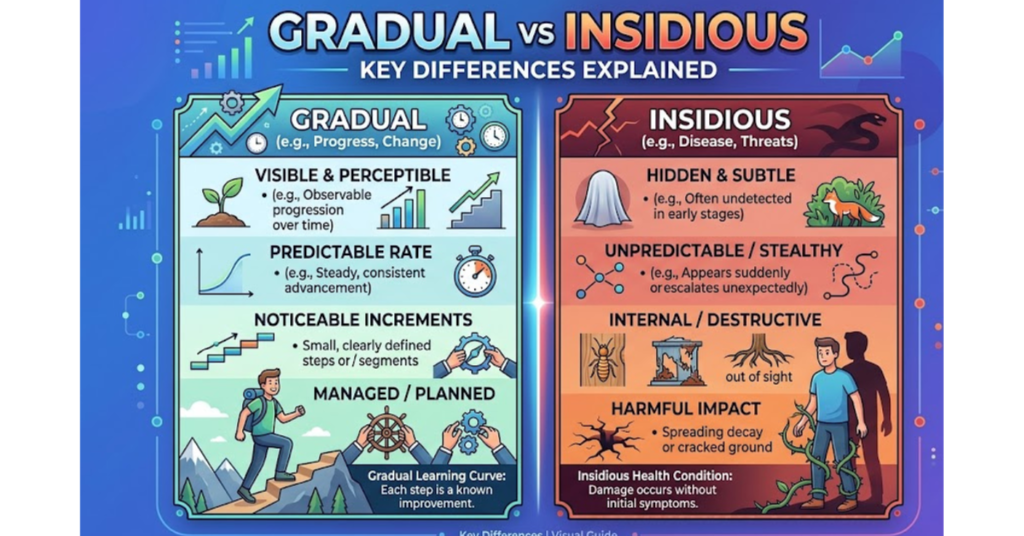
Have you ever noticed a change that happened so slowly you barely recognized it until much later? Or perhaps you’ve encountered a problem that seemed harmless at first but quietly caused significant consequences over time. While these situations may appear similar, they represent two distinct concepts: Gradual vs Insidious.
Many people use these terms interchangeably, but they carry different meanings and implications. Understanding the distinction is important in fields ranging from medicine and psychology to business, technology, and everyday communication.
In this guide, you’ll learn what each term means, how they differ, where they overlap, and how to use them correctly in real-world situations.
What Does “Gradual” Mean?
The word gradual refers to something that happens slowly and progressively over time. The change is often noticeable when viewed over a longer period, even if individual steps are small.
Characteristics of Gradual Change
A gradual process is typically:
- Slow and steady
- Progressive
- Predictable in many cases
- Not necessarily harmful
- Easy to observe over time
Examples of Gradual Changes
Consider the following examples:
- A child gradually learning to read
- A company gradually expanding into new markets
- Hair turning gray over several years
- Climate patterns shifting over decades
- Muscle growth through consistent exercise
In each case, the change occurs step by step rather than suddenly.
Gradual in Everyday Language
People often use “gradual” in positive, neutral, or negative contexts.
Examples:
- “The economy showed gradual improvement.”
- “Her confidence grew gradually.”
- “There was a gradual decline in sales.”
The term itself does not imply danger or hidden harm.
What Does “Insidious” Mean?
The word insidious describes something that develops in a subtle, hidden, or deceptive way, often causing harm before it becomes obvious.
Unlike gradual change, insidious processes usually carry a negative connotation.
Characteristics of Insidious Change
An insidious development is often:
- Difficult to detect initially
- Hidden or subtle
- Potentially harmful
- Progressive over time
- Deceptive in appearance
Examples of Insidious Processes
Examples include:
- A disease that develops without obvious symptoms
- Workplace burnout that slowly affects performance
- Cybersecurity threats hidden within software
- Corruption spreading within an organization
- Chronic stress impacting health over months or years
The defining feature is not simply slowness but the concealed nature of the problem.
Why “Insidious” Often Sounds More Serious
When people hear the word insidious, they typically associate it with danger because the issue remains unnoticed until significant damage has occurred.
For example:
- High blood pressure is often called an insidious condition because symptoms may be absent for years.
- Toxic workplace cultures can be insidious because harmful behaviors gradually become normalized.
Gradual vs Insidious: The Core Difference
The primary distinction between Gradual vs Insidious lies in visibility and intent rather than speed.
| Feature | Gradual | Insidious |
| Speed | Slow | Usually slow |
| Visibility | Often noticeable | Often hidden |
| Connotation | Neutral | Usually negative |
| Harm Required | No | Typically yes |
| Predictability | Often predictable | Often difficult to detect |
| Examples | Learning, growth, aging | Disease, manipulation, corruption |
Simple Rule to Remember
- Gradual = slow change
- Insidious = hidden harmful change
Not all gradual changes are insidious.
However, many insidious developments occur gradually.
Where Gradual and Insidious Overlap
The confusion arises because both concepts often involve the passage of time.
Example: Health Conditions
A disease can be:
Gradual
- Symptoms worsen slowly.
- Progression is visible and expected.
Insidious
- Symptoms remain unnoticed.
- Damage occurs before diagnosis.
Example: Financial Problems
A person may experience:
- A gradual reduction in savings due to lower income.
- An insidious accumulation of debt through hidden fees and unnoticed spending habits.
Both evolve over time, but only one is concealed and potentially deceptive.
Gradual vs Insidious in Medicine
Healthcare professionals frequently distinguish between gradual and insidious symptom onset.
Gradual Onset
A gradual onset means symptoms appear progressively.
Examples:
- Arthritis pain increasing over months
- Age-related vision changes
- Slow recovery from chronic conditions
Insidious Onset
An insidious onset refers to symptoms developing so subtly that the patient may not notice them initially.
Examples:
- Certain cancers
- Osteoporosis
- Hypertension
- Type 2 diabetes in early stages
Why the Distinction Matters
Medical diagnosis often depends on understanding symptom patterns.
Doctors ask questions such as:
- Did symptoms appear suddenly?
- Did they develop gradually?
- Were they present but unnoticed for a long time?
These details can help identify underlying causes.
Gradual vs Insidious in Psychology
Psychologists and mental health professionals often use these concepts when discussing behavioral changes.
Gradual Psychological Changes
Examples include:
- Increasing emotional maturity
- Developing coping skills
- Improving self-confidence
These changes are often observable and expected.
Insidious Psychological Changes
Examples include:
- Chronic anxiety developing unnoticed
- Manipulative relationships
- Emotional exhaustion
- Burnout
Because these issues build quietly, individuals may not recognize them until significant distress occurs.
Gradual vs Insidious in Business and Organizations
Businesses face both gradual and insidious challenges.
Gradual Business Changes
Examples:
- Market expansion
- Revenue growth
- Workforce development
- Brand recognition improvements
These developments typically occur over time and are measurable.
Insidious Business Threats
Examples:
- Declining employee morale
- Data security vulnerabilities
- Cultural toxicity
- Customer trust erosion
These problems may remain hidden beneath seemingly normal operations.
Mini Case Example
A company notices sales dropping by 2% annually.
This could be a gradual decline caused by changing market conditions.
However, if the decline stems from hidden customer dissatisfaction that leadership has failed to identify, the issue becomes insidious.
Common Misuses of the Terms
Many people incorrectly substitute one word for the other.
Incorrect Usage
“Technology adoption has been insidious.”
This statement suggests harmful hidden effects rather than simply slow adoption.
Better Usage
“Technology adoption has been gradual.”
Correct Use of Insidious
“The insidious spread of misinformation influenced public opinion.”
Here, the influence is subtle and potentially harmful, making the term appropriate.
How to Identify Whether Something Is Gradual or Insidious
Ask yourself these questions:
Is the change simply slow?
If yes, it may be gradual.
Is the change hidden or difficult to notice?
If yes, it may be insidious.
Does the change involve potential harm?
If yes, insidious may be the better term.
Can people easily observe the process?
If yes, gradual is usually more accurate.
Practical Tips for Using the Terms Correctly
When writing or speaking:
Use “Gradual” When
- Discussing slow progress
- Describing steady development
- Referring to visible long-term changes
- Explaining predictable transitions
Use “Insidious” When
- Discussing hidden threats
- Describing subtle harm
- Referring to deceptive processes
- Explaining problems that emerge unnoticed
Quick Memory Trick
Think:
- Gradual = gradual growth
- Insidious = invisible damage
This simple association helps distinguish the two terms quickly.
Key Takeaways
- Gradual means slow and progressive.
- Insidious means subtle, hidden, and often harmful.
- All insidious changes may be gradual, but not all gradual changes are insidious.
- The main difference is visibility and potential harm.
- Medical, psychological, and business contexts frequently rely on this distinction.
- Choosing the correct word improves communication accuracy.
Frequently Asked Questions
What is the difference between gradual and insidious?
Gradual refers to a slow and progressive change, while insidious refers to a subtle, hidden change that often causes harm before becoming obvious.
Can something be both gradual and insidious?
Yes. Many medical conditions and organizational problems develop slowly and remain unnoticed for long periods, making them both gradual and insidious.
Is insidious always negative?
In most modern usage, yes. The word typically describes harmful, deceptive, or damaging developments.
Does gradual mean harmless?
Not necessarily. A gradual process can be positive, neutral, or negative. The term only describes the pace of change, not its impact.
Why do doctors use the term insidious onset?
Doctors use it to describe symptoms that develop subtly and may go unnoticed until the condition becomes more advanced.
Which word should I use in professional writing?
Use “gradual” when emphasizing slow progression and “insidious” when highlighting hidden, harmful, or difficult-to-detect developments.
Conclusion
Understanding Gradual vs Insidious can significantly improve the way you interpret information and communicate ideas. While both terms often describe changes that unfold over time, they are not interchangeable. Gradual changes are simply slow and progressive, whereas insidious changes are subtle, concealed, and frequently harmful.
Whether you’re discussing health, psychology, business, or everyday situations, recognizing this distinction helps you describe events more accurately and understand their implications more clearly. The next time you encounter a slow-moving change, ask yourself one simple question: is it merely gradual, or is it insidious? The answer can reveal far more than you might expect.