
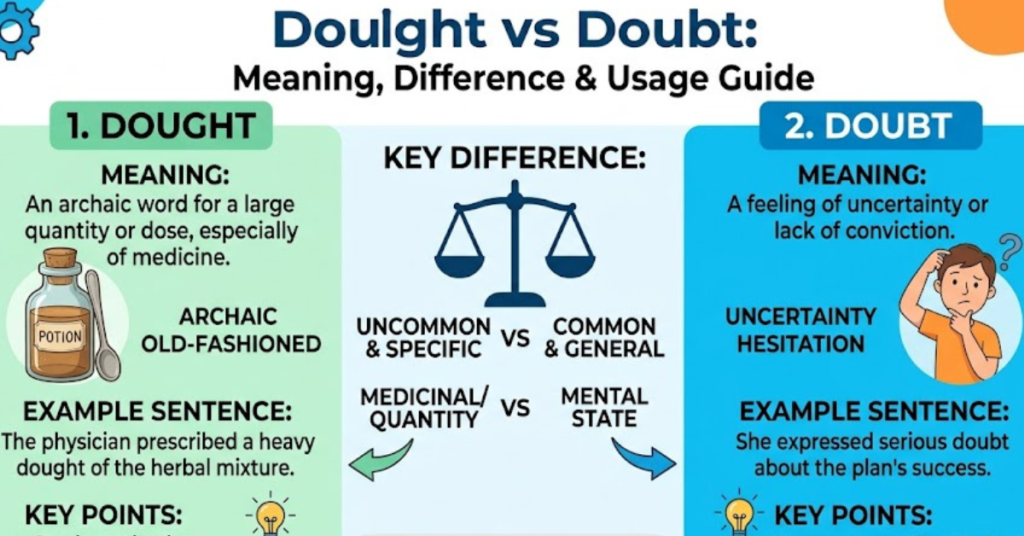
Ever typed a word and paused, wondering if it actually exists or if you’ve just made a spelling mistake? That’s exactly where the confusion between dought vs doubt often shows up. Many English learners and even native speakers mix these two up, but the truth is they are not interchangeable at all.
In this guide, we’ll break down the real meaning behind dought vs doubt, explain why the confusion happens, and show you how to use the correct word confidently in everyday writing. You’ll also see examples, common mistakes, and simple memory tricks to help you never mix them up again.
What does “doubt” mean?
The word doubt is widely used in modern English and refers to uncertainty or lack of belief in something.
It can be used as both a noun and a verb:
- Noun: a feeling of uncertainty
- Verb: to feel uncertain about something
Examples:
- I have no doubt that she will succeed.
- He doubts the accuracy of the report.
Common related phrases include:
- self-doubt
- beyond doubt
- cast doubt on something
This is the correct and standard word you’ll see in writing, speech, exams, and professional communication.
What does “dought” mean?
Unlike doubt, the word dought is rarely used in modern English. In fact, it is considered archaic.
Historically, dought was used in old or poetic English to mean brave, strong, or capable in battle. You might find it in older literature or historical texts, but it is not used in everyday language today.
Example (old usage):
- A dought warrior stood firm in battle.
Because of its outdated usage, most people encountering dought vs doubt are actually dealing with a spelling mistake rather than a meaningful comparison.
Dought vs doubt: key differences
The confusion between dought vs doubt mainly comes from spelling similarity, but the meanings are completely unrelated.
Here’s a simple breakdown:
- Doubt = uncertainty or lack of belief (modern English)
- Dought = old word meaning brave or strong (archaic English)
In modern usage, only doubt is correct and relevant. If you’re writing essays, emails, or online content, using dought is almost always incorrect unless you’re quoting historical literature.
So when comparing dought vs doubt, the real takeaway is that one is active in today’s language, while the other is mostly obsolete.
Common confusion and spelling mistakes
Most people don’t actually intend to use dought. Instead, it appears due to:
- Typing errors (especially fast typing)
- Autocorrect mistakes
- Mishearing the word while learning English
- Confusion from similar phonetics
English learners often struggle because dough, doubt, and dought look similar but behave very differently.
Remember:
- Correct modern spelling: doubt
- Incorrect in modern context: dought
Understanding this helps eliminate confusion around dought vs doubt in writing.
How to use “doubt” correctly in sentences
To fully understand dought vs doubt, it helps to see how doubt works in real-life usage.
Correct examples:
- There is still some doubt about the results.
- I doubt he will arrive on time.
- She expressed doubt about the decision.
Quick usage tips:
- Use doubt when talking about uncertainty
- Pair it with words like “have,” “express,” or “no”
- Avoid replacing it with similar-looking outdated terms
This ensures your writing stays natural and grammatically correct.
Practical tips to avoid confusion
If you often mix up dought vs doubt, here are a few easy memory tricks:
- Link doubt with “uncertain thoughts” (both start with D and imply hesitation)
- Remember: dought = “old knight language,” not modern English
- Practice using doubt in daily sentences
- Rely on spellcheck—but don’t depend on it blindly
These small habits can quickly eliminate the mistake from your writing.
Frequently Asked Questions (FAQ)
1. Is “dought” a correct English word?
Dought is technically a real word, but it is archaic and rarely used today. In modern English, it is not considered correct for everyday writing.
2. What is the main difference in dought vs doubt?
The main difference is meaning and usage. Doubt means uncertainty, while dought is an old word meaning brave or strong.
3. Why do people confuse dought vs doubt?
The confusion usually comes from similar spelling and pronunciation, along with typing errors or lack of familiarity with archaic English.
4. Can I use “dought” in modern writing?
No, it is not recommended. In modern contexts, always use doubt unless you are writing historical or poetic content.
5. What is an easy way to remember “doubt”?
Think of “doubt” as something that creates uncertainty in your mind. The “b” is silent, just like hidden hesitation.
Conclusion
The confusion between dought vs doubt is more common than it seems, especially among learners of English. However, once you understand that doubt is the modern, correct word and dought is largely outdated, the distinction becomes simple.
By practicing correct usage and remembering the key differences, you can confidently avoid this mistake in writing and communication. If you’re refining your English skills, focusing on small details like this can make a big difference in clarity and professionalism.