
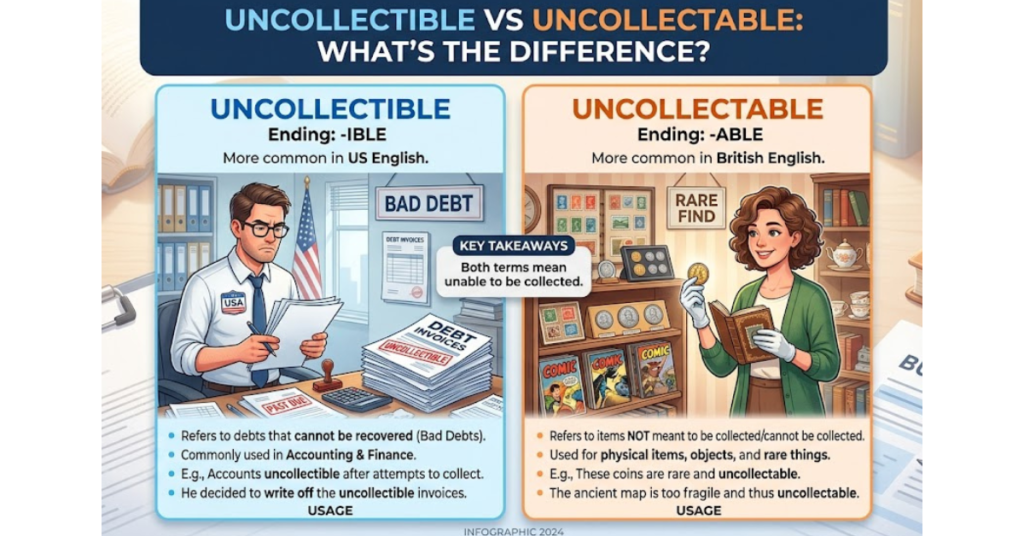
Have you ever written the word uncollectible and wondered whether uncollectable might be the correct spelling instead? You’re not alone. English is full of words that have multiple accepted forms, and this pair often causes confusion among writers, students, accountants, and business professionals.
The debate around Uncollectible vs Uncollectable isn’t about two completely different meanings. Instead, it’s largely a matter of spelling preference, regional usage, and context. In this article, you’ll learn the meaning of both terms, their grammatical background, which version is more commonly used, and when each spelling may be appropriate.
Understanding the Meaning of Uncollectible and Uncollectable
At their core, both uncollectible and uncollectable mean the same thing:
Something that cannot be collected, recovered, gathered, or obtained.
The term is most frequently used in finance and accounting to describe debts that are unlikely or impossible to recover.
Example Sentences
- The company wrote off several uncollectible accounts at the end of the fiscal year.
- After repeated attempts to contact the customer, the debt was deemed uncollectable.
- The tax authority classified the balance as uncollectible due to bankruptcy proceedings.
In every example, the meaning remains unchanged regardless of which spelling is used.
Uncollectible vs Uncollectable: Is There a Difference?
The Short Answer
No significant difference exists in meaning between the two words.
Both are accepted English spellings and function as adjectives. The distinction lies mainly in usage frequency rather than definition.
Why Do Two Versions Exist?
English contains many adjective pairs that use the suffixes:
- -ible
- -able
Examples include:
| -ible Form | -able Form |
| Accessible | Acceptable |
| Reversible | Advisable |
| Collectible | Collectable |
| Uncollectible | Uncollectable |
Historically, English borrowed words from Latin and French, resulting in multiple spelling patterns. Over time, some forms became more common than others.
Which Spelling Is More Common?
In modern English, uncollectible is generally the preferred and more widely used spelling.
Major dictionaries, style guides, and business publications tend to favor uncollectible, especially in American English.
Common Areas Where “Uncollectible” Appears
- Accounting reports
- Financial statements
- Tax documents
- Banking regulations
- Business publications
- Credit management resources
Because of its widespread use in professional contexts, many readers recognize uncollectible as the standard spelling.
What About “Uncollectable”?
Uncollectable is still considered correct and appears in many dictionaries. However, it is less common and may sound slightly unusual to some readers, particularly in North America.
In British English, both forms can appear, though uncollectible remains highly recognized.
The Accounting Perspective
One area where this spelling question frequently arises is accounting.
What Is an Uncollectible Account?
An uncollectible account refers to money owed to a business that is unlikely to be paid by the customer.
Examples include:
- Customer bankruptcy
- Fraudulent transactions
- Long-overdue invoices
- Business closures
- Insolvency cases
When recovery becomes unlikely, businesses may record the amount as bad debt.
Example
Imagine a company sells products worth $10,000 on credit.
After several months:
- The customer stops responding.
- Collection efforts fail.
- The customer files for bankruptcy.
The company may classify the debt as an uncollectible account and remove it from expected revenue.
This is one reason why the term appears so frequently in financial literature.
Collectible vs Collectable: The Related Word Pair
To fully understand Uncollectible vs Uncollectable, it helps to examine their root words.
Collectible
The word collectible often refers to an item valued by collectors.
Examples include:
- Rare coins
- Trading cards
- Vintage toys
- Comic books
- Memorabilia
Example:
That baseball card became a valuable collectible.
Collectable
Collectable is an alternative spelling of collectible.
However, just like the un- forms, collectible is generally more common in modern usage.
This preference naturally influences the popularity of uncollectible as well.
Dictionary Treatment of Both Words
Most major dictionaries recognize both spellings.
Typical Dictionary Position
- Uncollectible – commonly listed as the primary entry.
- Uncollectable – often listed as a variant spelling.
This indicates that neither form is wrong, but one has become more dominant in contemporary writing.
What Editors Usually Prefer
Professional editors often choose:
- Uncollectible for consistency.
- Uncollectable only when matching a publication’s style guide.
If you’re unsure which version to use, uncollectible is usually the safer option.
Regional Usage Differences
American English
American English overwhelmingly favors:
- Uncollectible
- Collectible
These spellings appear most frequently in legal, financial, and academic writing.
British English
British English allows both versions more freely.
However, modern British publications also commonly use uncollectible, particularly in business and accounting contexts.
International Business Writing
For global audiences, uncollectible tends to be the preferred choice because it is more widely recognized.
When Should You Use Each Word?
Use “Uncollectible” When:
- Writing business documents
- Creating financial reports
- Publishing professional content
- Following American English conventions
- Optimizing content for broader readership
Use “Uncollectable” When:
- Following a specific style guide
- Matching existing document terminology
- Maintaining consistency with regional preferences
In most situations, readers will understand either spelling without confusion.
Common Mistakes to Avoid
1. Assuming One Is Incorrect
Many people believe one spelling must be wrong.
In reality, both are legitimate English words.
2. Switching Between Spellings
Consistency matters.
Choose one spelling and use it throughout the document.
3. Ignoring Industry Standards
In accounting, finance, and business writing, uncollectible is generally the preferred form.
4. Confusing It With “Collectible Items”
Remember that context matters.
An uncollectible debt refers to money that cannot be recovered.
A collectible item refers to an object people collect.
These are entirely different concepts.
Quick Comparison Table
| Feature | Uncollectible | Uncollectable |
| Meaning | Cannot be collected | Cannot be collected |
| Correct Spelling | Yes | Yes |
| More Common | Yes | No |
| Used in Accounting | Very Common | Less Common |
| Preferred in American English | Yes | Rarely |
| Accepted in Dictionaries | Yes | Yes |
Key Takeaways
- Uncollectible and uncollectable have the same meaning.
- Both spellings are grammatically correct.
- Uncollectible is significantly more common in modern English.
- Financial and accounting industries typically favor uncollectible.
- Consistency is more important than choosing one variant over the other.
- For professional writing, uncollectible is usually the recommended option.
Frequently Asked Questions
Is uncollectible or uncollectable correct?
Both spellings are correct. However, uncollectible is more widely used in modern English, especially in business and accounting contexts.
Which spelling is preferred in accounting?
Most accountants, auditors, and financial organizations use uncollectible when referring to bad debts or accounts that cannot be recovered.
Does uncollectable mean something different from uncollectible?
No. The two words have the same meaning and can generally be used interchangeably.
Why is uncollectible more common?
The spelling follows the same pattern as collectible, which has become the dominant form in contemporary English usage.
Is uncollectable outdated?
Not necessarily. It is still recognized by dictionaries and remains grammatically acceptable, though it is less frequently used.
Can I use either spelling in professional writing?
Yes, but consistency is important. Most editors and style guides recommend uncollectible because it is the more familiar and widely accepted form.
Conclusion
The question of Uncollectible vs Uncollectable comes down to preference rather than meaning. Both words describe something that cannot be collected or recovered, and both are recognized by modern dictionaries. However, uncollectible has emerged as the dominant spelling, particularly in accounting, finance, business communication, and American English.
If you’re writing for a broad audience or preparing professional content, choosing uncollectible is usually the best approach. Understanding this subtle spelling distinction can help improve clarity, maintain consistency, and ensure your writing aligns with modern language conventions. As you continue refining your communication skills, paying attention to details like these can make your writing more polished and professional.