
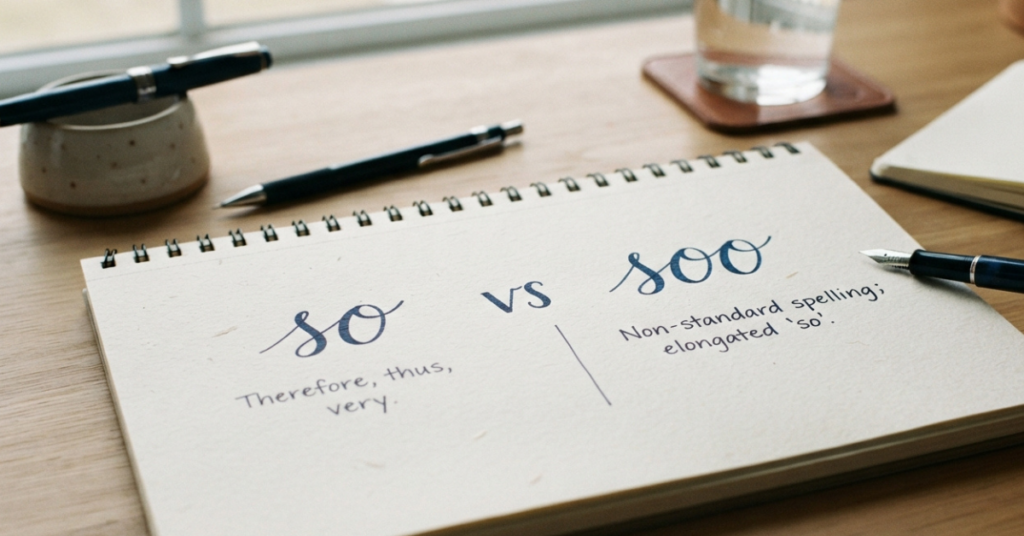
Have you ever seen someone type “I’m soo excited!” in a text message and wondered whether it’s actually correct? The debate around so vs soo is common, especially in texting, social media, and casual online conversations. While both forms appear frequently online, they don’t have the same role in English.
In this guide, we’ll explain the difference between so and soo, discuss whether soo is a real word, and show you when each version is appropriate. By the end, you’ll know exactly which spelling to use in formal writing and when the longer version works in casual communication.
What Does “So” Mean?
So is a standard English word with several meanings. It can function as an adverb, conjunction, or intensifier, depending on the sentence.
Some common uses include:
- Expressing degree: “The movie was so funny.”
- Showing a result: “It was raining, so we stayed inside.”
- Beginning a conversation: “So, what’s new?”
- Agreeing with someone: “I think so.”
Because it’s an officially recognized English word, so should be used in academic, professional, and everyday writing.
So vs Soo: What’s the Difference?
When comparing so vs soo, the biggest difference is that only one is considered standard English.
Here’s a simple comparison:
| So | Soo |
| Standard English word | Informal spelling variation |
| Used in formal and casual writing | Mostly used in texting and social media |
| Accepted in dictionaries | Generally not listed as a standard word |
| Appropriate for school and work | Best reserved for informal conversations |
In most situations, so is the correct choice.
Is Soo a Word?
One of the most frequently asked questions is, is soo a word?
The answer is not in standard English.
Most major dictionaries recognize so, but soo is generally considered a creative spelling rather than an official word.
People often write soo to:
- Add emphasis.
- Show excitement.
- Express affection.
- Mimic spoken pronunciation.
- Make messages sound more playful.
For example:
- “I’m soo happy!”
- “That was soo cute!”
- “I miss you soo much!”
Although these sentences are common in texting, they should usually be changed to so in formal writing.
So or Soo: Which Is Correct?
If you’re wondering so or soo, the answer depends on where you’re writing.
Use “So” When:
- Writing emails.
- Completing school assignments.
- Creating business documents.
- Publishing articles.
- Writing resumes.
- Communicating professionally.
Use “Soo” When:
- Texting close friends.
- Posting casually on social media.
- Writing humorous or playful messages.
- Emphasizing emotions informally.
Even then, using soo is a stylistic choice rather than a grammar rule.
Why Do People Type “Soo”?
Language on the internet often reflects the way people speak.
Stretching words creates emphasis, much like changing your tone in conversation.
For example:
- “I’m so excited.”
- “I’m soo excited!”
- “I’m sooo excited!!”
Each additional letter exaggerates the feeling.
Similar examples include:
- No → Nooo
- Yes → Yesss
- Wow → Wowww
- Cute → Cutieee
- Hi → Hiii
These spellings aren’t grammatically required—they simply add personality.
Can You Use “Soo” in Professional Writing?
Generally, no.
Professional communication values clarity and correctness.
Instead of writing:
“Thank you soo much.”
Write:
“Thank you so much.”
The second version looks more polished and appropriate in workplaces, schools, and official documents.
Examples of Correct Usage
Here are a few examples showing when each spelling works.
Standard English
- “The food was so delicious.”
- “I’m so grateful for your help.”
- “It was late, so we left.”
Casual Text Messages
- “I’m soo excited for tomorrow!”
- “You’re soo funny.”
- “That puppy is soo adorable!”
Notice that the informal spelling mainly appears in relaxed conversations.
Similar Informal Spellings
The internet is full of playful spelling variations.
Examples include:
- Hii
- Hellooo
- Yesss
- Nooo
- Okk
- Byeee
- Woohoo
- Lolll
Like soo, these forms are acceptable in casual conversations but should usually be avoided in formal writing.
Tips for Choosing the Right Spelling
Keep these simple guidelines in mind:
- Use so for professional communication.
- Reserve soo for texting and informal chats.
- Match your writing style to your audience.
- Avoid excessive letter repetition in business or academic writing.
- When unsure, choose the standard spelling.
Following these tips helps your writing remain clear and credible.
Frequently Asked Questions
What is the difference between so vs soo?
So is the standard English word, while soo is an informal spelling used mainly for emphasis in texting and social media.
Is soo a word?
Not in standard English. It is generally considered a creative or expressive variation of so rather than an officially recognized dictionary word.
Should I use so or soo in an email?
Always use so in professional emails, business documents, school assignments, and formal writing.
Why do people spell it “soo”?
People often add extra letters to emphasize excitement, affection, or emotion in casual online conversations.
Is using “soo” grammatically wrong?
In formal writing, it is considered nonstandard. In informal communication, however, many people use it stylistically without causing confusion.
Conclusion
Understanding so vs soo is straightforward once you know the difference between standard English and internet slang. So is the correct spelling for formal, academic, and professional writing, while soo is an informal variation used to add emphasis or emotion in casual conversations.
If your goal is clear and polished communication, stick with so. Save soo for friendly texts, social media posts, or playful chats where a more expressive tone feels natural. Choosing the right spelling for the right situation will make your writing both effective and appropriate.