
English is full of words that seem straightforward until you start writing them. One of the most common examples is payed vs paid. Many people write “payed” when talking about money, salaries, bills, or attention, only to discover later that it may not be correct.
If you’ve ever wondered whether you should write “I paid” or “I payed,” you’re not alone. This guide explains the difference, correct grammar rules, meanings, examples, and the rare situations where “payed” is actually the right word.
What Is the Difference Between Payed and Paid?
The primary difference is simple:
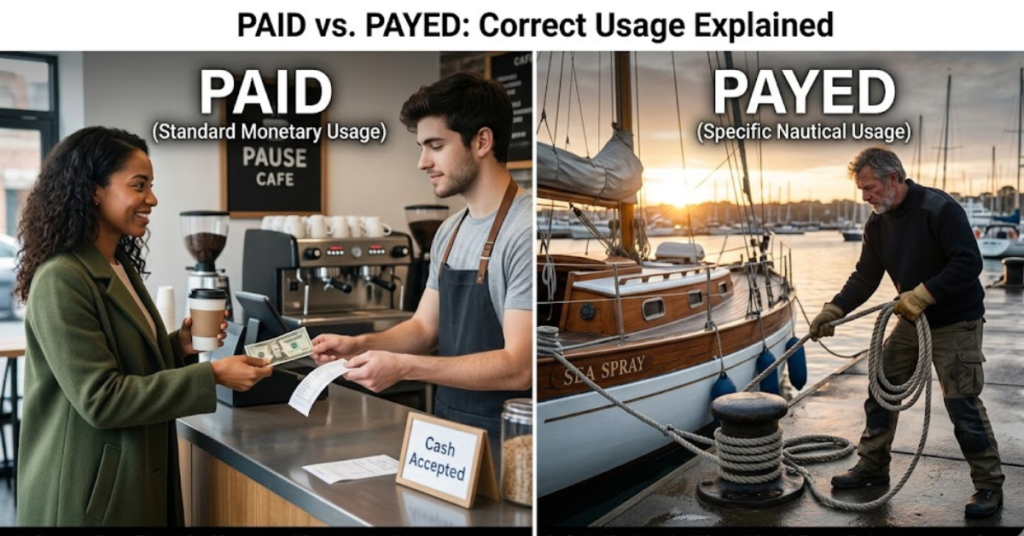
- Paid is the standard past tense and past participle of the verb “pay.”
- Payed is a specialized term used mainly in nautical and maritime contexts.
For most everyday writing, whether you’re talking about money, bills, wages, loans, or attention, paid is the correct spelling.
Quick Examples
Correct:
- I paid the electricity bill yesterday.
- She paid for lunch.
- We paid close attention during the presentation.
Incorrect in everyday usage:
- I payed the electricity bill yesterday.
- She payed for lunch.
Why Do People Confuse These Words?
The confusion occurs because many English verbs form their past tense by adding “-ed.”
Examples include:
- Play → Played
- Stay → Stayed
- Pray → Prayed
Naturally, many writers assume “pay” becomes “payed.” However, English contains many irregular verbs, and “pay” is one of them.
The correct past tense is paid, not “payed” in standard usage.
What Does Paid Mean?
Paid is the accepted past tense and past participle form of “pay.”
It refers to:
- Giving money in exchange for goods or services
- Settling debts or bills
- Receiving wages
- Giving attention or respect
- Returning something owed
Examples of Paid in Sentences
- I paid the rent on time.
- The company paid its employees early this month.
- She paid careful attention to the instructions.
- He paid off the loan within three years.
- We paid for our tickets online.
These are the situations most people encounter daily.
What Does Payed Mean?
Although uncommon, “payed” is a real English word.
Traditionally, it refers to maritime activities involving ropes, seams, or waterproofing a vessel. Sailors would “pay” a ship’s seams by coating them with tar, pitch, or similar substances to prevent leaks.
Examples of Payed
- The crew payed the deck seams before the voyage.
- The sailors payed out the rope slowly.
- The ship’s hull was carefully payed with sealant.
Unless you’re writing about ships, sailing, or historical maritime practices, you will rarely need this spelling.
Payed vs Paid Meaning Explained
Understanding the meaning behind each term helps eliminate confusion.
Paid
Associated with:
- Money
- Transactions
- Salaries
- Bills
- Debt repayment
- Attention and respect
Payed
Associated with:
- Sailing terminology
- Ropes and rigging
- Waterproofing ships
- Nautical operations
This distinction makes choosing the correct word much easier.
Payed vs Paid Grammar Rules
From a grammar perspective, the rule is straightforward.
Use “Paid” When Talking About:
- Purchasing something
- Paying a bill
- Paying wages
- Paying taxes
- Paying attention
- Paying respect
- Paying off debt
Examples:
- She paid the invoice immediately.
- We paid attention throughout the lecture.
- They paid off their mortgage.
Use “Payed” Only When Referring To:
- Maritime rope handling
- Coating ship seams
- Nautical terminology
For the vast majority of writers, “paid” will be the correct choice nearly every time.
Payed vs Paid Attention
One of the most searched grammar questions involves attention.
Correct:
- He paid attention to the teacher.
- They paid close attention to the details.
Incorrect:
- He payed attention to the teacher.
Whenever attention, focus, or concentration is involved, use paid.
Payed vs Paid Money
When discussing money, there is no debate.
Correct:
- I paid the contractor yesterday.
- She paid cash for the car.
- They paid the invoice before the deadline.
Incorrect:
- I payed the contractor yesterday.
Financial transactions always require paid.
I Payed vs Paid: Which Is Correct?
Many people write “I payed” in emails, essays, and social media posts.
In standard English, the correct version is:
- I paid for dinner.
- I paid the fee online.
- I paid my share of the expenses.
“I payed” is generally considered an error unless you’re discussing a nautical situation.
Payed vs Paid Off
The phrase “paid off” is extremely common.
Examples include:
- She paid off her student loans.
- The investment paid off.
- Hard work finally paid off.
The spelling remains paid in all these expressions.
Payed vs Paid UK Usage
British English and American English follow the same rule.
Both varieties use:
- Paid for financial transactions
- Paid for attention or respect
- Payed for maritime contexts
There is no regional difference that makes “payed” acceptable in ordinary situations.
Dictionary Guidance on the Usage
Many major dictionaries, including those often referenced in discussions about merriam-webster payed vs paid, recognize “payed” as a legitimate but highly specialized term.
They consistently identify paid as the standard past tense and past participle of “pay” for everyday English.
Common Mistakes to Avoid
Here are some frequent errors writers make:
Mistake 1: Using Payed for Money
Incorrect:
- I payed my credit card bill.
Correct:
- I paid my credit card bill.
Mistake 2: Using Payed for Attention
Incorrect:
- She payed attention during class.
Correct:
- She paid attention during class.
Mistake 3: Assuming All Verbs Follow Regular Patterns
English contains many irregular verbs. Learning them individually helps avoid spelling mistakes.
Easy Memory Trick
A simple way to remember the rule is:
Money = Paid
If the sentence involves money, attention, debt, respect, or compensation, use “paid.”
Ships = Payed
If the sentence involves ropes, rigging, or waterproofing a vessel, “payed” may be correct.
Frequently Asked Questions
Is payed ever correct?
Yes. It is correct in certain maritime and nautical contexts involving ropes, rigging, or sealing ship seams.
Why is paid spelled differently?
“Pay” is an irregular verb. Its accepted past tense evolved as “paid” rather than following the regular “-ed” pattern.
Is “I payed” wrong?
In ordinary writing, yes. The correct form is “I paid.”
Which spelling should I use in business writing?
Always use “paid” when discussing payments, invoices, salaries, expenses, or financial transactions.
Is payed accepted in British English?
Only in its specialized nautical meaning. Otherwise, British English uses “paid” just like American English.
How do I remember the difference?
Think: money, bills, loans, attention, and respect all use “paid.” Maritime activities may use “payed.”
Conclusion
Understanding payed vs paid is easier once you know that only one form is commonly used in everyday English. When discussing money, bills, wages, attention, debt, or compensation, paid is the correct choice. The word “payed” survives mainly in nautical language and is rarely needed outside maritime writing.
The next time you’re unsure which spelling to use, remember the simple rule: if it involves ordinary communication, business, school, or personal finances, choose paid. Doing so will keep your writing accurate, professional, and grammatically correct.