
English has many word pairs that look closely related but serve different purposes in a sentence. One common source of confusion is complaint vs complain. Because both words come from the same root and relate to expressing dissatisfaction, many people use them incorrectly or struggle to understand when each should be used.
The good news is that the distinction is actually quite simple. One word is a noun, while the other is a verb. Once you understand this basic grammar rule, you’ll be able to use both words confidently in everyday conversations, professional emails, academic writing, and customer service situations.
Complaint vs Complain Meaning
The easiest way to understand these terms is to look at their grammatical roles.
What Is a Complaint?
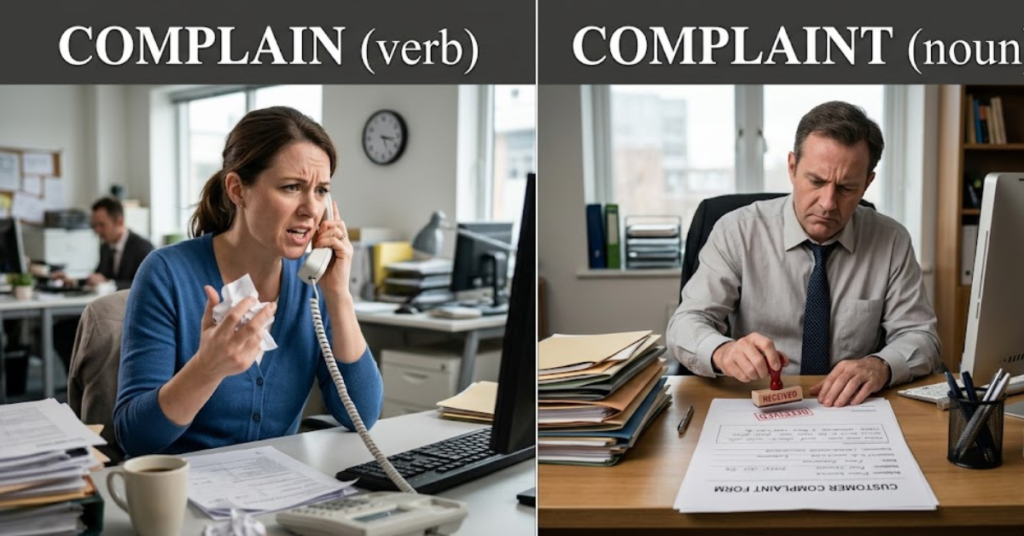
A complaint is a noun. It refers to a statement, concern, or expression of dissatisfaction about a problem, service, product, or situation.
Examples:
- The customer filed a complaint about the delayed delivery.
- Her complaint was addressed within two days.
- The manager received several complaints from guests.
In each example, the word refers to the issue or concern itself.
What Does Complain Mean?
Complain is a verb. It describes the action of expressing dissatisfaction, annoyance, or concern.
Examples:
- Customers often complain when orders arrive late.
- He decided to complain about the poor service.
- They rarely complain about minor inconveniences.
Here, the word describes what someone is doing rather than the issue being discussed.
The Main Difference Between Complaint and Complain
A simple rule can help you remember the distinction:
- Complaint = a thing (noun)
- Complain = an action (verb)
Consider these sentences:
- She made a complaint to the hotel manager.
- She decided to complain to the hotel manager.
Both sentences discuss dissatisfaction, but the first refers to the concern itself, while the second describes the act of expressing it.
Why Do People Confuse These Words?
These terms are often confused because they share the same origin and are closely connected in meaning.
For example:
- When someone complains, they may create a complaint.
- A complaint usually exists because someone chose to complain.
Since they are related conceptually, writers sometimes accidentally substitute one for the other.
Grammar Rules for Correct Usage
Understanding the grammar behind these words makes choosing the right one much easier.
Use Complaint as a Noun
A noun names a person, place, thing, or idea.
Common sentence patterns include:
- File a complaint
- Submit a complaint
- Receive a complaint
- Address a complaint
- Investigate a complaint
Examples:
- The company resolved the complaint quickly.
- We received a formal complaint from a customer.
- Her complaint concerned billing errors.
Use Complain as a Verb
A verb expresses an action.
Common sentence patterns include:
- Complain about
- Complain to
- Complain that
- Complain frequently
Examples:
- Customers complain about slow service.
- She complained to the supervisor.
- They complain whenever prices increase.
Complaint vs Complain Examples in Everyday Situations
Looking at real-world examples can make the difference clearer.
Workplace Example
Correct:
- An employee submitted a complaint to human resources.
- An employee decided to complain to human resources.
Restaurant Example
Correct:
- The restaurant received a complaint regarding food quality.
- A customer complained about the meal.
Online Shopping Example
Correct:
- The company reviewed the complaint carefully.
- Buyers often complain when packages arrive damaged.
Notice how the noun refers to the issue, while the verb describes the action.
Common Mistakes to Avoid
Many learners make similar errors when using these words.
Mistake 1: Using Complaint as a Verb
Incorrect:
- I want to complaint about the service.
Correct:
- I want to complain about the service.
Mistake 2: Using Complain as a Noun
Incorrect:
- The manager received a complain.
Correct:
- The manager received a complaint.
Mistake 3: Forgetting the Part of Speech
Before writing, ask yourself:
- Am I talking about an issue or concern? Use “complaint.”
- Am I talking about the act of expressing dissatisfaction? Use “complain.”
Useful Memory Trick
A simple memory technique can help.
Complaint Ends with “-aint”
Think of it as the actual concern or issue being discussed.
Example:
- The complaint was investigated.
Complain Ends with “-ain”
Think of it as the action someone performs.
Example:
- People complain when they are unhappy.
Remembering noun versus verb is usually enough to choose the correct word.
Common Phrases Using Complaint
You will frequently encounter phrases such as:
- Formal complaint
- Customer complaint
- Written complaint
- Official complaint
- Complaint department
- Complaint procedure
In all of these cases, the word functions as a noun.
Common Phrases Using Complain
Common verb phrases include:
- Complain about service
- Complain to a manager
- Complain frequently
- Complain publicly
- Complain formally
- Complain unnecessarily
These expressions describe actions people take when they are dissatisfied.
When to Use Each Word
Choose “complaint” when referring to:
- A concern
- A grievance
- A report of dissatisfaction
- A formal statement
Choose “complain” when referring to:
- Speaking about a problem
- Expressing dissatisfaction
- Reporting concerns verbally or in writing
- Voicing objections
Frequently Asked Questions
What is the difference between complaint and complain?
The primary difference is grammatical. Complaint is a noun that refers to a concern or grievance, while complain is a verb that means to express dissatisfaction.
Can complaint be used as a verb?
No. Complaint is always a noun. If you need an action word, use complain.
Is complain a noun or a verb?
Complain is a verb. It describes the act of expressing dissatisfaction about something.
Which comes first, complain or complaint?
Typically, someone complains first, and that action may result in a complaint being recorded or submitted.
How do I remember the correct usage?
Think of complaint as the issue and complain as the action. If someone is doing something, use complain. If you’re referring to the concern itself, use complaint.
Can a complaint be formal or informal?
Yes. A complaint may be a casual expression of dissatisfaction or a formal report submitted to an organization.
Conclusion
Understanding complaint vs complain becomes easy once you recognize their grammatical roles. Complaint is a noun that refers to a concern, grievance, or statement of dissatisfaction. Complain is a verb that describes the act of expressing that dissatisfaction.
Whenever you’re unsure which word to use, ask yourself whether you’re talking about the issue itself or the action of raising it. This simple distinction will help you write more clearly, communicate more effectively, and avoid one of the most common English grammar mistakes. Continue exploring similar word comparisons to strengthen your vocabulary and improve your confidence in everyday writing.