
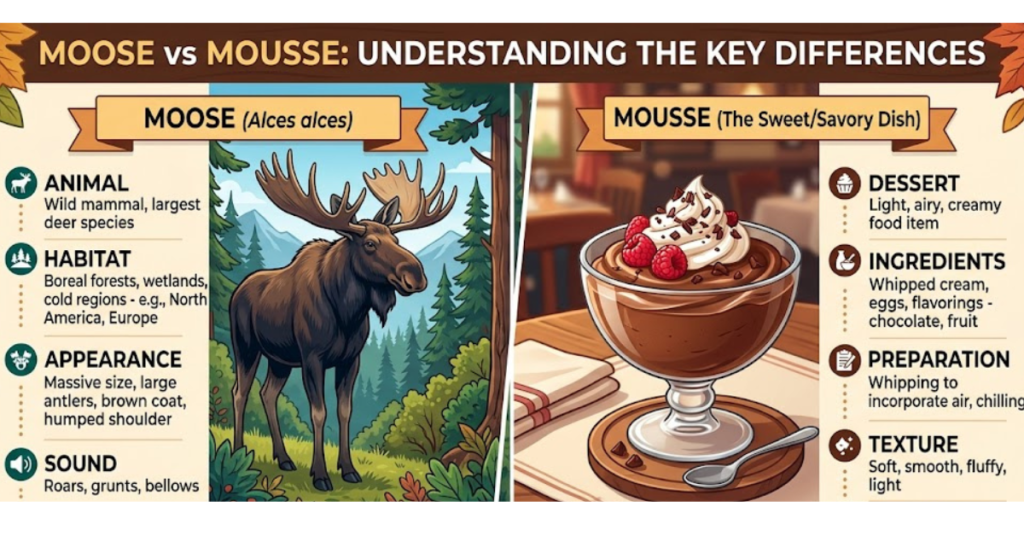
Have you ever seen the words moose and mousse and wondered if they’re somehow connected? Although they look and sound somewhat similar, moose vs mousse refers to two completely different things. One is the largest member of the deer family roaming forests, while the other is a light and airy dish—or even a popular hair styling product.
The confusion between these words is common, especially for English learners and people encountering them in writing. This guide will explain the meanings, differences, pronunciation, origins, and correct usage of moose and mousse so you never mix them up again.
What Is a Moose?
A moose is a large wild mammal belonging to the deer family (Cervidae). It is native to the northern regions of North America, Europe, and Asia and is known for its impressive size and enormous antlers.
Key Facts About a Moose
- Scientific name: Alces alces
- Family: Deer family (Cervidae)
- Habitat: Boreal forests, wetlands, and cold climates
- Diet: Herbivore, eating leaves, bark, and aquatic plants
- Weight: Can range from 600 to over 1,500 pounds
Male moose, known as bulls, develop massive antlers that can spread more than six feet across. These antlers are shed and regrown annually.
Example Sentences With Moose
- We spotted a huge moose near the lake during our camping trip.
- A moose can swim surprisingly well despite its enormous size.
- The national park is home to hundreds of moose.
One interesting fact is that the plural of moose is also moose, not “mooses.”
What Is Mousse?
A mousse is a soft, fluffy substance with several different uses. The most commonly known types are a creamy dessert and a hair styling product.
The word comes from the French word mousse, meaning “foam,” which perfectly describes its light and airy texture.
Mousse as a Dessert
Dessert mousse is made by combining ingredients such as chocolate, fruit, cream, or egg whites to create a smooth and airy treat.
Popular types include:
- Chocolate mousse
- Strawberry mousse
- Lemon mousse
- Coffee mousse
- Vanilla mousse
Mousse as a Hair Product
Hair mousse is a foamy styling product designed to add:
- Volume
- Hold
- Texture
- Definition, especially for curls and waves
It is usually applied to damp hair before drying or styling.
Example Sentences With Mousse
- The chocolate mousse was rich, creamy, and delicious.
- She applied hair mousse to add volume to her hairstyle.
- The restaurant’s mango mousse became its signature dessert.
Moose vs Mousse: Side-by-Side Comparison
| Feature | Moose | Mousse |
| Meaning | A large wild animal | A fluffy food or cosmetic product |
| Origin | Indigenous North American languages | French |
| Category | Mammal | Dessert or hair product |
| Texture | Has fur and antlers | Soft and foamy |
| Pronunciation | /muːs/ | /muːs/ |
| Plural | Moose | Mousse or mousses (depending on context) |
Although they have the same pronunciation, their meanings are entirely unrelated.
Why Do People Confuse Moose and Mousse?
The confusion between moose vs mousse happens mainly because they are homophones—words that sound the same but have different spellings and meanings.
English contains many similar word pairs, such as:
- Their vs there
- Flour vs flower
- Sea vs see
- Bear vs bare
The best way to remember the difference is to associate the extra “s” in mousse with something soft and smooth, like a dessert or foam.
The Origin of the Words Moose and Mousse
Understanding where these words came from can make them easier to remember.
Origin of Moose
The word moose entered English from Eastern Algonquian languages, where it referred to a large animal or “twig eater.” It has been used in English since the early 17th century.
Origin of Mousse
The word mousse was borrowed from French in the 19th century. In French, it means “foam,” which describes the airy quality of both dessert mousse and hair mousse.
How to Remember Moose vs Mousse
A simple memory trick can prevent mistakes:
- Moose = an animal with antlers living in the wild.
- Mousse = a soft foam, either something you eat or put in your hair.
Think of the extra “s” in mousse as representing the extra softness.
Common Mistakes When Using Moose and Mousse
Here are some examples of incorrect and correct usage.
Incorrect:
I ordered a chocolate moose after dinner.
Correct:
I ordered a chocolate mousse after dinner.
Incorrect:
We saw a giant mousse in the forest.
Correct:
We saw a giant moose in the forest.
Small spelling differences can completely change the meaning of a sentence.
FAQs About Moose vs Mousse
Is moose the same as mousse?
No. A moose is a large deer species, while mousse is a light, airy substance such as a dessert or a hair styling foam.
Why do moose and mousse sound the same?
They are homophones in English, meaning they have the same pronunciation but different meanings and spellings.
Is chocolate mousse made from moose?
No. Chocolate mousse has nothing to do with the animal. It is a French dessert made with ingredients like chocolate, cream, and eggs or other whipping agents.
What is the plural of moose?
The plural form of moose is still moose. For example, “Two moose crossed the road.”
Can mousse refer to anything besides dessert?
Yes. Mousse can also describe a foamy hair styling product and other light, airy preparations in cooking.
Which word is older, moose or mousse?
The word moose entered English earlier, around the 1600s, while mousse was adopted from French much later.
Conclusion: Moose vs Mousse Explained Simply
The difference between moose vs mousse is easy to remember once you understand their meanings. A moose is a huge antlered animal found in northern forests, while mousse is a soft, airy substance commonly enjoyed as a dessert or used as a hair styling product.
Because they sound exactly alike, they are often confused, but their spelling and context make their meaning clear. The next time you encounter these words, you’ll know whether someone is talking about a majestic animal in the wilderness or a delicious chocolate treat on a plate.
For more language guides and word comparisons, explore related articles that break down confusing English words in simple terms.