Have you ever read the words miner vs minor and wondered whether they mean the same thing? Although they sound identical when spoken, they have completely different meanings and are used in very different situations. This makes them a classic example of homophones—words that share the same pronunciation but differ in spelling and definition.
Understanding the difference between miner vs minor can improve your writing, prevent embarrassing mistakes, and help you communicate more clearly. In this guide, we’ll break down the meanings, uses, examples, and easy tricks to remember which word to choose.
What Does “Miner” Mean?
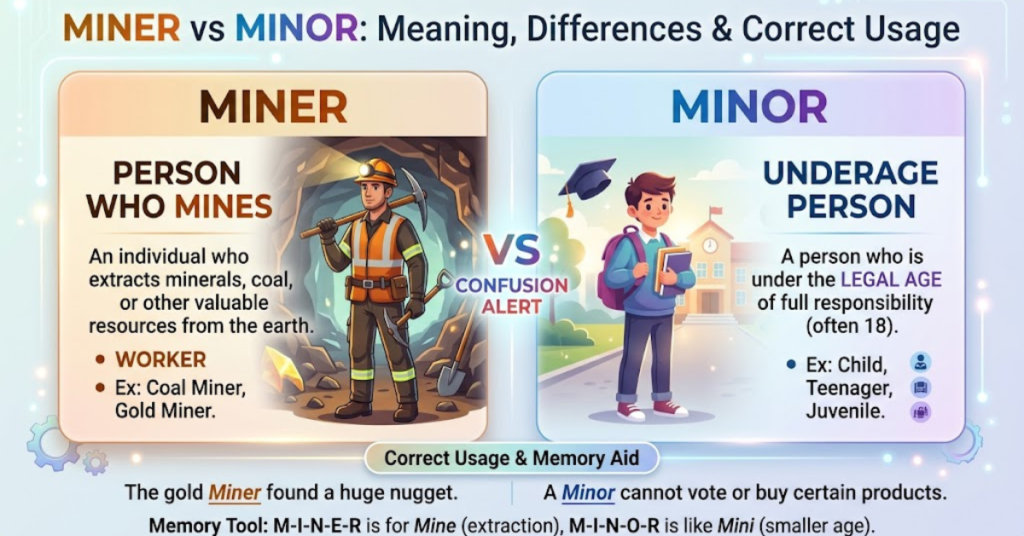
A miner is a person who works in a mine, extracting valuable materials from beneath the earth. These materials can include coal, gold, diamonds, copper, and other minerals.
Examples of Miner in a Sentence
- The miner spent hours underground searching for valuable metals.
- Coal miners played a major role in the industrial development of many countries.
- A gold miner discovered a small nugget near the river.
The word miner comes from the term mine, which refers to a place where natural resources are dug from the ground.
Types of Miners
Different industries have different kinds of miners, such as:
- Coal miners who extract coal for energy production.
- Gold miners who search for and collect gold deposits.
- Cryptocurrency miners who use powerful computers to validate blockchain transactions and earn digital coins.
- Underground miners who work in tunnels beneath the Earth’s surface.
Today, the term “miner” is also widely associated with Bitcoin mining and cryptocurrency technology, showing how the meaning has expanded beyond traditional mining.
What Does “Minor” Mean?
A minor generally refers to something that is smaller, less important, or a person who is below the legal age of adulthood.
Minor as a Young Person
In legal terms, a minor is someone who has not yet reached the age recognized as adulthood, which varies depending on the country or region.
Examples:
- A minor cannot sign certain legal contracts without a guardian’s approval.
- The event was only open to adults, so minors were not allowed to enter.
Minor as Something Small or Less Important
The word minor can also describe something that is not serious or has a lower level of importance.
Examples:
- The car suffered only minor damage in the accident.
- She made a minor mistake during the presentation.
- The company experienced a minor financial loss.
Minor in Education and Music
The word also has specialized meanings:
- In college, a minor is a secondary subject a student studies alongside their major.
- Example: “She majored in biology with a minor in chemistry.”
- In music, minor refers to a type of scale or chord that often creates a more serious or emotional sound.
- Example: “The song is written in a minor key.”
Miner vs Minor: Side-by-Side Comparison
| Feature | Miner | Minor |
| Meaning | A person or system involved in mining | A young person or something less important |
| Related To | Mines, minerals, cryptocurrency | Age, size, importance, education, music |
| Word Origin | From “mine” | From Latin minor, meaning “smaller” |
| Example | The miner extracted gold. | The injury was minor. |
How to Remember the Difference Between Miner and Minor
A simple memory trick can help you avoid confusion:
Remember “Miner” Has “Mine”
The word miner contains the word mine, making it easy to associate with digging, minerals, and extraction.
Example:
- A miner works in a mine.
Remember “Minor” Means Smaller
Think of minor as something small, younger, or less significant.
Example:
- A minor problem is a small problem.
These associations make it much easier to choose the correct spelling.
Common Mistakes When Using Miner vs Minor
Because these words sound exactly the same, many people accidentally use one in place of the other.
Incorrect:
- The young miner was not old enough to vote.
Correct:
- The young minor was not old enough to vote.
Incorrect:
- The coal minor worked underground for thirty years.
Correct:
- The coal miner worked underground for thirty years.
Always consider whether you are talking about mining or something young or small.
Why Are Miner and Minor Often Confused?
The confusion between miner vs minor comes from the fact that they are homophones. English contains many words that sound alike but have different meanings and spellings, such as:
- Their vs There vs They’re
- Your vs You’re
- Brake vs Break
- Principal vs Principle
Learning the context in which each word is used is the best way to avoid mistakes.
FAQs About Miner vs Minor
Is a miner the same as a minor?
No. A miner is someone involved in mining or a system that performs mining, such as cryptocurrency mining. A minor is a person under the legal age of adulthood or something of lesser importance.
How do you remember miner vs minor?
Remember that miner contains the word “mine,” which relates to digging and extracting resources. Minor usually means young, small, or less significant.
Can a person be both a miner and a minor?
Yes. A person who is under the legal age of adulthood and works in mining could technically be both a minor and a miner, although child labor laws may restrict or prohibit such work in many places.
What does minor mean in college?
In education, a minor is a secondary area of study that a student chooses alongside their main field, known as a major.
What is a cryptocurrency miner?
A cryptocurrency miner is a computer system or person that validates blockchain transactions and helps maintain the network in exchange for potential rewards.
Conclusion
The difference between miner vs minor is simple once you understand the context. A miner is connected to mining, whether digging for natural resources or verifying cryptocurrency transactions. A minor, on the other hand, refers to a person under the age of adulthood, something less important, or a secondary area of study.
Since these words sound the same, they are easy to mix up, but remembering that a miner works in a mine is a quick way to avoid mistakes. Keep exploring common English word differences to strengthen your vocabulary and write with greater confidence.