
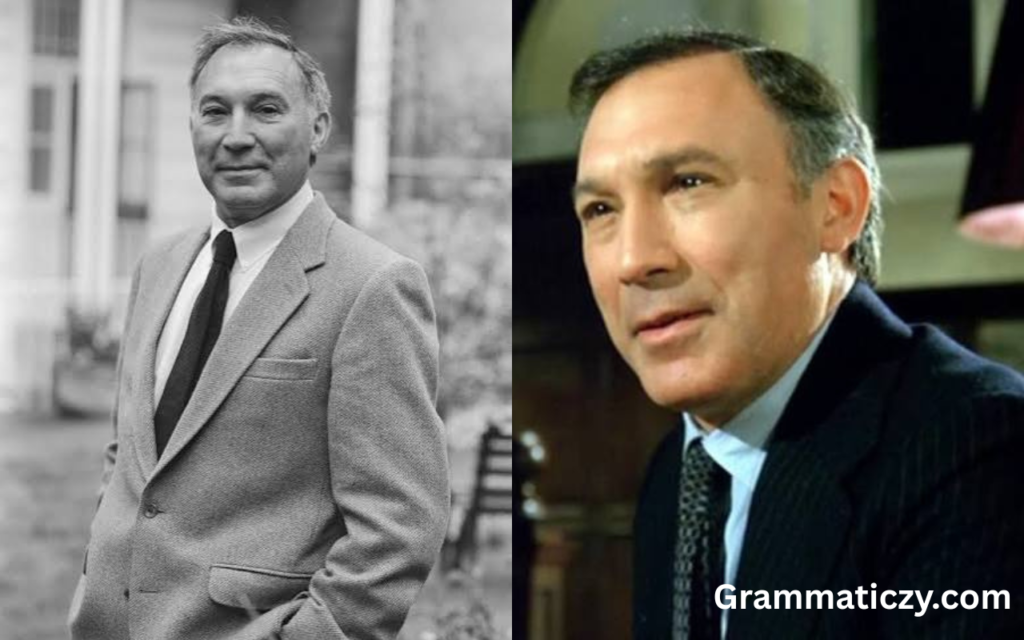
Some actors become famous because they are constantly placed at the center of a story. Others build something just as remarkable by becoming the face audiences remember when the leading character has left the screen. Lee Montague belonged to the second group. Across more than six decades, the English actor created a career that moved comfortably between classical theatre, Broadway, British television, international cinema and children’s storytelling. He was often cast as a tough, imposing or mysterious figure, yet the breadth of his work revealed a performer with considerably more range than that familiar screen image suggested. Montague died in March 2025 at the age of 97, closing a career that had begun professionally at the Old Vic in the early postwar years.
Born Leonard Goldberg in Bow, East London, Montague came from a Jewish family with immigrant roots. His father was a Russian-born tailor and his mother was Lithuanian, and his early years in the East End helped shape the personality of a man who remained deeply connected to his local community throughout his life. Acting eventually became his profession, but literature, sport, theatre and community service became equally important parts of his identity. His later role in helping establish the Keats Community Library in Hampstead would become one of the most meaningful achievements of his life outside entertainment.
What makes Lee Montague’s story especially compelling is that his career cannot be reduced to a list of film and television credits. He worked alongside major figures, appeared in productions ranging from Moulin Rouge and Billy Budd to Brother Sun, Sister Moon and Jesus of Nazareth, became the first storyteller on the BBC’s Jackanory, and performed extensively on the classical stage. Yet in later life he also became a cultural campaigner, helping save a local library and organizing literary events with celebrated actors. His story is therefore one of professional longevity, adaptability and a lasting commitment to the arts.
Lee Montague Quick Facts
| Fact | Details |
|---|---|
| Full name | Leonard Goldberg |
| Professional name | Lee Montague |
| Date of birth | October 16, 1927 |
| Birthplace | Bow, East London, England |
| Date of death | March 30, 2025 |
| Age at death | 97 |
| Profession | Actor and storyteller |
| Education | Old Vic Theatre School |
| Father | Russian-born tailor |
| Mother | Lithuanian |
| Wife | Ruth Goring, actress |
| Marriage | 1955 until Ruth Goring’s death in 2023 |
| Children | Two |
| Known for | Moulin Rouge, Billy Budd, Brother Sun, Sister Moon, Jesus of Nazareth, The Sweeney, Bergerac, Seconds Out, Jackanory |
| Years active | 1950s–2010s |
| Net worth | No reliable public figure available |
| No verified official account located | |
| X/Twitter | No verified official account located |
| No verified official account located |
The biographical record gives a clear picture of Montague’s professional life, but it does not establish a trustworthy figure for his personal net worth. Online celebrity-estimate websites sometimes publish precise numbers without explaining their sources, so those figures should not be treated as verified financial information. The same caution applies to social media: Montague belonged to a generation of performers who established their reputations long before Instagram, Facebook, X and LinkedIn existed, and no verified personal accounts have been identified in the principal biographical sources.
The basic facts of his life, however, are unusually well documented. He was born in London in 1927, trained at the Old Vic Theatre School, entered professional theatre in 1950, reached Broadway in 1952 and subsequently developed an extensive screen career. He was married to fellow actor Ruth Goring for 67 years and had two children. His connection to Hampstead later became central to his community work, particularly his efforts on behalf of the Keats Community Library.
For readers researching Lee Montague’s biography, his career is best understood through several connected chapters: his East End upbringing, classical theatre training, stage work in Britain and America, film and television career, contribution to Jackanory, family life and, finally, his extraordinary community work. Each chapter explains something about the actor and helps show why his legacy extends considerably beyond individual performances.
Early Life and East London Family Background
Lee Montague was born Leonard Goldberg on October 16, 1927, in Bow, an area of London’s East End. His Jewish family reflected the immigrant character of the district. His father worked as a tailor after arriving from Russia, while his mother was Lithuanian. Growing up in this environment gave Montague an early connection with a part of London known for its close-knit communities, working-class culture and strong traditions.
His childhood coincided with years of enormous national change. Britain was moving through economic hardship, the Second World War and the social transformation that followed it. Montague was evacuated to Wiltshire during the war but became homesick and returned to London in 1942. The experience was an early reminder of how strongly he was attached to his home city, a relationship that remained evident many decades later when he became involved in protecting cultural institutions in north London.
There was also a playful side to his personality from a young age. Montague became a passionate Arsenal supporter, and one frequently retold story from his teenage years illustrates his determination to attend an important football match. He reportedly covered his leg with tomato ketchup and bandages to persuade his employer that he had been injured by a bus. Years later, Montague himself joked that perhaps acting had been in his blood even then.
Education and Discovery of Acting
Montague initially followed a more conventional educational route. He won a scholarship to Cooper’s Company School, where he studied accountancy, although he reportedly disliked the subject. His eventual move toward acting did not happen immediately. Like many performers of his generation, he first had to find a practical route into the profession rather than simply deciding to become a star.
The turning point came after his National Service in the Royal Air Force. A drama teacher at Toynbee Hall in the East End recognized his potential and encouraged him to pursue professional acting. In 1948, Montague secured a scholarship to the Old Vic Theatre School. That opportunity changed the direction of his life and gave him the disciplined training that would support his career for decades.
The Old Vic was an especially important environment for a young actor. Rather than simply learning how to perform for a camera, Montague was trained in the traditions of stage acting, where voice, movement, timing and interpretation are essential. He eventually joined the Old Vic company, making his professional stage appearance in Twelfth Night in 1950. That beginning placed him at the heart of one of Britain’s most respected theatrical traditions.
Theatre Career and Shakespearean Training
Theatre remained one of the strongest foundations of Lee Montague’s professional identity. His early career included work with the Old Vic, Bristol Old Vic, Shakespeare Memorial Theatre, Royal Shakespeare Company and Royal Exchange Manchester. These were not isolated appearances; they represented a sustained period of classical and repertory work in which actors were expected to perform a wide range of demanding material.
Montague was particularly comfortable with Shakespeare. His stage credits included King Lear, Henry V, Titus Andronicus, Othello, The Merchant of Venice and The Alchemist. His performance as Iago in Othello at the Oxford Playhouse was reportedly one of the roles he valued most highly, while his Shylock at the Old Vic was another notable Shakespearean performance.
His stage career also brought him into contact with major theatre figures. He toured internationally in Peter Brook’s production of Titus Andronicus with Laurence Olivier and Vivien Leigh and worked across Britain and America. The experience helped establish him as a serious stage actor before his film and television work became the part of his career most familiar to general audiences.
Broadway and International Stage Work
Montague’s success in Britain soon opened the door to American theatre. In 1952, he made his Broadway debut in Moss Hart’s The Climate of Eden, portraying Gregory Hawke. Reaching Broadway only a few years after beginning his professional career was a major achievement and demonstrated that his acting ambitions extended well beyond the British stage.
He returned to Broadway in 1965 in Entertaining Mr. Sloane, playing Ed. His stage career also included work in London’s West End and performances in a wide variety of plays by writers such as Shakespeare, Chekhov, Rattigan and Neil Simon. This range reinforced an important characteristic of Montague’s acting: he was not tied to one particular theatrical style.
International theatre also broadened his professional experience. He toured in productions outside Britain and performed alongside some of the most prominent actors of the postwar British theatre. Those experiences gave Montague a valuable combination of classical discipline and practical adaptability, qualities that would later serve him particularly well when he moved between film, television and stage productions.
Lee Montague’s Film Career
Lee Montague entered the film industry in 1952 with John Huston’s Moulin Rouge. The film, starring José Ferrer and Zsa Zsa Gabor, was an important early screen credit and introduced Montague to the world of international cinema. From that point onward, he became a dependable supporting performer whose physical presence and serious delivery made him particularly effective in dramatic roles.
His filmography developed rapidly during the late 1950s and 1960s. Among his credits were The Camp on Blood Island, The Silent Enemy, The Savage Innocents, The Singer Not the Song and Billy Budd. His role in Billy Budd placed him in a highly regarded adaptation featuring Terence Stamp and other major performers of the period.
Montague continued working in films throughout the 1970s and beyond. His credits included Franco Zeffirelli’s Brother Sun, Sister Moon, Ken Russell’s Mahler, Brass Target, Silver Dream Racer, Red Monarch, Lady Jane and Madame Sousatzka. His film work was often built around supporting roles rather than conventional leading-man parts, but his consistency made him a recognizable figure across British and international productions.
Brother Sun, Sister Moon and Jesus of Nazareth
Two of Montague’s best-known collaborations with director Franco Zeffirelli were particularly significant. In Brother Sun, Sister Moon (1972), Montague played Pietro di Bernardone, the father of Francis of Assisi. The historical drama gave him an opportunity to work within an expansive cinematic production and to portray a character whose relationship with the central figure was emotionally important to the story.
A few years later, Zeffirelli cast him as the prophet Habakkuk in Jesus of Nazareth, the ambitious television epic starring Robert Powell. The production became one of the most widely remembered religious dramas of its era, and Montague’s participation added another major historical and biblical role to his growing screen résumé.
These performances also illustrate why Montague’s career is interesting from an acting perspective. He could move from Shakespearean theatre to crime television, from historical cinema to children’s storytelling and from contemporary drama to biblical productions. His professional identity was not built around a single genre, but around his ability to make himself useful to very different kinds of productions.
Television Career and Memorable Roles
British television eventually became one of the most important parts of Montague’s career. He appeared in numerous popular programmes, including Danger Man, The Baron, Department S, Dixon of Dock Green, The Sweeney, Space: 1999, Minder, The Chinese Detective, Bergerac, Casualty and Waking the Dead. His television work helped make him familiar to audiences who may not have followed his theatre career.
Montague was frequently cast as a tough, threatening or authoritative character. His robust appearance and serious screen presence made him convincing as criminals, officials, military figures and other powerful personalities. IMDb describes this as a niche he carved out for himself, although his stage career clearly demonstrated that he was capable of a much broader range.
One particularly notable television role came in Seconds Out, where he played the manager of a boxer portrayed by Robert Lindsay. He also appeared in Bergerac, among numerous other television productions. His ability to return repeatedly to television series without being limited to one character type helped make him one of those reliable British character actors whose faces audiences recognized even when they did not immediately remember his name.
Jackanory and Becoming the First Storyteller
One of the most charming chapters in Lee Montague’s career began in 1965 when he became the first storyteller on the BBC children’s programme Jackanory. The programme was designed around the simple but powerful idea of having well-known performers read stories to children, encouraging an interest in books and storytelling. Montague read the very first story, Cap-o’-Rushes.
Montague narrated 15 stories during 1965 and 1966. This was a very different performance challenge from playing a threatening character in a crime drama or a villain in a theatrical production. There was no elaborate action sequence to dominate the screen. The performer’s voice, timing and ability to create an imaginative world had to carry the experience.
His connection with Jackanory became an important part of his television legacy. Later accounts also connect his television recognition with his work in Harold Pinter’s The Birthday Party, in which he played the sinister Goldberg. The Guardian reports that he won a TV Actor of the Year award for the performance.
Awards, Recognition and Professional Reputation
Montague’s career earned recognition from the television industry as well as respect from fellow performers. His performance as Goldberg in The Birthday Party was especially important because the role demonstrated his ability to handle psychologically complex material. The production was directed by Joan Kemp-Welch and became one of the performances associated with his reputation as a serious television actor.
Some later sources describe Montague as a BAFTA-winning actor, particularly in connection with his television and Jackanory work. Because published accounts differ in the precise way they describe the award history, it is more responsible to acknowledge the recognition without inventing a detailed award record that the strongest sources do not consistently establish. The Keats Community Library itself describes him as a highly respected BAFTA award-winning actor.
Beyond formal awards, Montague’s longevity was itself a major achievement. He worked with leading theatre companies, appeared on Broadway, collaborated with major film directors and remained a familiar television performer across several generations. His professional reputation was ultimately based on reliability, versatility and the ability to give supporting characters genuine weight.
Lee Montague and Ruth Goring
Lee Montague’s personal life was closely connected with the theatre. He married actress Ruth Goring in 1955, and their marriage lasted until her death in 2023. They were together for 67 years, a remarkable partnership that survived the pressures of two acting careers and decades of changing professional circumstances.
The couple had two children and later grandchildren. Although Montague was a public performer, he generally maintained a distinction between his professional reputation and his private family life. The available biographies therefore provide considerably more information about his acting and community activities than about the everyday details of his household.
His relationship with Goring also reflected a shared love of performance and literature. In later years, the pair were involved in literary and fundraising activities, combining acting with cultural work. Their partnership therefore became part of the wider story of how Montague used performance not only as a profession but also as a means of connecting people with books, theatre and community life.
Hobbies, Personality and Life Away From Acting
Montague had a strong passion for football, particularly Arsenal. His devotion to the club was not a passing interest but something that remained part of his personality throughout his life. The famous story about disguising a leg injury to attend a match offers a humorous glimpse of the determination behind that enthusiasm.
He was also associated with tennis and bridge. The Keats Community Library remembered him as a formidable bridge and tennis player, while its account of his life describes him as an avid Arsenal supporter. These interests provide a useful contrast with his often stern screen persona and suggest a man whose life contained plenty of competition, recreation and social interaction outside acting.
Those who knew him later in life remembered a somewhat different Lee Montague from the intimidating figures he often portrayed. The Keats Community Library described him as modest about his career and exceptionally well read, while fellow performers remembered his humour, warmth and generosity. His ability to build friendships across the theatre and literary worlds became particularly important during his community work in Hampstead.
The Keats Community Library and His Greatest Contribution
Perhaps the most remarkable part of Montague’s later life was his work to protect local library services. He had lived in South End Green, Hampstead, for more than six decades and became deeply involved when the local library faced closure. After the library was ultimately closed by Camden in 2011, Montague helped organize a committee of local residents determined to establish a community alternative.
The result was the Keats Community Library, which became a functioning charity and cultural centre. Montague was eventually recognized as its President for Life. His contribution went far beyond lending books: he helped create a place where literature, performance and community life could meet. The library’s current records continue to acknowledge his contribution and list him as its past president.
In his later years, Montague wrote literary and biographical scripts and performed them as fundraising events for the library. He worked with actors including Michael Palin, Robert Powell, Simon Callow and Janet Suzman, with events reportedly drawing full houses. This part of his legacy is especially significant because it shows how his professional network and storytelling abilities were ultimately redirected toward a cause that mattered deeply to him and his neighbours.
Net Worth and Sources of Income
There is no dependable public record that establishes Lee Montague’s exact net worth at the time of his death. Unlike contemporary celebrities whose business interests, property portfolios and commercial endorsements may be extensively documented, Montague maintained a comparatively private financial life. For that reason, online estimates should be treated as speculation rather than established fact.
His principal professional income would have come from a remarkably broad acting career. Theatre performances, Broadway work, films, television appearances and storytelling assignments all contributed to his professional earnings over the decades. He also continued to participate in literary performances and fundraising events later in life, although those activities were closely connected to charitable and community causes rather than being presented as a conventional celebrity business empire.
The more meaningful measure of Montague’s success is therefore not a speculative net-worth figure but the longevity and diversity of his work. He remained professionally active across changing eras of British entertainment and accumulated credits in theatre, film and television. His legacy demonstrates how a character actor can build a substantial career through consistency and versatility rather than relying on one enormous commercial breakthrough.
Social Media Presence and Public Image
Lee Montague did not have the kind of social-media presence associated with modern actors. There is no reliably verified Instagram, X/Twitter or LinkedIn account that can be confidently attributed to him. His professional reputation was established decades before social networking became part of the entertainment business, and his public image was shaped primarily by television appearances, films, theatre reviews and personal relationships.
That does not mean Montague lacked a relationship with audiences. His work on Jackanory was built around direct communication with viewers, particularly children listening to stories. His later literary performances created another form of audience interaction, with theatre and community events providing a physical space in which he could share stories, biographies and ideas.
Today, much of his digital legacy is preserved through archives and institutions rather than personal accounts. Film databases document his screen career, theatre records preserve his stage work and the Keats Community Library continues to remember his contribution. In that sense, his online legacy is communal: it survives through the people and organizations that continue telling the story of his life.
Final Years and Death
Montague continued to remain involved with literature and performance during his later years. Rather than simply withdrawing from public life after decades in the entertainment industry, he continued developing literary programmes and supporting the library he had helped establish. His final years therefore retained the same connection between acting, storytelling and community that had increasingly defined his life outside mainstream television and film.
Lee Montague died on March 30, 2025, at the age of 97. His death marked the end of a career spanning more than six decades and brought tributes from colleagues, friends and members of the Hampstead community. The Guardian described him as a prominent actor across theatre, film and television, while the Keats Community Library remembered him not only as an actor but as a central figure in its own history.
The circumstances of his death also placed his life in perspective. He had entered the profession as a young man in postwar Britain and continued performing across multiple generations of audiences. By the end, his legacy was no longer limited to the entertainment industry. It included a family, friendships, decades of performances and a community library that continued operating because local people, led in part by Montague, refused to let it disappear.
Lee Montague’s Lasting Legacy
Lee Montague’s legacy begins with his acting career, but it does not end there. He demonstrated the value of the character actor: someone capable of entering a production for a comparatively small amount of screen time and still giving the audience a character they remember. His work in Moulin Rouge, Billy Budd, Brother Sun, Sister Moon, Jesus of Nazareth, The Sweeney, Bergerac and many other productions illustrates the extraordinary breadth of his professional life.
His theatre work adds another dimension. Trained at the Old Vic, he developed within the demanding tradition of British classical theatre and worked with some of the most respected stage companies and performers of his era. His Shakespearean performances, Broadway appearances and international tours established a serious theatrical foundation that remained visible even when his television roles made him more widely recognized by the public.
Yet the most inspiring part of his story may be what he chose to do after achieving professional recognition. Montague used his energy, knowledge and relationships to help preserve access to books and culture in his local community. The Keats Community Library became a living expression of that commitment. His life therefore offers a lesson that extends beyond acting: success becomes more meaningful when it is used to create something that benefits other people.
Conclusion
Lee Montague’s journey from Leonard Goldberg, the son of an East End tailor, to a respected British character actor is a story of persistence, versatility and continual reinvention. He entered professional theatre in the early 1950s, reached Broadway, worked with major directors, appeared in internationally recognized films and became a familiar face on British television. He also became the first storyteller on Jackanory, giving his voice to a programme that would become an important part of British children’s television history.
But the final chapters of his life reveal an achievement that cannot be measured through film credits or awards. Montague became a champion for his local community and played a major role in creating the Keats Community Library after the closure of the area’s former library. He continued writing and performing literary programmes to raise funds for the institution and brought fellow performers into those events. In doing so, he transformed a successful acting career into a broader cultural legacy.
As Lee Montague’s films, television performances and theatre work continue to be rediscovered, his story remains a reminder that a meaningful career is not necessarily defined by being the biggest star in the room. Sometimes it is built through hundreds of performances, decades of professionalism, strong relationships and a willingness to keep contributing long after the spotlight begins to fade. Montague’s life shows that perseverance can create longevity, but purpose is what can turn longevity into legacy.