
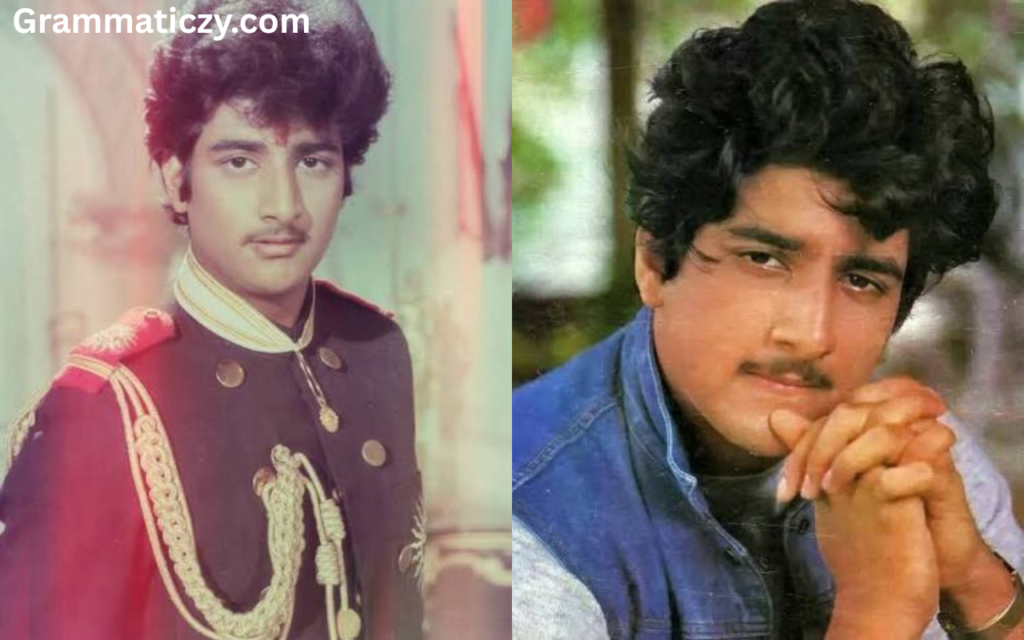
There are some Bollywood stories that are remembered because they ended with extraordinary fame, while others remain interesting because the journey took an entirely different direction. Kunal Goswami belongs to the second category. Born into one of Hindi cinema’s most prominent families, he entered the film industry carrying the enormous legacy of his father, legendary actor and filmmaker Manoj Kumar. He worked with established names, appeared opposite Sridevi in the much-remembered Kalakaar, featured in several Hindi films during the 1980s and 1990s, and even returned to the screen in his father’s Jai Hind. Yet his story did not become the conventional tale of a star son transforming into a major Bollywood superstar. Instead, Kunal Goswami eventually stepped away from acting and moved into the catering business, creating a professional identity beyond the world of movies.
What makes Kunal Goswami’s biography especially compelling is the contrast between opportunity and outcome. He had an extraordinary entry point into Hindi cinema because his father was already one of the industry’s most influential figures. At the same time, that family connection created expectations that were difficult to escape. Kunal himself later described being a star’s son as a “double-edged sword,” explaining that the family name could provide an initial platform while also creating assumptions and comparisons. His reflections offer a rare personal perspective on what it meant to try to establish an independent identity while carrying the surname of Manoj Kumar.
Kunal’s journey therefore deserves to be examined as more than a list of movies. It is a story about growing up around cinema, entering Bollywood at a very young age, experiencing the pressures associated with a famous family, working with major performers, facing an acting career that did not develop as expected, and eventually choosing a different professional path. His story also became relevant again after Manoj Kumar’s death in April 2025, when Kunal spoke publicly about his father, his upbringing and the lessons he had learned from living alongside one of Indian cinema’s most recognizable personalities.
Kunal Goswami Biography at a Glance
Kunal Goswami’s publicly available biography contains a few conflicting details, particularly regarding his birth year. IMDb lists November 24, 1965, while other biographical databases have listed 1961 or 1971. Because reputable entertainment databases do not agree on the year, it would be misleading to present one figure as unquestionably established. His birthplace is also inconsistently reported across entertainment databases, so the safest approach is to focus on information that is better documented through his career and interviews.
| Category | Details |
|---|---|
| Full Name | Kunal Goswami |
| Profession | Former Hindi film actor, businessman |
| Father | Manoj Kumar |
| Mother | Shashi Goswami |
| Brother | Vishal Goswami |
| Wife | Riti Goswami |
| Acting Debut | Kranti (1981) |
| Breakthrough-era Film | Kalakaar (1983) |
| Famous Co-star | Sridevi |
| Television Work | Alag Alag |
| Notable Later Film | Jai Hind |
| Post-acting Career | Catering business |
| Industry | Hindi cinema / Business |
| @gkunal556 | |
| Verified Net Worth | Not reliably publicly documented |
Kunal’s filmography is considerably clearer than some of the personal information published about him online. Major databases list Kranti, Ghungroo, Kalakaar, Do Gulab, Ricky, Aakhri Baazi, Paap Ki Kamaee, Numbri Aadmi, Vishkanya and Jai Hind among his acting credits. Bollywood Hungama’s filmography places these releases between 1981 and 1999, while IMDb also records his work across the same broad period.
Early Life and Growing Up in the World of Manoj Kumar
Kunal Goswami grew up in an environment that was fundamentally different from that of an ordinary child. His father, Manoj Kumar, was already a major figure in Hindi cinema, known for acting, directing and producing films that often carried strong patriotic and social themes. The household was therefore closely connected with filmmaking, actors, music and production. Rather than discovering Bollywood from the outside, Kunal encountered the industry as part of his everyday family environment.
His mother, Shashi Goswami, has been described by biographical sources as being involved in film production, while his brother Vishal Goswami pursued music and singing. StarsUnfolded identifies Vishal as Kunal’s brother and notes several connections between the family and the film industry. This background meant that Kunal was surrounded by creative influences from an early age, making his eventual entry into acting appear almost natural.
Yet Kunal’s own recollection suggests that becoming an actor was not necessarily the result of a carefully planned childhood ambition. In a 2025 interview with The Times of India, he explained that he was very young when his father invited him to a film set. He suddenly found himself among a huge crowd and media presence while his father was directing a scene involving Dilip Kumar and Hema Malini. Kunal said he was around 14 when he made his debut, showing how unexpectedly his professional relationship with cinema began.
Kunal Goswami and His Father Manoj Kumar
The relationship between Kunal Goswami and Manoj Kumar is central to understanding his life. Manoj Kumar was not merely a successful Bollywood actor; he became a cultural figure whose screen persona and filmmaking were strongly associated with patriotism. Films such as Upkar, Purab Aur Pachhim and Shaheed became important parts of his professional legacy. Kunal grew up watching that dedication from close range, and later described his father as someone whose passion for cinema influenced the entire family.
In 2025, following Manoj Kumar’s death, Kunal spoke openly about the lessons he had absorbed from his father. He described the experience as learning and unlearning things about cinema and life. He also emphasized that his father’s patriotism was not simply an image created for films; it was something the family witnessed in everyday life. His comments provide a more personal understanding of the man behind the famous “Bharat Kumar” image.
Kunal has also made it clear that he does not believe his father’s most famous films can simply be remade to continue the family legacy. In his 2025 interview, he argued that movies such as Upkar, Purab Aur Pachhim and Roti Kapda Aur Makaan belonged to a particular emotional and social context. His position suggests that he respects his father’s work precisely because he understands that its impact came from something deeper than commercial formulas.
Bollywood Debut With Kranti
Kunal Goswami’s first major connection with Hindi cinema came through Kranti, the 1981 film directed by Manoj Kumar. IMDb records him as appearing in the film as the son of the characters played by Manoj Kumar and Hema Malini. This was an extraordinary beginning for a young performer because Kranti was a major production involving some of the most recognizable names of its era.
The importance of Kranti in Kunal’s biography goes beyond its place as his first credited film. It established a pattern that would remain connected with his career: his professional life was closely intertwined with his father’s filmmaking. That association gave him access to the industry, but it also meant that audiences and filmmakers were likely to evaluate him through the lens of his famous family.
His early entry also meant that Kunal experienced the film industry at an age when most young people were still deciding what they wanted to do with their lives. The exposure could have been an advantage, but it also placed him in a professional environment where expectations were exceptionally high. Instead of gradually building a career away from family comparisons, Kunal began his journey with the Manoj Kumar name already attached to him.
Kunal Goswami in the 1980s
The early 1980s became the most active period of Kunal Goswami’s acting career. Bollywood Hungama lists Ghungroo, Kalakaar and Do Gulab among his 1983 releases, while IMDb also credits him in those films. He later appeared in Ricky in 1986 and continued working through the end of the decade.
This period was particularly important because Kunal was no longer simply being introduced as Manoj Kumar’s son. He was receiving opportunities as a young actor in his own right. His film roles placed him alongside established performers, giving him the chance to develop a screen identity. However, the wider Bollywood environment was highly competitive, and being part of a famous family did not automatically translate into sustained audience success.
His filmography from this period includes several titles that are still useful for understanding the evolution of his career:
- Ghungroo — 1983
- Kalakaar — 1983
- Do Gulab — 1983
- Ricky — 1986
- Aakhri Baazi — 1989
These films show that Kunal continued receiving acting opportunities over several years rather than disappearing immediately after his debut.
Kalakaar and Kunal Goswami’s Association With Sridevi
Among all the movies associated with Kunal Goswami, Kalakaar remains perhaps the most recognizable. Released in 1983, the romantic musical drama starred Kunal alongside Sridevi. Kunal played Ravi Kumar, while Sridevi played Radha Khanna. The film was directed by P. Sambasiva Rao and featured music by Kalyanji–Anandji.
The film’s commercial performance did not make it a major blockbuster, but its music gave it a much longer afterlife. “Neele Neele Ambar Par” became the best-known song associated with Kalakaar, and the song remains one of the strongest reasons the movie continues to be remembered by Hindi film audiences. Contemporary retrospectives frequently identify the music as the major enduring attraction of the film.
The Sridevi connection also became an important part of Kunal’s public identity. Sridevi was already becoming a major Bollywood presence around this period, and she would go on to become one of Indian cinema’s most celebrated actresses. For Kunal, working opposite her gave him a memorable place in the history of 1980s Hindi romantic cinema, even though his own acting career did not reach comparable heights.
Why Kunal Goswami’s Acting Career Did Not Become a Major Success
Kunal Goswami’s acting career presents a complicated picture. He received opportunities that many newcomers could only dream about, yet his career never developed into sustained mainstream stardom. It would be too simplistic to attribute that entirely to acting ability because film careers depend on many factors, including scripts, directors, marketing, audience response, competition, timing and the availability of suitable roles.
Kunal himself provided a more nuanced explanation in his 2025 interview. He said that being the son of a famous actor provided an initial platform but also created assumptions. According to him, some filmmakers believed they needed to approach him through his father, while Manoj Kumar was not particularly social or easily approachable. Kunal said he also approached filmmakers himself but did not receive the strong roles needed to establish his career.
His experience is therefore an interesting example of the complicated reality of Bollywood nepotism and star-family expectations. A famous surname can make the first opportunity easier to obtain, but maintaining a career still requires the right combination of talent, material and audience connection. Kunal’s own description of his experience suggests that the family name was both an advantage and a burden rather than a guaranteed route to success.
Later Films and the Road Toward Jai Hind
Kunal continued appearing in Hindi films during the late 1980s and early 1990s. His credits include Aakhri Baazi in 1989, Paap Ki Kamaee in 1990, Numbri Aadmi and Vishkanya in 1991. IMDb and Bollywood Hungama both document this progression, demonstrating that his career continued for considerably longer than the short-lived trajectory sometimes suggested by online summaries.
His filmography also includes projects that were never released. StarsUnfolded lists several shelved projects associated with Kunal, including Jhamura, Kaayar, Manasi, Maut Ki Pukar and Kirtimaan. The latter reportedly involved a substantial cast including Monica Bedi, Amrish Puri, Anupam Kher and Prem Chopra and was produced and directed by Manoj Kumar.
These unreleased projects are an important reminder that an actor’s career cannot be judged only by the films audiences eventually see. Development problems, financing, production delays and changing market conditions can affect an actor’s filmography significantly. For Kunal, the combination of released and shelved projects meant that his career contained more possibilities than the final list of available movies alone suggests.
Jai Hind and Kunal Goswami’s Final Major Acting Phase
One of the most significant later chapters in Kunal Goswami’s film career was Jai Hind. The film was directed by Manoj Kumar and released in 1999, with Kunal among the principal cast. IMDb lists Kunal as playing Vijay, while Bollywood Hungama records Jai Hind as a 1999 release.
The movie gave father and son another opportunity to work together professionally. For Kunal, it was more than another acting credit because it represented an attempt to revive or extend a career that had not developed as expected. In his later interview, he explained that after his father’s film Jai Hind, he ultimately decided to step away from the film industry rather than continue accepting roles simply to remain an actor.
This decision is one of the most revealing parts of Kunal’s career. Instead of treating acting as an identity that had to continue at any cost, he recognized that the opportunities available to him were not matching his ambitions. His decision to leave Bollywood was therefore not simply the end of a career; it was the beginning of a different professional chapter.
Television Work and Alag Alag
Kunal’s connection with entertainment did not end immediately after his film career began winding down. He also worked in television, with biographical sources recording his appearance in Alag Alag, which aired on DD National around 2000.
Television offered actors a different route to maintaining visibility at a time when India’s television industry was expanding rapidly. For someone with Kunal’s background, it could have provided another opportunity to build a screen career without relying exclusively on theatrical Hindi films. Yet his television work did not develop into a long-running career comparable to the later television careers of many Bollywood actors.
His decision eventually to move away from acting altogether therefore appears to have been deliberate. Kunal has explained that he did not want to cling to the idea of being an actor simply because acting had once been his profession. That perspective became particularly important as he moved into business and began building a life outside the entertainment industry.
Kunal Goswami’s Career After Bollywood
After leaving acting, Kunal Goswami moved into the catering business in Delhi. IMDb specifically notes that his acting career did not develop as he had hoped and that he subsequently went into catering. Other biographical sources likewise identify catering as his post-Bollywood professional direction.
This transition is significant because it shows that Kunal did not allow his identity to remain tied exclusively to his father’s profession. Instead, he entered a completely different commercial field. Catering requires its own combination of organization, management, customer service and business judgment, giving him an opportunity to establish himself outside the expectations surrounding Bollywood.
Reports about his later career sometimes use dramatic language to describe his move into catering, but the more meaningful interpretation is that Kunal chose reinvention. His story demonstrates that changing professions after an unsuccessful or incomplete first career does not necessarily mean giving up. It can instead mean recognizing a different opportunity and having the confidence to pursue it.
Personal Life, Wife and Family
Kunal Goswami married Riti Goswami in 2005, according to IMDb’s personal information. Public information about their family life remains relatively limited, and Kunal has generally maintained a lower public profile than many contemporary Bollywood personalities.
His comparatively private lifestyle is understandable given the nature of his career after Bollywood. Unlike actors who remain active in films, television, endorsements and entertainment publicity, Kunal has spent much of his later professional life outside the mainstream celebrity ecosystem. As a result, reliable information about his daily routine, private relationships and personal habits is considerably more limited than the abundance of material available about his father.
The limited public record also means that claims about his private life should be approached carefully. A biography should distinguish between documented information and assumptions created by celebrity websites. What is clear is that family remains an important part of Kunal’s identity, particularly his relationship with Manoj Kumar and the lessons he says he carried from his father’s life and career.
Manoj Kumar’s Death and Kunal’s Reflections in 2025
The death of Manoj Kumar on April 4, 2025 brought renewed public attention to Kunal Goswami. India Today interviewed Kunal on the day his father died, and Kunal described the loss as significant not only for the family but also for the nation and the film industry. He emphasized that his father’s patriotic message had connected with generations of viewers.
In a subsequent Times of India interview, Kunal reflected on his relationship with Manoj Kumar as both a son and someone who had worked under his direction. He spoke about learning from his father’s approach to cinema and life and recalled how deeply his father’s passion for filmmaking and patriotism shaped the household. These reflections offered audiences a more intimate understanding of the relationship between the two men.
Kunal also made an important distinction between preserving a legacy and copying it. He said he did not believe films such as Upkar, Purab Aur Pachhim and Roti Kapda Aur Makaan could simply be remade because their emotional impact depended on the historical and social circumstances in which they were created. His comments show that he sees his father’s legacy as something to respect rather than mechanically reproduce.
Kunal Goswami Net Worth and Sources of Income
There is no dependable public financial disclosure establishing Kunal Goswami’s current net worth. Various celebrity websites have published numerical estimates, but these figures are generally unsupported by audited financial information, official business records or reliable disclosures. For that reason, a responsible biography should not present a specific dollar or rupee amount as his confirmed wealth.
His professional income has come from different stages of his career. During his acting years, his earnings would have been connected to film work and related entertainment activities. After leaving Bollywood, his professional life shifted toward catering and business, meaning that his later income structure would have been fundamentally different from that of an active film actor. The precise revenue of his business and the value of his assets are not publicly established.
This is an area where online biography articles often become unreliable. A large net-worth number may look attractive in search results, but without credible evidence it should not be treated as fact. In Kunal Goswami’s case, the more informative story is not a speculative wealth figure but the transformation of his career from Bollywood actor to businessman and the independence that came with that transition.
Kunal Goswami on Social Media
Kunal Goswami has maintained a presence on social media, although he has not built the kind of highly commercialized online persona associated with today’s leading Bollywood stars. An Instagram account using the handle @gkunal556 has been associated with him in online coverage, giving fans and vintage-Bollywood followers a way to remain connected with his public life.
His social-media presence is particularly relevant because interest in Kunal has periodically returned through discussions about Manoj Kumar, Sridevi and classic Hindi cinema. Instead of appearing constantly in entertainment headlines, he tends to attract attention when older films are revisited or when his family legacy becomes part of public discussion.
This relatively restrained online profile also reflects the broader direction of his life. Kunal is no longer trying to compete for screen visibility, and his professional identity is not primarily dependent on celebrity publicity. Social media therefore functions more as a bridge between his past as a film actor and the audience that still remembers his work.
Kunal Goswami’s Interest in Directing
Although Kunal left acting, cinema has not completely disappeared from his ambitions. In his 2025 interview, he said that acting may be behind him but that he would still like to direct a film someday. This is particularly interesting because directing would allow him to remain connected to filmmaking without returning to the demanding expectations associated with being an on-screen actor.
His interest in direction is not entirely new. Earlier reports had already discussed Kunal’s plans to move behind the camera and develop projects connected with his family’s production background. Those plans demonstrate that his creative ambitions extended beyond acting even during the earlier stages of his career.
As of 2026, however, there is no strong publicly verified evidence of a formally announced upcoming feature directed by Kunal Goswami. His interest should therefore be described as an ongoing creative ambition rather than an officially confirmed production. If he eventually directs a film, it could provide an intriguing new chapter in a career that has already moved through acting, television and business.
Kunal Goswami’s Filmography
Kunal Goswami’s filmography may be relatively short compared with the careers of major Bollywood stars, but it covers several important periods of Hindi cinema. His recorded credits begin with Kranti in 1981 and continue through Jai Hind in 1999. Bollywood Hungama lists the sequence of releases, while IMDb provides additional role information for several films.
Some of his better-known credits include:
- Kranti — 1981
- Ghungroo — 1983
- Kalakaar — 1983
- Do Gulab — 1983
- Ricky — 1986
- Aakhri Baazi — 1989
- Paap Ki Kamaee — 1990
- Numbri Aadmi — 1991
- Vishkanya — 1991
- Jai Hind — 1999
IMDb also records Kunal in Insaan Ki Aulad and provides additional information about shelved projects, showing that his complete professional history was broader than the most commonly repeated list of released movies.
The Real Meaning of Kunal Goswami’s Journey
Kunal Goswami’s career is often discussed through the language of success and failure, but that approach leaves out the most interesting part of his story. He was given an early opportunity because of his family background, worked with major names and remained active across several years, yet he ultimately decided that acting was not providing the career he wanted. Instead of allowing that disappointment to define him permanently, he moved into a different profession.
His story also illustrates the complicated nature of being a celebrity child. The famous surname can create immediate recognition, but recognition is not the same as a lasting audience connection. Kunal himself acknowledged that being Manoj Kumar’s son gave him an initial platform while simultaneously creating assumptions that could make it difficult to be judged entirely on his own merits.
Perhaps the strongest lesson is that a person’s life cannot be reduced to the career they were originally expected to have. Kunal Goswami did not become the next Manoj Kumar, and he did not need to. His life eventually moved in another direction, through business and personal reinvention, while his connection with cinema remained part of his identity.
Conclusion
Kunal Goswami’s story is ultimately about much more than a Bollywood career that did not reach the level many people expected. It is the story of a young man who entered cinema through the extraordinary world of Manoj Kumar, experienced the pressures of a famous family, appeared opposite Sridevi, worked across a number of Hindi films, attempted a later comeback with Jai Hind, explored television and eventually chose to leave acting behind.
His journey becomes even more meaningful when viewed against the legacy of his father. Manoj Kumar built an extraordinary place for himself in Indian cinema, and Kunal had the difficult task of finding his own identity within the shadow of that achievement. Rather than endlessly trying to recreate his father’s career, he eventually chose another professional path while retaining an appreciation for filmmaking and expressing an interest in directing.
Kunal Goswami’s life therefore offers a quieter but valuable lesson about perseverance. Not every dream unfolds according to its original plan, and not every person who enters a famous profession is destined to remain there. Sometimes growth means recognizing when to change direction, accepting reality without losing self-respect and finding a new way to build a meaningful life. In that sense, Kunal Goswami’s legacy is not defined only by the films he made, but also by his willingness to move beyond them and continue building his own story.