
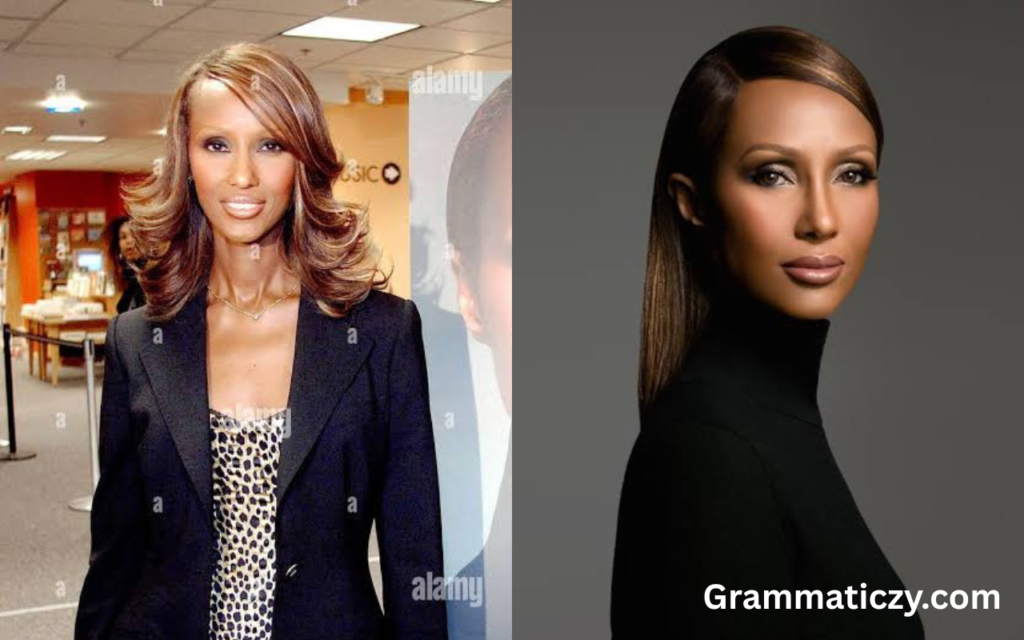
Iman is far more than a legendary fashion model. She is a woman who entered an industry that was not built to accommodate women who looked like her and transformed that limitation into a source of strength, creativity and business success. Born in Mogadishu, Somalia, Iman Abdulmajid rose from a political-science student in Nairobi to become one of the most recognizable faces in international fashion. Her career eventually expanded into beauty, acting, television, philanthropy and entrepreneurship, giving her an influence that has lasted long after she stepped away from full-time modeling.
What makes Iman’s story particularly compelling is that her success was never simply handed to her because of her extraordinary appearance. When she arrived in the United States in the 1970s, she was unfamiliar with the fashion industry’s rules and faced racial barriers, unequal treatment and a lack of suitable beauty products. Instead of allowing those obstacles to define her future, she learned how the business worked, demanded professional respect and eventually built companies that addressed problems she had personally experienced. Her modeling career became the foundation for a much broader legacy involving representation, beauty and women’s empowerment.
Today, Iman remains an important figure in fashion and popular culture. She has been recognized as a fashion icon, continues to appear in major fashion projects, and has used her platform to advocate for women, girls, refugees and greater diversity. Her story is ultimately about reinvention: every time one chapter of her life appeared to be ending, she found a new way to turn her experience into something meaningful.
Iman Model Biography: Quick Facts
| Fact | Details |
|---|---|
| Full name | Iman Mohamed Abdulmajid |
| Birth name | Zara Mohamed Abdulmajid |
| Known professionally as | Iman |
| Date of birth | July 25, 1955 |
| Age | 71 as of September 2026 |
| Birthplace | Mogadishu, Somalia |
| Nationality | Somali-American |
| Profession | Model, entrepreneur, actress, author, philanthropist and activist |
| Father | Mohamed Abdulmajid, diplomat |
| Mother | Gynecologist |
| Siblings | Four siblings |
| Education | Political science studies at the University of Nairobi |
| Modeling debut | Vogue, 1976 |
| Modeling career | Approximately 14 years |
| Modeling retirement | 1989 |
| Beauty company | IMAN Cosmetics, founded 1994 |
| Former husband | David Bowie |
| Children | Zulekha Haywood and Alexandria Zahra Jones |
| Major honor | CFDA Fashion Icon Award, 2010 |
| Estimated net worth | Commonly reported around $200 million; not independently audited |
| @the_real_iman |
Iman’s Early Life in Somalia and Her Family Background
Iman was born Zara Mohamed Abdulmajid on July 25, 1955, in Mogadishu, Somalia. She grew up in a family that valued education, independence and public service. Her father was a diplomat, while her mother worked as a gynecologist. That background gave Iman an unusually broad perspective from childhood because her family environment was connected to education, politics and international affairs rather than the fashion world she would eventually enter.
Her upbringing also exposed her to different cultures and languages. Iman has been described as having grown up speaking five languages, and her childhood included time outside Somalia. She attended school in Egypt before later living in Kenya, experiences that helped shape her international outlook. This multicultural upbringing would eventually become an important part of her identity because she never presented herself simply as a fashion personality; she carried her African heritage and international experience into everything from modeling to business.
Education was particularly important to her family. Iman eventually studied political science at the University of Nairobi, and modeling was not originally the obvious career she had planned for herself. Her transition into fashion happened unexpectedly when photographer Peter Beard discovered her in Kenya during the 1970s. That encounter changed the direction of her life and ultimately transported her from university life in Nairobi into the highly competitive international modeling industry.
How Peter Beard Discovered Iman and Changed Her Life
The story of Iman’s discovery has become one of the most famous stories in modeling history. While she was studying in Nairobi, photographer Peter Beard noticed her and photographed her. His interest eventually helped open the door to an international career, and Iman was introduced to the American fashion world. She moved to the United States in 1975, entering an industry she knew almost nothing about.
Iman later recalled that she was not certain the move would work. In an interview with ELLE, she described arriving in America with very little understanding of how the modeling business operated. She even asked for a return ticket because she did not know whether she would succeed. She had to learn everything from walking in heels to understanding contracts, clients, photographers and the economics of modeling.
Her early uncertainty makes her eventual success even more remarkable. Iman entered a highly competitive environment as an outsider and quickly learned how to observe, adapt and protect herself. She has described keeping quiet and watching people during her early days because she was afraid of being exposed as inexperienced. Over time, however, that cautious beginning developed into confidence, business awareness and an understanding of her own value.
Iman’s Breakthrough in International Fashion
Iman made her U.S. Vogue debut in 1976, only a short time after arriving in America. The appearance helped establish her as a serious fashion talent, and she quickly began working with some of the most influential photographers and designers of the period. The National Portrait Gallery records her collaboration with photographers including Norman Parkinson, Richard Avedon and Francesco Scavullo.
Her distinctive appearance made her instantly recognizable. Iman’s elegance, strong features and commanding presence gave photographers and designers an extraordinary canvas to work with. She became associated with fashion houses including Yves Saint Laurent, Versace, Calvin Klein and Donna Karan, while photographers such as Helmut Newton, Irving Penn and Annie Leibovitz photographed her during her career.
But Iman’s influence went deeper than simply being a successful Black model. During the period when she became internationally famous, the fashion industry still offered limited opportunities and inadequate representation for many models of color. Her success challenged assumptions about what a high-fashion model could look like and helped make an African woman one of the defining faces of global fashion.
The Challenges Iman Faced as a Black Model
Behind the glamour of Iman’s modeling career was a less glamorous reality. She entered the industry at a time when Black models often faced discrimination and significant pay differences. Iman has spoken openly about discovering that Black and white models could receive different compensation for their work, an experience that made her increasingly conscious of the business side of fashion.
She also encountered a major problem with professional makeup. During one of her first modeling assignments, a makeup artist asked whether she had brought her own foundation. The experience made her realize that the industry did not have adequate products for her skin tone. She began mixing different foundations herself and testing them through Polaroid photographs to determine how they would appear on camera.
That experience eventually became the foundation for one of the most important business decisions of her life. Iman understood that her appearance was central to her livelihood and that she could not afford to leave something as important as makeup entirely in somebody else’s hands. Years later, the personal frustration she experienced as a young model became the inspiration for IMAN Cosmetics, a company designed specifically to provide better choices for women with skin of color.
Iman Cosmetics: Turning a Problem Into a Business
After retiring from modeling in 1989, Iman took time away from the industry to consider what she wanted to do next. She eventually returned to the problem that had stayed with her since her earliest modeling jobs: the lack of appropriate cosmetics for women with darker skin. In 1994, she launched IMAN Cosmetics, creating one of the pioneering beauty businesses focused on women of color.
The significance of IMAN Cosmetics was enormous because the brand entered the market at a time when mainstream beauty companies frequently offered only a small range of shades for darker complexions. Iman’s business recognized that women of color were not one uniform customer group. Different ethnicities and complexions required different shades, undertones and formulations. The brand therefore became part of the larger movement toward more inclusive beauty.
Her business success also changed perceptions of what a model could accomplish after leaving the runway. Iman did not simply attach her name to a product; she brought firsthand knowledge of professional makeup and the needs of women who had been ignored by the industry. Her entrepreneurial approach demonstrated how lived experience can become a powerful foundation for building a company.
Iman’s Work in Acting, Television and Publishing
Fashion was Iman’s primary field, but she also explored acting and television. Her film credits included appearances in productions such as Out of Africa, No Way Out, L.A. Story and Star Trek VI: The Undiscovered Country. These roles allowed her to expand beyond fashion photography and demonstrate another side of her creativity.
She also became an author. Her book I Am Iman presented aspects of her professional life and helped establish her as someone capable of telling her own story rather than simply being represented through magazine photographs. Her work in publishing complemented her wider transition from model to entrepreneur and public figure.
Later, Iman also became involved in documentary work examining the history of Black models. She served as an executive producer on Supreme Models, a YouTube documentary series that explored the experiences and contributions of Black women in fashion. The project fit naturally with her longstanding advocacy for greater representation and equality in the industry.
Iman and the Black Girls Coalition
Iman’s commitment to improving opportunities for Black models extended beyond her own career. In the late 1980s, she became a co-founder of the Black Girls Coalition alongside Bethann Hardison. The organization was created during a period when Black models were pushing for greater visibility and fairer treatment within fashion.
The coalition reflected an important change in Iman’s career. By that point, she had achieved enough success to use her influence for other women rather than focusing exclusively on herself. She understood that individual success could not solve structural problems within an industry, so collective advocacy became part of her approach.
Her involvement also helped establish the idea that successful models could become advocates for industry reform. Iman and other Black fashion figures helped force conversations about diversity, casting and professional opportunities. Many of today’s discussions about representation in fashion build on battles that figures such as Iman and Hardison were already fighting decades ago.
Iman’s Marriage to David Bowie and Family Life
Iman’s personal life became internationally famous after she married British musician and cultural icon David Bowie in 1992. Their relationship attracted intense public interest because both were already major figures in their respective industries. Yet despite their celebrity status, they generally maintained a relatively private family life.
Iman was previously married to basketball player Spencer Haywood, with whom she has a daughter, Zulekha Haywood. She and David Bowie later welcomed their daughter Alexandria Zahra Jones. Through her family, motherhood became another important dimension of her identity outside fashion and entertainment.
Bowie died on January 10, 2016, bringing an end to their marriage after nearly 24 years together. Iman has continued to speak about him with affection while maintaining boundaries around her private life. Her public comments and social-media tributes have shown that his memory remains important to her, but she has continued building her own identity rather than allowing her life story to be defined solely by her famous husband.
Iman’s Philanthropy and Humanitarian Work
Iman’s influence eventually expanded into humanitarian advocacy. Her work has included causes involving women and girls, children in vulnerable circumstances, refugees and people affected by HIV/AIDS. Her public profile has allowed her to draw attention to issues that extend far beyond fashion.
In 2019, Iman became CARE’s first-ever Global Advocate. CARE is an international humanitarian organization focused on poverty reduction and empowering women and girls. The appointment reflected Iman’s longstanding interest in using her fame to support people facing inequality and difficult circumstances.
Her humanitarian work is especially significant because it connects with her own background and worldview. Iman has experienced living across different countries and cultures, and she has repeatedly emphasized the importance of education, independence and opportunity. Her advocacy therefore represents another evolution of the same principle that shaped her modeling and business careers: people deserve the opportunity to define their own futures.
Iman’s Awards and Fashion Legacy
One of the most significant honors of Iman’s career came in 2010, when the Council of Fashion Designers of America honored her with its prestigious Fashion Icon Award. The recognition formally acknowledged the extraordinary influence she had exercised over fashion throughout her career.
The award was particularly meaningful because Iman’s influence was not limited to the runway. She had helped change the visual language of fashion, challenged discriminatory practices and eventually created a cosmetics company that responded to the needs of women who had been underserved by the beauty industry.
Her legacy has continued to be recognized by younger generations of fashion professionals. She remains a reference point for conversations about Black representation, beauty diversity and longevity in the fashion business. Her career helped demonstrate that a model can have influence without remaining permanently dependent on modeling itself.
Iman’s Age, Beauty Philosophy and Life Today
Iman turned 70 on July 25, 2025, and celebrated the milestone publicly with an attitude of gratitude and confidence. Rather than treating aging as something to conceal, she has spoken about embracing it. She has also contrasted Western attitudes toward aging with perspectives from African cultures in which growing older can be regarded as a privilege and a sign of having lived a full life.
Her approach to beauty remains remarkably consistent with the philosophy she has carried throughout her career. Iman has emphasized skincare and consistency rather than presenting youth as the only standard of beauty. In a 2025 British Vogue interview, she described a simple skincare routine involving cleanser, vitamin C, moisturizer and daily SPF.
She has also continued to embrace fashion experimentation. In the same period, she spoke about taking risks with clothing and style, demonstrating that turning 70 had not changed her appetite for creativity. Her current image is therefore not an attempt to recreate the supermodel of the 1970s and 1980s; it is the image of a woman comfortable evolving with time.
Iman in 2026: Recent Career and Fashion Activity
Iman remains active in fashion even decades after retiring from full-time modeling. A recent example came through Tommy Hilfiger’s Spring 2026 campaign, which brought together figures from fashion, music, entertainment and sport. Vogue Germany reported on Iman’s participation in the campaign and highlighted her continued relationship with the fashion world.
Her appearance at the Fashion Awards in 2025 also demonstrated her continuing relevance. She presented an award and discussed her philosophy of taking fashion risks, skincare and offering advice to younger models. Rather than simply looking back at her own career, she used the opportunity to encourage the next generation to understand their identity and protect their professional integrity.
These recent appearances are important because they show that Iman’s influence has not depended on remaining constantly visible. She has spent decades moving in and out of the spotlight according to her own priorities. Her continued invitations to major fashion events suggest that the industry still regards her not merely as a former model, but as a cultural authority whose perspective carries weight.
Iman Net Worth and Sources of Income
Iman’s exact net worth is not publicly established through audited personal financial records, so celebrity wealth estimates should be treated cautiously. Various publications have placed her estimated net worth around $200 million, but this figure should not be presented as an independently verified financial statement.
Her wealth has been generated through several different areas. Modeling provided the initial platform, particularly through major fashion campaigns and advertising contracts. She later developed IMAN Cosmetics and other business ventures, including Global Chic, a clothing line associated with the Home Shopping Network. She also earned income through acting, publishing, television and other fashion-related activities.
The diversity of her income sources is one of the most important lessons from her financial story. Iman did not depend forever on one profession. She converted her fame into entrepreneurship and used her knowledge of an underserved market to build something with independent commercial value. Her career is therefore an example of how personal branding can become much more powerful when combined with genuine expertise and a clear understanding of consumer needs.
Iman’s Social Media and Connection With Fans
Social media has given Iman a more direct relationship with the public than was possible during the height of her modeling career. Her Instagram account, @the_real_iman, provides glimpses into her fashion appearances, memories, celebrations and personal reflections.
Her social-media presence is also notable because it does not rely exclusively on nostalgia. While she occasionally shares memories of David Bowie and important moments from her past, she also presents herself as a woman continuing to live, work, experiment and evolve. Her 70th-birthday posts in 2025 were a particularly personal example, combining celebration with a tribute to a birthday message written for her by Bowie before his death.
This balance helps explain her continuing appeal. Iman’s audience includes people who remember her from the golden age of supermodels as well as younger followers who know her through beauty, fashion advocacy and entrepreneurship. Her online presence effectively connects those generations.
The Lasting Legacy of Iman
Iman’s legacy cannot be reduced to a list of magazine covers or designer campaigns. She helped change the way the fashion industry saw Black beauty, and she used her experiences to build opportunities for other women. Her success challenged the idea that models were simply passive faces in advertising campaigns. She became an entrepreneur, advocate and business leader who understood how to turn visibility into influence.
Her work in cosmetics may ultimately be one of the most enduring parts of her legacy. Long before inclusive beauty became a major industry trend, Iman recognized that women with darker skin tones deserved products created with their needs in mind. Her decision to build a company around that need was both commercially intelligent and culturally important.
Perhaps most importantly, Iman’s career demonstrates the power of reinvention. She began as a university student, became an international supermodel, moved into acting, created beauty and fashion businesses, advocated for racial equality and later became a humanitarian voice. Each chapter built upon the previous one without being trapped by it.
Conclusion
Iman’s biography is ultimately a story about far more than beauty. From Mogadishu to Nairobi, from the early challenges of New York modeling to international fashion runways, and from cosmetics entrepreneurship to humanitarian advocacy, she repeatedly transformed obstacles into opportunities. Her journey shows what can happen when talent is combined with discipline, self-belief and the courage to challenge an industry that says something cannot be done.
She also leaves behind an important lesson for the generations who followed her. Success becomes more meaningful when it creates space for other people. Iman used her position to demand better representation, support women and girls, create products for underserved customers and encourage younger models to protect their identity and integrity. Her influence therefore reaches far beyond the photographs that first made her famous.
As Iman continues to participate in fashion and cultural life, her story remains a powerful reminder that a career does not have to follow one straight path. A person can change industries, build businesses, embrace new stages of life and still remain authentic to the values that shaped them. Iman’s legacy is ultimately one of resilience, representation, independence and reinvention—a legacy that continues to inspire people who believe that true success is not simply about becoming visible, but about using that visibility to make the world more inclusive for those who come next.