
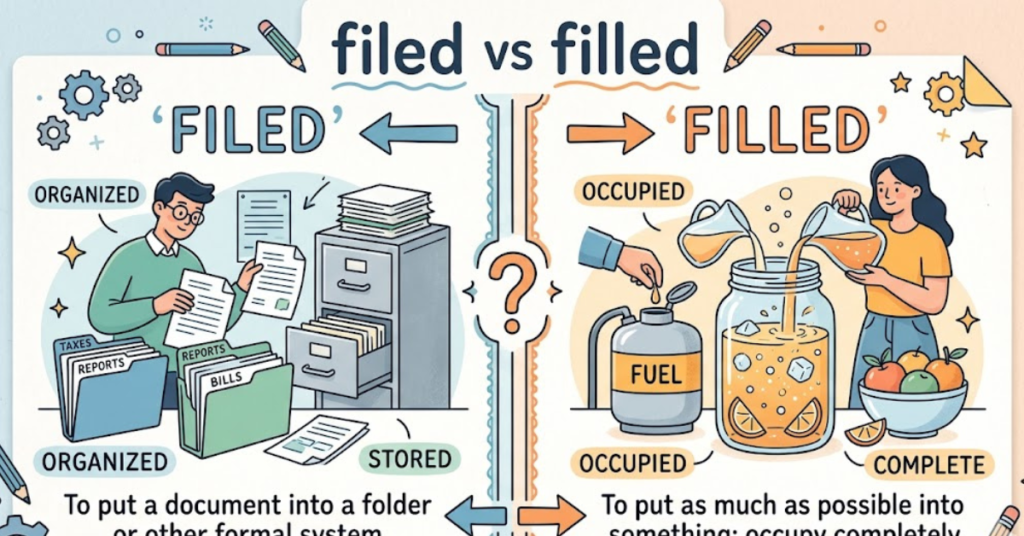
English has plenty of words that sound similar but mean completely different things. One common example is filed vs filled. At first glance, these two words seem almost identical, and when spoken quickly, they can even sound the same. That’s exactly why many people confuse them in writing.
The problem is that using the wrong word can completely change the meaning of a sentence. Saying you “filed a document” is very different from saying you “filled a document.” One refers to submitting or organizing something, while the other means completing or making something full.
In this guide, we’ll break down the filed vs filled meaning, explain the grammatical differences, provide easy examples, and help you remember when to use each word correctly.
Filed vs Filled: The Basic Difference
The easiest way to understand the difference is to look at the root verbs:
- Filed comes from the verb “file”
- Filled comes from the verb “fill”
Although they sound alike, their meanings are unrelated.
What Does “Filed” Mean?
“Filed” usually means:
- Submitted officially
- Organized documents
- Stored information properly
Examples:
- She filed her tax return yesterday.
- The lawyer filed the paperwork in court.
- He filed the documents alphabetically.
In these examples, “filed” relates to arranging, submitting, or storing something.
What Does “Filled” Mean?
“Filled” means:
- Made something full
- Completed empty spaces
- Added content or material
Examples:
- She filled the glass with water.
- He filled out the application form.
- The stadium was filled with fans.
Here, the word refers to adding something until space is occupied or complete.
Filed vs Filled Meaning Explained Clearly
The confusion often happens because both words are past tense verbs ending in “-ed.” However, their functions in sentences are completely different.
Filed = Submit or Organize
Think about offices, paperwork, and records.
Common uses include:
- Filed a complaint
- Filed taxes
- Filed documents
- Filed a lawsuit
The focus is usually on formal submission or organization.
Filled = Complete or Make Full
Think about containers, forms, or spaces.
Common uses include:
- Filled a bottle
- Filled a room
- Filled out paperwork
- Filled a position
The focus is on adding content or occupying space.
Filed vs Filled Difference in Everyday English
Understanding the context makes choosing the correct word much easier.
Examples Using “Filed”
- The employee filed the report before the deadline.
- She filed her insurance claim online.
- They filed the records into separate folders.
In all these examples, the action involves submission or organization.
Examples Using “Filled”
- He filled the bucket with sand.
- The audience filled the concert hall.
- She filled out the registration form carefully.
These examples involve making something complete or full.
Why People Confuse Filed and Filled
There are several reasons these words get mixed up so often.
1. Similar Pronunciation
In fast speech, “filed” and “filled” can sound nearly identical, especially in some accents.
2. Similar Sentence Structures
Both words often appear in workplace or document-related contexts.
For example:
- Filed a form
- Filled a form
This similarity makes mistakes more common.
3. Typing Errors
Because the words differ by only one letter, autocorrect mistakes happen frequently.
Filed vs Filled in Forms and Documents
This is where confusion becomes most common.
“Filled Out a Form” Is Correct
When you complete information on a form, you “fill it out.”
Correct:
- She filled out the application form.
Incorrect:
- She filed out the application form.
“Filed a Form” Is Also Correct
Once the form is completed and officially submitted, you “file” it.
Correct:
- He filed the completed paperwork yesterday.
This simple distinction helps many people remember the difference.
Easy Memory Trick for Filed vs Filled
A quick memory trick can make these words easier to remember.
Filed = File Cabinet
Think of paperwork being stored or submitted into a file system.
Filled = Full
Both words start with “fill,” which connects naturally to the idea of making something full or complete.
Common Grammar Mistakes
Writers often accidentally swap these words in professional communication.
Incorrect Example
- She filled a complaint against the company.
Correct Example
- She filed a complaint against the company.
A complaint is officially submitted, not made full.
Another Incorrect Example
- He filed the water bottle.
Correct Example
- He filled the water bottle.
The bottle became full, so “filled” is correct.
Filed vs Filled in Professional Writing
Using the wrong word in formal writing can create confusion or make your writing appear less polished.
Correct word choice matters in:
- Business emails
- Legal documents
- Academic writing
- Job applications
- Reports and presentations
Even small grammar mistakes can affect clarity and professionalism.
How Context Helps You Choose the Right Word
If you’re unsure which word to use, ask yourself this question:
Is Something Being Submitted or Organized?
Use “filed.”
Examples:
- Filed taxes
- Filed paperwork
- Filed a report
Is Something Being Completed or Made Full?
Use “filled.”
Examples:
- Filled a cup
- Filled the room
- Filled out a survey
This simple approach works in most situations.
Filed vs Filled Difference in Legal and Office English
The word “filed” appears very often in legal and administrative contexts.
Examples include:
- Filed a lawsuit
- Filed bankruptcy papers
- Filed court documents
Meanwhile, “filled” appears more often when discussing forms, spaces, or quantities.
Examples include:
- Filled the application
- Filled the tank
- Filled every seat in the theater
Recognizing these common contexts helps reinforce correct usage.
FAQs
What is the difference between filed and filled?
“Filed” means submitted, stored, or organized, while “filled” means made full or completed.
Is it filed out or filled out?
The correct phrase is “filled out” when completing a form or document.
Can you say filed a form?
Yes. Once a form is completed and officially submitted, it can be “filed.”
Why do people confuse filed and filled?
They sound similar, look alike in writing, and are both commonly used around paperwork and forms.
Which word should I use for complaints?
Use “filed” because complaints are officially submitted.
Conclusion
Understanding the filed vs filled difference becomes much easier once you focus on meaning and context. Although the words sound similar, they describe completely different actions. “Filed” relates to submitting, storing, or organizing documents, while “filled” refers to making something full or completing information.
Small grammar distinctions like these can significantly improve your writing clarity and professionalism. Whether you’re writing emails, filling out forms, or preparing official documents, choosing the correct word helps avoid confusion and strengthens communication.
The next time you hesitate between these two words, remember the simplest rule: if it involves paperwork submission, use “filed.” If it involves completion or fullness, use “filled.”