English punctuation can be surprisingly confusing, especially when apostrophes are involved. One common grammar question people ask is “yesterdays or yesterday’s.” At first glance, both versions may seem correct, but only one usually fits standard English grammar rules.
If you’ve ever written phrases like “yesterday’s meeting” or “yesterdays news” and paused to second-guess yourself, you’re definitely not alone. In this guide, you’ll learn the difference between “yesterdays or yesterday’s,” when to use the apostrophe, common mistakes to avoid, and plenty of practical examples to make the rule easy to remember.
Yesterdays or Yesterday’s: Which Is Correct?
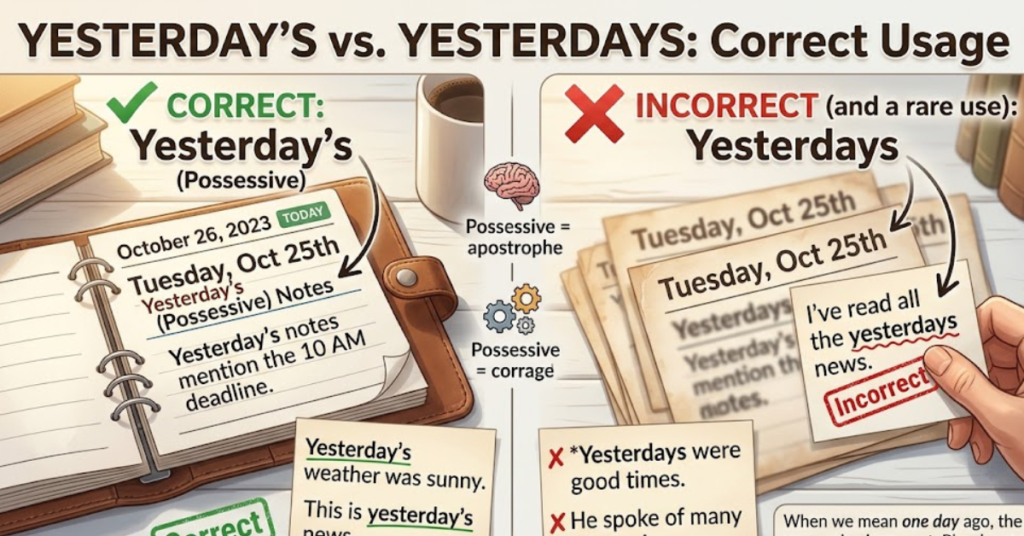
In most situations, the correct form is “yesterday’s” with an apostrophe.
The apostrophe shows possession or connection. When we say “yesterday’s meeting,” we mean “the meeting of yesterday” or “the meeting that happened yesterday.”
Correct:
- Yesterday’s weather was terrible.
- I reviewed yesterday’s notes.
- Yesterday’s meeting lasted two hours.
Incorrect:
- Yesterdays meeting was productive.
- I lost yesterdays report.
So if you are asking “is it yesterdays or yesterday’s,” the answer is usually “yesterday’s.”
Why “Yesterday’s” Uses an Apostrophe
The word “yesterday” becomes possessive when it describes something connected to that day.
In English grammar, apostrophes are commonly used to show:
- ownership
- association
- time relationships
Examples:
- today’s news
- tomorrow’s schedule
- yesterday’s meeting
In each case, the apostrophe indicates a relationship between time and the noun that follows.
Yesterdays or Yesterday’s Meaning
Understanding the meaning helps the grammar make much more sense.
“Yesterday’s”
This form means:
- something belonging to yesterday
- something connected to yesterday
- something that happened yesterday
Examples:
- Yesterday’s game was exciting.
- Yesterday’s conversation changed everything.
“Yesterdays”
Without the apostrophe, “yesterdays” is extremely rare and usually incorrect in everyday writing. Technically, it can act as a plural noun meaning multiple past times or former periods, but this usage is uncommon and mostly literary.
Example:
- The artist often dreams about forgotten yesterdays.
In normal communication, you will almost always need “yesterday’s.”
Yesterdays or Yesterday’s Grammar Rules
The grammar rule is actually straightforward once you break it down.
Use “Yesterday’s” When Something Is Connected to Yesterday
Examples:
- yesterday’s homework
- yesterday’s meeting
- yesterday’s headlines
- yesterday’s events
The apostrophe + s shows a possessive relationship.
Use “Yesterdays” Only as a Rare Plural Noun
This form appears mostly in poetry, storytelling, or artistic writing.
Example:
- We cannot relive our yesterdays.
Most English learners and writers rarely need this version.
Yesterdays or Yesterday’s Meeting
One of the most searched grammar questions involves the phrase “meeting.”
The correct phrase is:
- yesterday’s meeting
Why?
Because the meeting belongs to or occurred during yesterday.
Correct examples:
- Yesterday’s meeting was postponed.
- I missed yesterday’s meeting notes.
- Yesterday’s meeting covered the new budget.
Incorrect examples:
- Yesterdays meeting was canceled.
- I attended yesterdays meeting.
Whenever a noun follows “yesterday” to describe something connected to that day, the apostrophe is usually necessary.
Common Examples of “Yesterday’s” in Sentences
Here are some everyday examples showing correct usage.
Workplace Examples
- Yesterday’s presentation impressed the clients.
- I emailed yesterday’s report this morning.
- Yesterday’s deadline caused a lot of stress.
School Examples
- Yesterday’s homework was difficult.
- Did you finish yesterday’s assignment?
- Yesterday’s lecture was interesting.
Casual Conversation Examples
- Yesterday’s weather felt perfect.
- I enjoyed yesterday’s movie.
- Yesterday’s traffic was terrible.
These examples show how naturally the possessive form appears in English.
Why People Confuse “Yesterdays or Yesterday’s”
There are several reasons this mistake happens frequently.
1. Apostrophes Confuse Many Writers
English punctuation rules are not always intuitive, especially for non-native speakers.
2. Spoken English Hides the Difference
Both versions sound almost identical when spoken aloud.
3. People Avoid Apostrophes in Informal Writing
Texting and social media often skip punctuation, which can create bad writing habits over time.
Quick Trick to Remember the Correct Form
A simple trick is to expand the phrase mentally.
For example:
- yesterday’s meeting
becomes: - the meeting of yesterday
If the sentence still makes sense, you probably need the apostrophe.
Difference Between Possessive and Plural Forms
This distinction helps many writers avoid confusion.
Possessive Form
Shows connection or ownership.
- yesterday’s news
- yesterday’s game
Plural Form
Means more than one “yesterday.”
- many yesterdays
- forgotten yesterdays
In everyday grammar, the possessive form is far more common.
Common Mistakes to Avoid
Here are some errors people frequently make.
Incorrect:
- yesterdays meeting
- yesterdays homework
- yesterdays weather
Correct:
- yesterday’s meeting
- yesterday’s homework
- yesterday’s weather
Another common issue is adding apostrophes where they do not belong.
Incorrect:
- yesterday’ss report
Correct:
- yesterday’s report
Is “Yesterdays” Ever Correct?
No. “Yesterdays” without the apostrophe is generally considered incorrect spelling unless intentionally stylized in informal writing.
The standard forms are:
- yesterday
- yesterday’s
- yesterdays (rare plural noun)
Yesterdays or Yesterday’s in British and American English
The grammar rule is the same in:
- British English
- American English
- Canadian English
- Australian English
Both language systems use “yesterday’s” for possessive meaning.
So if you’re wondering about regional differences, there are none in this case.
FAQs
Is it yesterdays or yesterday’s?
The correct form is usually “yesterday’s” with an apostrophe.
Why does “yesterday’s” need an apostrophe?
The apostrophe shows possession or connection to yesterday.
Is “yesterdays” ever correct?
Yes, but only as a rare plural noun meaning multiple past times.
How do you write yesterday’s meeting?
The correct phrase is:
- yesterday’s meeting
What does “yesterday’s” mean?
It refers to something connected to or happening during yesterday.
Is “yesterdays” correct without an apostrophe?
No. Standard English grammar requires the apostrophe in possessive usage.
Do British and American English use different forms?
No. Both use “yesterday’s” in the same way.
Can “yesterday” be plural?
Technically yes. “Yesterdays” can refer to past times, but this usage is uncommon.
Conclusion
Understanding the difference between “yesterdays or yesterday’s” becomes much easier once you know the role of the apostrophe. In everyday English, “yesterday’s” is almost always the correct choice because it shows a connection to something that happened yesterday.
While “yesterdays” can occasionally appear as a rare plural noun in literary writing, most people will rarely need that form. Whether you’re writing about yesterday’s meeting, yesterday’s weather, or yesterday’s news, remembering the possessive rule will help your writing look clearer and more professional.
The next time you hesitate over the apostrophe, think about whether the noun belongs to or relates to yesterday. If it does, “yesterday’s” is the correct answer.