
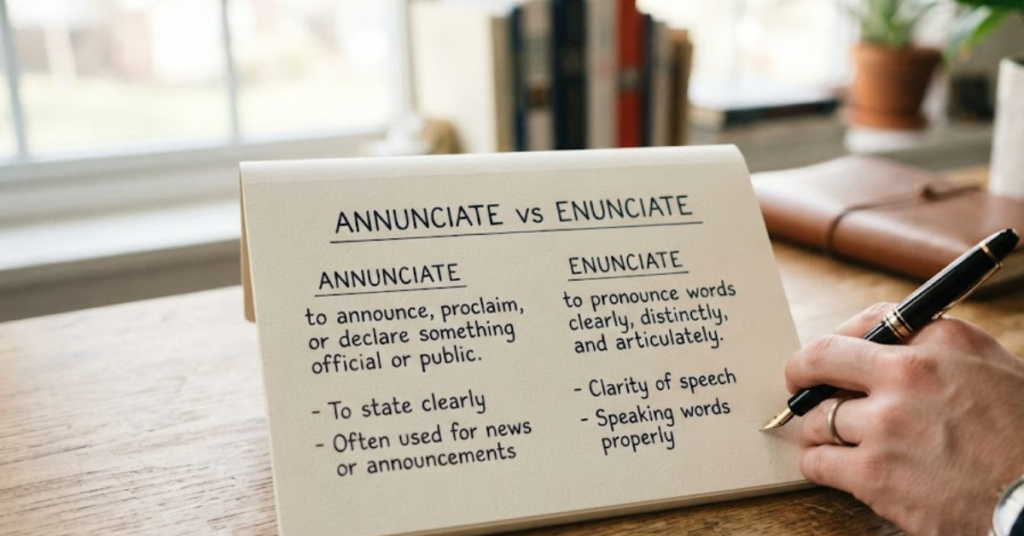
Have you ever heard someone say, “Please annunciate your words,” and wondered whether that was the correct expression? You’re not alone. The debate over annunciate vs enunciate is surprisingly common, especially among public speakers, teachers, students, and professionals who rely on clear communication.
The short answer is this: “Enunciate” is the standard English verb used to describe speaking words clearly and distinctly. While annunciate does appear in some dictionaries as a less common variant or regional usage, it is generally considered nonstandard in modern English. Understanding the difference can help you communicate more accurately and confidently.
Annunciate vs Enunciate: The Quick Answer
When comparing annunciate vs enunciate, the preferred word is enunciate.
Enunciate means:
- To pronounce words clearly.
- To articulate speech distinctly.
- To speak so listeners can easily understand every word.
For example:
- “Please enunciate each word during your presentation.”
- “Actors practice enunciation to improve clarity.”
Although some people use annunciate with the same intended meaning, it is far less common and is not the standard choice in formal English.
What Does Enunciate Mean?
The verb enunciate comes from the Latin enuntiare, meaning “to declare” or “to state clearly.”
Today, it refers primarily to clear pronunciation.
Examples include:
- Enunciating difficult vocabulary.
- Speaking clearly during a speech.
- Pronouncing each syllable carefully.
- Improving diction and articulation.
Teachers, speech-language pathologists, broadcasters, and voice coaches frequently encourage students to enunciate.
What Does Annunciate Mean?
The word annunciate has occasionally appeared in historical usage and is recognized by some dictionaries as a variant. However, it is much less common than enunciate and is often regarded as a mistaken substitution rather than the preferred term.
In everyday English, if you want to encourage someone to pronounce words more clearly, enunciate is almost always the better choice.
Annunciate or Enunciate: Which Should You Use?
If you’re wondering annunciate or enunciate, the answer depends on your goal.
For modern, standard English:
- Enunciate — Correct and widely accepted.
- Annunciate — Rare, nonstandard in many contexts, and may sound incorrect to many readers or listeners.
Using enunciate ensures your writing and speech align with contemporary dictionaries and style guides.
Why Do People Say “Annunciate”?
There are a few reasons why annunciate is commonly heard in conversation.
Similar Sound
The words sound somewhat alike, making them easy to confuse.
Influence of “Announce”
Many speakers unconsciously blend announce and enunciate, creating annunciate.
Informal Speech
Some regional dialects and conversational habits have kept the word in occasional use, even though enunciate remains the preferred term.
Enunciate vs Articulate
These words are related but not identical.
Enunciate
Focuses on pronouncing words clearly.
Example:
- “She enunciated every syllable.”
Articulate
Can describe both clear speech and the ability to express ideas effectively.
Example:
- “He’s an articulate speaker.”
Someone can be articulate in expressing ideas while still needing to improve enunciation.
Tips to Improve Enunciation
Clear speech benefits everyone, whether you’re giving presentations, teaching, interviewing, or recording videos.
Here are a few practical tips:
Slow Down
Speaking slightly slower gives your mouth time to form each word clearly.
Practice Tongue Twisters
Tongue twisters strengthen pronunciation and improve diction.
Examples include:
- She sells seashells by the seashore.
- Red leather, yellow leather.
Read Aloud
Reading books or articles aloud helps develop consistent speech patterns.
Record Yourself
Listening to recordings allows you to identify words that are difficult to pronounce clearly.
Focus on Final Consonants
Many people unintentionally drop the ends of words. Pronouncing every sound improves clarity.
Common Examples
Correct:
- Please enunciate your words.
- The teacher asked students to enunciate carefully.
- Good presenters enunciate clearly.
Less Preferred:
- Please annunciate your words.
Although listeners will usually understand the intended meaning, enunciate is considered the better choice.
Common Misconceptions
Some people believe annunciate is completely incorrect.
In reality:
- It has appeared historically.
- Some dictionaries acknowledge it as a variant.
- It remains uncommon in modern edited English.
- Most language experts recommend using enunciate instead.
This distinction explains why both words occasionally appear, even though one is clearly preferred.
Frequently Asked Questions
What is the difference between annunciate vs enunciate?
The primary difference is usage. Enunciate is the standard English word meaning “to pronounce words clearly,” while annunciate is an uncommon variant that is generally avoided in formal writing and speech.
Is annunciate a real word?
Yes. Some dictionaries recognize annunciate as a variant, but it is much less common than enunciate and is rarely recommended in standard English.
Should I use annunciate or enunciate?
Use enunciate in almost all situations. It is the widely accepted and preferred term.
Why do people say annunciate?
People often confuse enunciate with announce, resulting in the informal use of annunciate.
Is enunciate the same as articulate?
Not exactly. Enunciate refers to clear pronunciation, while articulate usually describes expressing ideas clearly or speaking fluently.
How can I improve my enunciation?
Practice speaking slowly, read aloud regularly, use tongue twisters, record your voice, and pay attention to pronouncing every syllable.
Conclusion
When comparing annunciate vs enunciate, the evidence is clear: enunciate is the standard, widely accepted word for speaking clearly and pronouncing words distinctly. While annunciate has appeared as a historical or regional variant, it is far less common and is generally not recommended in formal communication.
If you’re deciding between annunciate or enunciate, choosing enunciate will help your writing and speech sound polished, professional, and grammatically correct. Whether you’re giving a presentation, teaching a class, interviewing for a job, or simply improving your communication skills, strong enunciation makes your message easier for everyone to understand.