
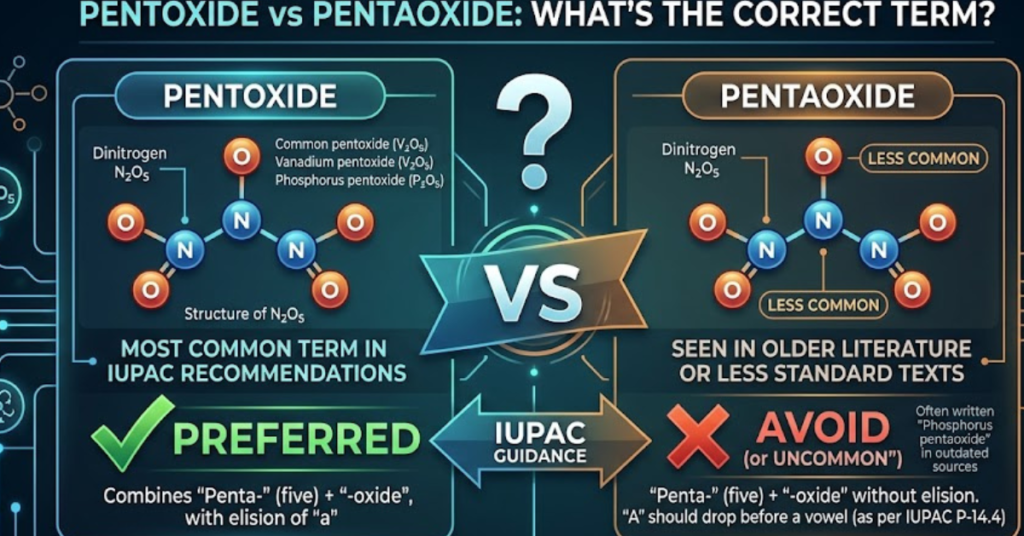
Have you ever come across the words pentoxide and pentaoxide and wondered whether they mean the same thing? You’re not alone. Chemistry terminology can be confusing, especially when similar-looking words appear in textbooks, online articles, and scientific discussions.
The debate around Pentoxide vs Pentaoxide often stems from how chemical compounds are named using standardized nomenclature rules. While both terms may seem logical, only one is considered correct in modern chemical naming conventions. In this guide, you’ll learn the difference between the two terms, why one is preferred, how chemical prefixes work, and where these words are used in real-world chemistry.
Understanding Chemical Naming Conventions
Before comparing the two terms directly, it’s helpful to understand how chemists name compounds.
Chemical nomenclature follows internationally accepted guidelines established by organizations such as the International Union of Pure and Applied Chemistry (IUPAC). These rules ensure that scientists around the world use consistent terminology.
For binary molecular compounds, prefixes indicate the number of atoms present:
| Prefix | Number |
| Mono- | 1 |
| Di- | 2 |
| Tri- | 3 |
| Tetra- | 4 |
| Penta- | 5 |
| Hexa- | 6 |
| Hepta- | 7 |
| Octa- | 8 |
The prefix “penta-” means five atoms.
Pentoxide vs Pentaoxide: The Main Difference
The key distinction is straightforward:
- Pentoxide is the correct and widely accepted chemical term.
- Pentaoxide is generally considered incorrect or non-standard in modern chemical nomenclature.
When naming compounds containing five oxygen atoms, chemists typically use pentoxide rather than pentaoxide.
For example:
- Dinitrogen pentoxide (N₂O₅)
- Phosphorus pentoxide (commonly used name)
You will rarely find reputable chemistry textbooks or scientific journals using “pentaoxide.”
Why Is “Pentoxide” Correct?
The Rule of Vowel Elision
One of the most important naming principles in chemistry involves dropping certain vowels when prefixes are combined with element names.
The prefix penta- ends in the vowel “a.”
The word oxide begins with the vowel “o.”
Instead of combining them directly as:
Penta + oxide = Pentaoxide
chemists remove the “a” to improve pronunciation:
Penta + oxide = Pentoxide
This process is known as vowel elision or vowel omission.
Similar Examples
The same rule appears in many chemical names:
- Monoxide (not monooxide)
- Pentoxide (not pentaoxide)
- Tetroxide (not tetraoxide)
Examples include:
- Carbon monoxide (CO)
- Dinitrogen tetroxide (N₂O₄)
- Dinitrogen pentoxide (N₂O₅)
These names are easier to pronounce and conform to established conventions.
Historical Use of Pentaoxide
Although pentaoxide is not the preferred modern spelling, you may occasionally encounter it in:
- Older chemistry references
- Historical scientific documents
- Informal educational materials
- User-generated online content
In many cases, writers simply apply the prefix “penta-” directly without considering nomenclature rules.
This doesn’t necessarily make the term incomprehensible, but it does make it non-standard.
Common Compounds Named Using “Pentoxide”
Several important chemical compounds use the term pentoxide.
Dinitrogen Pentoxide (N₂O₅)
Dinitrogen pentoxide is a powerful oxidizing agent and an important compound in atmospheric chemistry.
Key facts:
- Molecular formula: N₂O₅
- Contains five oxygen atoms
- Used in laboratory research
- Associated with nitric acid chemistry
Phosphorus Pentoxide (P₂O₅)
Although its actual molecular structure is more complex, phosphorus pentoxide remains a widely used common name.
Applications include:
- Drying agents
- Dehydration reactions
- Chemical manufacturing
- Laboratory processes
Vanadium Pentoxide (V₂O₅)
Vanadium pentoxide is an industrially significant compound.
Uses include:
- Sulfuric acid production
- Catalysts
- Ceramics
- Battery technologies
In each case, the accepted name uses pentoxide, not pentaoxide.
How IUPAC Naming Rules Handle Prefixes
Prefix Adjustment Rules
When a numerical prefix ends with a vowel and the element name begins with another vowel, the final vowel in the prefix is often removed.
Examples:
| Original Form | Standard Name |
| Mono + oxide | Monoxide |
| Tetra + oxide | Tetroxide |
| Penta + oxide | Pentoxide |
This rule helps create names that are easier to pronounce and more concise.
Why Pronunciation Matters
Scientific terminology is designed to be spoken as well as written.
Consider these comparisons:
- Pentaoxide → More awkward pronunciation
- Pentoxide → Smoother pronunciation
Standard nomenclature aims to reduce linguistic complexity while maintaining accuracy.
Is Pentaoxide Ever Accepted?
In formal chemistry contexts, pentaoxide is generally not accepted as the preferred term.
However, readers encountering the word should understand that it usually refers to a compound containing five oxygen atoms.
In practice:
Acceptable Contexts
- Historical references
- Informal discussions
- Explanations of nomenclature
Not Recommended For
- Academic papers
- Scientific journals
- Chemistry textbooks
- Laboratory reports
- Educational examinations
Using the standardized term demonstrates familiarity with chemical naming conventions.
Pentoxide vs Pentaoxide: Side-by-Side Comparison
| Feature | Pentoxide | Pentaoxide |
| Standard chemical term | Yes | No |
| IUPAC-compliant usage | Yes | Generally No |
| Commonly found in textbooks | Yes | Rarely |
| Easier pronunciation | Yes | Less so |
| Used in scientific literature | Frequently | Rarely |
| Refers to five oxygen atoms | Yes | Yes |
The comparison clearly shows why pentoxide dominates scientific communication.
Why This Distinction Matters
At first glance, the difference may seem minor. However, accurate terminology plays an important role in science.
Benefits of using correct nomenclature include:
- Clear communication
- International consistency
- Academic credibility
- Reduced misunderstanding
- Easier literature searches
Students, researchers, and professionals benefit from learning the accepted forms early.
Practical Tips for Remembering the Correct Term
If you’re studying chemistry, these simple tricks can help:
Remember the Vowel Rule
When a prefix ending in “a” meets “oxide”:
- Drop the “a”
- Use the shortened form
Example:
- Penta + oxide = Pentoxide
Learn Common Examples
Memorize compounds such as:
- Carbon monoxide
- Dinitrogen tetroxide
- Dinitrogen pentoxide
Recognizing these names makes the pattern easier to remember.
Follow Standard Textbooks
Modern chemistry textbooks consistently use standardized naming conventions, making them the most reliable reference source.
Key Takeaways
- Pentoxide is the accepted chemical term.
- Pentaoxide is generally considered non-standard.
- The difference comes from a nomenclature rule that removes the final vowel from certain prefixes before “oxide.”
- Examples include dinitrogen pentoxide, phosphorus pentoxide, and vanadium pentoxide.
- Using standard terminology improves scientific accuracy and communication.
Frequently Asked Questions
Is pentoxide or pentaoxide correct?
Pentoxide is the correct and widely accepted chemical term. Pentaoxide is generally considered a non-standard variation that does not follow modern nomenclature conventions.
Why is it called pentoxide instead of pentaoxide?
The final “a” in the prefix “penta-” is removed when combined with “oxide.” This naming convention improves pronunciation and follows established chemical rules.
Does pentaoxide mean something different from pentoxide?
No. Both terms generally refer to compounds containing five oxygen atoms. However, pentoxide is the scientifically preferred term.
Is pentaoxide ever used in chemistry?
You may occasionally see pentaoxide in older references or informal discussions, but it is rarely used in modern scientific literature.
What is an example of a pentoxide compound?
Dinitrogen pentoxide (N₂O₅) is one of the most common examples. Other examples include vanadium pentoxide and phosphorus pentoxide.
Who decides chemical naming rules?
Organizations such as the International Union of Pure and Applied Chemistry (IUPAC) establish standardized naming conventions used worldwide.
Conclusion
Understanding Pentoxide vs Pentaoxide comes down to knowing how chemical nomenclature works. While both words may appear to describe compounds containing five oxygen atoms, pentoxide is the correct and universally accepted term in modern chemistry. The omission of the extra vowel follows long-established naming rules that make scientific terminology more consistent and easier to pronounce.
Whether you’re a chemistry student, educator, researcher, or simply curious about scientific language, mastering these small distinctions can strengthen your understanding of chemical communication. Continue exploring nomenclature principles, and you’ll find that many seemingly complex chemical names become much easier to interpret.