
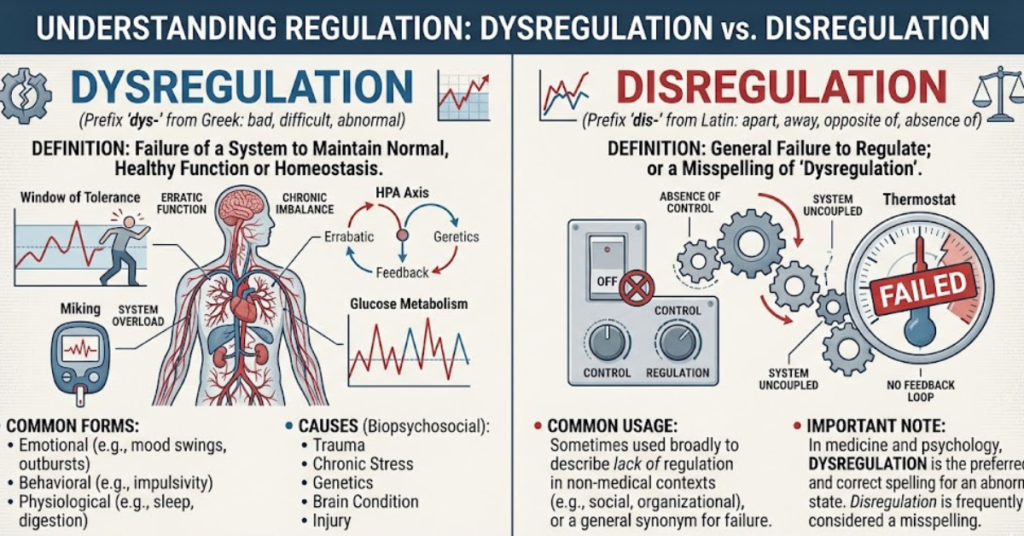
English can be surprisingly tricky, especially when two words look almost identical but carry very different meanings or levels of correctness. One common source of confusion is dysregulation vs disregulation. At first glance, the terms seem interchangeable, but only one is considered the standard and widely accepted spelling in medical, psychological, and scientific contexts.
Understanding the distinction matters because the correct term appears frequently in discussions about emotional health, mental disorders, nervous system function, and biological processes. In this article, you’ll learn what each term means, why the confusion happens, how professionals use the correct spelling, and how to avoid mistakes in writing and communication.
What Does Dysregulation Mean?
Dysregulation refers to an impaired or abnormal regulation of a process within the body or mind. The term is commonly used in psychology, neuroscience, psychiatry, and medicine.
It describes situations where normal control systems stop functioning properly.
Examples include:
- Emotional dysregulation
- Immune system dysregulation
- Nervous system dysregulation
- Hormonal dysregulation
In simple terms, the body or brain struggles to maintain balance or stability.
Is “Disregulation” a Real Word?
The word “disregulation” occasionally appears online or in informal writing, but it is generally considered a nonstandard or incorrect spelling in professional contexts.
Most dictionaries, medical journals, and academic publications recognize “dysregulation” as the correct term.
The confusion usually happens because:
- The prefixes “dis-” and “dys-” sound somewhat similar
- English spelling patterns can be inconsistent
- People assume “disregulation” follows words like “disorganization” or “disconnection”
However, in scientific and psychological language, “dysregulation” is the accepted spelling.
Understanding the Prefixes: Dys- vs Dis-
The difference becomes clearer when you understand the meaning of each prefix.
What Does “Dys-” Mean?
The prefix “dys-” comes from Greek and generally means:
- Abnormal
- Impaired
- Difficult
- Dysfunctional
It appears in many medical terms, including:
- Dyslexia
- Dysfunction
- Dysphagia
- Dysautonomia
In this context, dysregulation means faulty or impaired regulation.
What Does “Dis-” Mean?
The prefix “dis-” usually means:
- Not
- Opposite of
- Removal of
- Reversal
Examples include:
- Disconnect
- Disapprove
- Disappear
- Disorder
Because of this meaning, “disregulation” does not fit standard medical terminology as accurately as “dysregulation.”
Why Dysregulation Is Common in Psychology
The term is especially important in mental health discussions. Emotional regulation is the ability to manage reactions, feelings, and behaviors effectively.
When someone experiences emotional dysregulation, they may struggle with:
- Intense mood swings
- Impulsive behavior
- Difficulty calming down
- Overwhelming emotional responses
- Stress intolerance
Mental health professionals often discuss dysregulation in relation to conditions such as:
- Anxiety disorders
- ADHD
- Borderline personality disorder
- PTSD
- Autism spectrum disorder
The term helps describe challenges in maintaining emotional balance.
Dysregulation in Physical Health
The concept is not limited to emotions or psychology. It also appears frequently in medicine and biology.
Examples include:
Hormonal Dysregulation
This occurs when hormones become imbalanced, affecting metabolism, mood, sleep, or energy levels.
Immune Dysregulation
The immune system may become overactive or underactive, contributing to autoimmune diseases or chronic inflammation.
Nervous System Dysregulation
This involves problems in how the nervous system responds to stress, stimulation, or body functions.
In all these cases, the idea remains the same: a system that normally maintains balance is no longer functioning properly.
Common Mistakes People Make
Because the two words look similar, many writers accidentally use the wrong spelling.
Here are the most common mistakes:
- Writing “disregulation” in academic papers
- Assuming both spellings are interchangeable
- Confusing medical terminology with everyday English patterns
- Using autocorrect suggestions without verification
The safest approach is simple: use “dysregulation” in professional, educational, psychological, or medical writing.
How to Remember the Correct Spelling
A simple memory trick can help.
Think about these words:
- Dysfunction
- Dyslexia
- Dysphoria
They all use “dys-” to describe something functioning abnormally.
Since dysregulation also refers to impaired functioning, the same prefix applies naturally.
Examples of Correct Usage
Here are a few examples showing how the correct term appears in sentences.
- Emotional dysregulation can affect relationships and stress management.
- Chronic stress may contribute to nervous system dysregulation.
- Researchers continue studying immune dysregulation and autoimmune disorders.
- Sleep deprivation can worsen emotional dysregulation symptoms.
These examples reflect how the word is commonly used in professional communication.
Why Correct Terminology Matters
Using accurate terminology improves clarity and credibility, especially in educational or professional settings.
Correct language helps:
- Avoid misunderstandings
- Improve academic writing quality
- Build trust with readers
- Ensure consistency in medical discussions
- Support clearer communication
Even small spelling differences can change how writing is perceived.
The Role of Dysregulation in Everyday Life
Although the term sounds clinical, many people experience forms of dysregulation during stressful periods.
For example:
- Difficulty managing emotions during burnout
- Sleep disruptions caused by stress
- Overreacting emotionally after exhaustion
- Trouble calming the nervous system after anxiety
These experiences help explain why the term has become more widely discussed in wellness and mental health conversations.
FAQs
Which spelling is correct: dysregulation or disregulation?
“Dysregulation” is the correct and widely accepted spelling in psychology, medicine, and scientific writing.
Is disregulation a real word?
It may appear occasionally in informal usage, but it is generally considered nonstandard or incorrect in professional contexts.
What does dysregulation mean?
It refers to impaired or abnormal regulation of emotional, biological, or neurological processes.
Why do people confuse the two words?
The confusion happens because the prefixes “dys-” and “dis-” sound similar and English spelling patterns can be inconsistent.
Is dysregulation only related to mental health?
No. The term also applies to physical systems such as the immune system, hormones, metabolism, and nervous system function.
What is emotional dysregulation?
Emotional dysregulation describes difficulty controlling or managing emotional responses effectively.
Conclusion
Understanding the difference between dysregulation vs disregulation is important for accurate communication, especially in psychology, medicine, and academic writing. While both words may appear similar, “dysregulation” is the correct and professionally accepted term used to describe impaired regulation within the body or mind.
Whether discussing emotional health, nervous system balance, or biological processes, using the proper spelling improves clarity and credibility. Small language details can make a big difference in how information is understood and trusted.
If you found this guide helpful, consider exploring more articles on commonly confused words, psychology terminology, and language usage to strengthen your understanding even further.