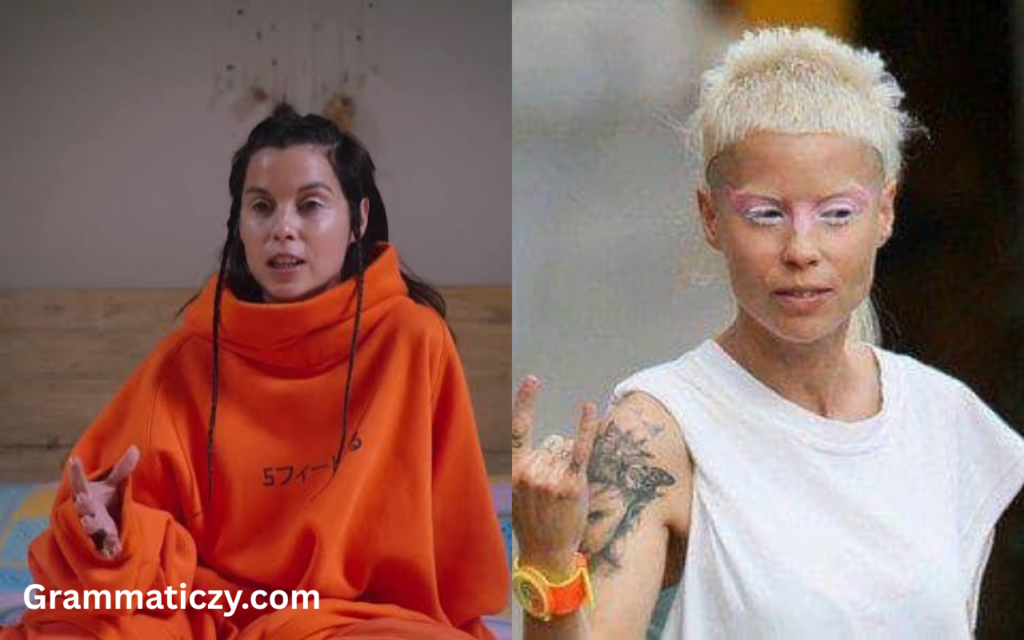
Yolandi Visser is the kind of artist who seems impossible to separate from the world she helped create. With her distinctive voice, bleach-blonde hairstyle, unconventional fashion, provocative performances and instantly recognizable stage presence, she became one of the most unusual figures to emerge from South Africa’s alternative music scene. Born Anri du Toit, Visser became internationally known as ¥o-Landi Vi$$er, the female vocalist of the South African rap-rave group Die Antwoord alongside Watkin Tudor Jones, better known as Ninja. Their music combined hip-hop, rave, electronic production, Afrikaans and English lyrics, and an aggressively visual form of storytelling that eventually attracted a worldwide cult following.
Her story, however, began long before Die Antwoord became an internet sensation. Visser grew up in South Africa after being adopted as a baby by an Afrikaans family. Her adoptive father, Reverend Ben du Toit, was a clergyman, while her adoptive mother was described as a homemaker. She has spoken about feeling different while growing up and about developing a rebellious personality during her teenage years. That sense of being an outsider eventually became an important part of the artistic identity she developed as an adult.
From her early experiments with South African alternative music to Die Antwoord’s international breakthrough, Visser’s career has been defined by experimentation rather than convention. She has worked as a rapper, singer, songwriter and actress, and she appeared alongside Ninja in Neill Blomkamp’s 2015 science-fiction film Chappie. Even decades after her emergence, her work remains closely associated with the distinctive “zef” aesthetic that made Die Antwoord such a controversial and recognizable cultural phenomenon.
Yolandi Visser Quick Facts
| Fact | Details |
|---|---|
| Full name | Anri du Toit |
| Professional name | Yolandi Visser / ¥o-Landi Vi$$er |
| Date of birth | March 3, 1984 |
| Age | 42 in 2026 |
| Birthplace | Port Alfred, Eastern Cape, South Africa |
| Nationality | South African |
| Profession | Rapper, singer, songwriter, actress |
| Best known for | Die Antwoord |
| Musical genres | Alternative hip-hop, rap-rave, electronic, techno |
| Adoptive father | Reverend Ben du Toit |
| Adoptive sibling | Leon du Toit |
| Child | Sixteen Jones |
| Former partner and collaborator | Watkin Tudor Jones (Ninja) |
| Major film appearance | Chappie (2015) |
| Notable documentary | ZEF: The Story of Die Antwoord (2024) |
| Estimated net worth | Around $10 million according to Celebrity Net Worth; not independently verified |
| Years active | 2002–present |
| Main musical group | Die Antwoord |
Early Life and Family Background
Yolandi Visser was born Anri du Toit on March 3, 1984, in Port Alfred, a small town on the eastern coast of South Africa. According to biographical accounts, she was adopted as a baby by Reverend Ben du Toit and his wife. Her adoptive father was a religious figure, creating a family environment that was very different from the rebellious artistic identity Visser would eventually develop. She has said that she has never met her biological parents, making the circumstances surrounding her birth and biological family an enduringly private part of her personal history.
Visser’s childhood was not presented as a conventional path toward celebrity. Accounts of her youth describe her as rebellious and someone who struggled with fitting in. She has recalled being a “little punk” who frequently became involved in fights, while her musical interests developed around artists and groups outside mainstream pop culture. Nirvana, PJ Harvey, Nine Inch Nails, Cypress Hill, Eminem, Marilyn Manson and Aphex Twin have been associated with the musical influences that shaped her taste.
At 16, Visser was sent to a boarding school in Pretoria. The experience appears to have played a significant role in her development because she encountered other creative and artistic-minded young people there. Rather than simply treating her differences as weaknesses, she increasingly found ways to turn those differences into creative expression. That transformation would later become central to the persona she built as Yolandi Visser and, eventually, ¥o-Landi Vi$$er.
Education and the Beginning of Her Creative Journey
Visser’s education did not follow the conventional route associated with professional musicians. Her artistic development was shaped more by friendships, collaborations, underground culture and experimentation than by formal music training. Her time in Pretoria exposed her to creative people, and her eventual move to Cape Town placed her in a much more active environment for alternative music and art.
In 2003, Visser moved to Cape Town, an important turning point in her life. There she met Watkin Tudor Jones, the artist who would become known internationally as Ninja. Their meeting introduced Visser to a broader creative network and gave her an opportunity to experiment with performance and music. Jones had already developed experience in South Africa’s alternative hip-hop scene, and their collaboration would eventually become one of the country’s most internationally recognizable music partnerships.
Before Die Antwoord, Visser was connected to projects including The Constructus Corporation and MaxNormal.TV. In The Constructus Corporation she was credited as Anica the Snuffling, while MaxNormal.TV gave her the stage identity Yolandi Visser. These early projects were important because they allowed her and Jones to experiment with characters, storytelling, comedy, visual presentation and unconventional hip-hop. In many ways, they served as the creative laboratory from which Die Antwoord eventually emerged.
Meeting Ninja and the Formation of Die Antwoord
The professional relationship between Yolandi Visser and Ninja became the foundation of her international career. Their collaboration developed around a shared interest in unusual forms of South African music and performance. Instead of attempting to reproduce the sound and image of American rappers, they wanted to create something that felt distinctly South African and deliberately unconventional.
Die Antwoord was formed in Cape Town in 2008. The name translates from Afrikaans as “The Answer,” while the group’s music became associated with a fusion of hip-hop and rave. Their performances combined Afrikaans and English, electronic production, aggressive rap, theatrical characters and an intentionally exaggerated visual identity. Visser’s high-pitched delivery contrasted with Ninja’s deeper voice, creating a combination that quickly became one of the group’s defining musical characteristics.
A major part of their identity was the concept of “zef.” The term had existing cultural meaning in South Africa, but Die Antwoord adopted and transformed it into an artistic philosophy involving outsider culture, irreverence, fashion, humor and deliberately unconventional aesthetics. Visser’s appearance became inseparable from that identity, particularly her bleach-blonde hair and distinctive stage styling. The result was a musical project that functioned as much as a visual universe as it did a recording group.
The Viral Breakthrough of Enter the Ninja
Die Antwoord’s international breakthrough came through the internet. Their early videos were unlike the polished mainstream music videos audiences were accustomed to seeing, and that difference became an advantage. When “Enter the Ninja” began circulating online in 2010, international audiences suddenly encountered a South African act that appeared completely unlike anything else on the global music scene.
The song and video became viral sensations, bringing enormous attention to Visser, Ninja and their distinctive zef aesthetic. Their rise demonstrated how YouTube, blogs and social media could allow an unconventional artist to bypass many traditional barriers within the music industry. Instead of gradually building recognition through conventional radio promotion, Die Antwoord attracted worldwide attention because people were intrigued, shocked or fascinated by what they were seeing and hearing.
For Visser, the success transformed her from an alternative South African performer into an international celebrity. Her voice became one of Die Antwoord’s most recognizable features, while her visual identity helped make the group immediately identifiable. The combination of music, fashion, characters and controversial imagery created an audience that extended far beyond ordinary hip-hop listeners.
Die Antwoord’s Music Career and Major Albums
Following their online breakthrough, Die Antwoord released their debut studio album $O$, establishing the musical foundation for their international career. Their early sound combined rap with rave, electronic production and South African cultural references. Visser’s vocals were central to the group’s contrast between playful melodies, aggressive delivery and deliberately strange lyrical ideas.
The group followed with albums including TEN$ION, Donker Mag, Mount Ninji and da Nice Time Kid and House of Zef. Their catalogue demonstrates an evolving sound, moving through different combinations of electronic music, trap, techno and rap while maintaining the distinctive identity that had made them famous. According to available discography records, Donker Mag and Mount Ninji and da Nice Time Kid became particularly successful on the U.S. Billboard Dance/Electronic Albums chart.
Die Antwoord’s most recent album listed in major discography sources is Pokémon, released in 2024, while the group’s current online presence has also expanded into a broader fictionalized “micro-drama” universe. Their official website continues to present Die Antwoord through the same mixture of music, characters and visual storytelling that has defined their career.
Yolandi Visser’s Most Recognizable Songs and Style
Yolandi’s voice is perhaps the easiest way to identify Die Antwoord. Her delivery can shift rapidly from a soft, almost childlike tone to energetic rap, creating an unusual contrast with Ninja’s vocal style. Songs such as “Enter the Ninja,” “I Fink U Freeky,” “Baby’s on Fire,” “Ugly Boy,” “Cookie Thumper” and “Banana Brain” helped establish her reputation as a performer who could turn an unconventional vocal approach into a recognizable signature.
The group’s music videos were equally important. Visser was rarely presented simply as a singer standing in front of a camera. Instead, she appeared inside elaborate visual worlds featuring unusual clothing, exaggerated characters, surreal imagery and deliberately provocative concepts. This made the videos essential parts of the group’s artistic identity rather than merely promotional material.
Her fashion also became part of the Die Antwoord phenomenon. The bleach-blonde hairstyle, athletic clothing, provocative styling and deliberately rebellious aesthetic became closely associated with her public image. For many viewers, seeing Yolandi Visser was almost as important as hearing her music because the character and the sound were designed to function together.
Acting Career and Chappie
Music was not Visser’s only venture into entertainment. She also developed a film career, most notably through her appearance in Neill Blomkamp’s 2015 science-fiction movie Chappie. Visser and Ninja appeared in the film as fictionalized versions of themselves, allowing their existing personalities and visual identities to become part of the movie’s story.
Chappie was particularly significant because it introduced Die Antwoord’s aesthetic to audiences who might never have encountered their music. The film’s soundtrack also incorporated several Die Antwoord songs, including “Baby’s on Fire,” “Ugly Boy,” “Cookie Thumper” and “Enter the Ninja.” Their involvement therefore extended beyond a conventional acting cameo and became part of the film’s broader musical and visual identity.
Visser’s screen presence was naturally suited to the project because she was already experienced at performing a highly distinctive public character. Although she never became a conventional Hollywood actress, her role in Chappie remains one of the most notable examples of her ability to move between music, visual performance and cinema.
Personal Life, Relationships and Daughter
Yolandi Visser’s personal life has often been closely connected to her professional career because Ninja has been both her creative partner and former romantic partner. The two share a daughter, Sixteen Jones, who was born in 2005. Their personal relationship evolved over time, but their creative partnership remained central to Die Antwoord.
Sixteen Jones has also entered the creative world surrounding her parents. She narrated the documentary ZEF: The Story of Die Antwoord, giving the film a particularly personal perspective because the narrator is the daughter of the two central figures being examined. The documentary therefore provides a different lens on Visser and Ninja’s story than a conventional music biography would.
Visser has generally maintained a more mysterious public image than many mainstream celebrities. Much of the information available about her personal life is intertwined with Die Antwoord’s artistic mythology, making it important to distinguish between the band’s fictionalized storytelling and independently documented biographical information.
Controversies and Public Scrutiny
Yolandi Visser’s career has also been accompanied by significant controversy. Die Antwoord has faced criticism over its use of provocative imagery, questions surrounding cultural representation and accusations involving the boundaries between artistic performance and real-life behavior. These controversies have contributed to the highly divided reactions that have followed the group throughout its career.
In 2022, one of Visser and Ninja’s adoptive sons made serious allegations about his childhood in an interview published by News24. The allegations included claims concerning exposure to drugs, violence and other disturbing experiences. Die Antwoord denied the allegations and described them as fabrications. Because the public record contains allegations, denials and accounts from multiple parties, these claims should be presented as disputed allegations rather than established facts.
The controversy became part of the broader story explored in ZEF: The Story of Die Antwoord. The documentary, directed by Jon Day after five years of filming, examines both the rise of the group and the controversies surrounding it. Its selection for Docville 2026 demonstrates that interest in Die Antwoord’s story continues well beyond the group’s original period of viral fame.
Yolandi Visser’s Net Worth and Sources of Income
Yolandi Visser’s exact personal net worth is not publicly established through audited financial statements. Various celebrity wealth websites publish estimates, with Celebrity Net Worth placing her fortune at roughly $10 million. Such figures should be treated as estimates rather than confirmed financial information because private earnings, contracts, royalties, investments and expenses are not publicly available.
Her potential income has come from several areas throughout her career. Music sales, streaming royalties, concert performances, touring, songwriting and merchandise have all been associated with Die Antwoord’s commercial activity. Her film work, including Chappie, provides another professional income stream, although specific compensation figures for her individual projects have generally not been made public.
The scale of Die Antwoord’s international audience gives some context for her financial success. Spotify currently lists the group with millions of monthly listeners and describes its music as a combination of zef rap-rave, high-energy rave music and distinctive visual styling. However, listener numbers should not be confused with Yolandi’s personal earnings, and there is no reliable public accounting of her private assets.
Social Media, Fans and Online Presence
The internet has played a remarkable role in Yolandi Visser’s career. Die Antwoord’s international success was largely accelerated by online video, and their unusual visual style proved particularly compatible with platforms where music videos could spread rapidly through sharing and discussion.
Rather than building her identity around a conventional celebrity lifestyle brand, Visser has generally remained closely associated with the Die Antwoord creative universe. The group’s official website continues to publish music-related and visual material, including its current micro-drama concept and character-based storytelling.
For fans searching for Yolandi Visser on Instagram, X or other platforms, caution is worthwhile because unofficial celebrity accounts can easily be mistaken for authentic profiles. The most reliable route for current professional information is the band’s official online presence and verified music platforms rather than assuming that every account using her name is genuine.
Recent Projects and Current Career
One of the most important recent developments in Yolandi Visser’s career has been ZEF: The Story of Die Antwoord. Released in 2024, the 90-minute documentary was directed by South African filmmaker Jon Day after he spent five years following the group’s story. The film was art-directed by surrealist photographer Roger Ballen and narrated by Sixteen Jones.
The documentary is significant because it looks behind the carefully constructed mythology surrounding Die Antwoord. Rather than focusing only on the group’s music, it examines their rise, aesthetic, relationships and controversies. Its continued appearance at film festivals, including Docville’s 2026 program, shows that the story of Visser and Die Antwoord remains culturally relevant.
Die Antwoord’s official website also indicates that the creative project remains active, with new visual material and an ongoing fictionalized universe. Spotify currently identifies ZAMA ZAMA as the group’s latest album and describes a related micro-drama series, suggesting that Visser’s creative work with Die Antwoord continues to evolve rather than simply looking backward at the group’s early-2010s success.
Yolandi Visser’s Influence and Legacy
Yolandi Visser’s greatest contribution to music may be her demonstration that an artist can build an international career by refusing to conform to conventional expectations. Die Antwoord did not sound like ordinary American hip-hop, did not look like a conventional pop group and did not market itself according to traditional celebrity formulas. Instead, Visser and Ninja constructed an exaggerated artistic universe around South African cultural references and their own interpretation of zef.
Her influence can also be seen in the growing importance of visual identity in modern music. Die Antwoord understood early that an artist’s music, fashion, videos and online presence could operate as one interconnected experience. Visser’s hairstyle, voice, clothing and stage persona became instantly recognizable, showing how a powerful visual identity can amplify music in an internet-driven entertainment industry.
At the same time, her legacy is complicated. The group’s controversies have become an unavoidable part of discussions about their career, meaning Visser’s influence cannot be separated entirely from criticism of the artistic choices and real-life allegations surrounding Die Antwoord. That complexity does not erase her impact; instead, it demonstrates how difficult it can be to separate art, persona, celebrity and controversy in modern popular culture.
Final Thoughts on Yolandi Visser
Yolandi Visser’s journey from Anri du Toit, an adopted child growing up in South Africa, to one of the world’s most recognizable alternative rap performers is an extraordinary example of artistic reinvention. She transformed her sense of difference into a creative identity and eventually helped create one of the most visually distinctive music acts of the internet era.
Her career is also a reminder that international success does not always begin with fitting into an established formula. Die Antwoord found a worldwide audience precisely because its music and imagery felt unfamiliar. Visser’s distinctive voice, fearless appearance and willingness to experiment helped turn that unfamiliarity into a recognizable global brand.
As Yolandi Visser continues to remain connected to the evolving Die Antwoord universe, her story remains a mixture of creativity, ambition, controversy and reinvention. Whether viewed as a musician, performer, actress, cultural provocateur or visual icon, she has left a distinctive mark on alternative music. Her journey ultimately suggests that originality can become a powerful force when an artist is willing to develop a unique identity rather than simply follow an existing path. As her career continues to evolve, Yolandi Visser’s legacy stands as a reminder that perseverance, experimentation and an unmistakable creative voice can transform an outsider into an artist with a lasting place in popular culture.