Every piece of yarn, nonwoven fabric, or fiber-filled product starts as a mass of loose, tangled fibers. Before those fibers can be turned into anything useful, they must be opened, cleaned, and arranged in the same direction. This process is called carding. In textile research, testing, and teaching, the equipment used for this step is a lab carding machine.
In this guide, we explain what a lab carding machine is, how it works, its main parts, and why so many textile professionals rely on it.
What Is a Lab Carding Machine?
A lab carding machine is a compact version of the large carding machines used in spinning mills and nonwoven production lines. Instead of processing hundreds of kilograms of fiber per hour, it handles small samples, usually from a few grams up to a few hundred grams.
Its purpose is not mass production. It is designed so that textile engineers, quality control staff, researchers, and students can see how a fiber will behave during carding without running a full-scale line. The result is a thin web of aligned fibers that can be studied, weighed, tested, or passed on to further processes such as drawing, spinning, or bonding.
Why Carding Matters in Textile Processing
Raw fibers are rarely clean or uniform. Cotton contains seed-coat fragments, leaf particles, and dust. Wool carries grease and vegetable matter. Synthetic fibers may be clumped from baling. Recycled fibers can be tangled and uneven in length.
Carding solves several problems at once:
- Opening: Clumps of fiber are broken into individual fibers.
- Cleaning: Trash, dust, and short fibers are separated from the good fiber.
- Aligning: Fibers are straightened and arranged in a parallel direction.
- Blending: Different fiber types can be mixed more evenly.
- Web formation: The fibers are delivered as a thin, continuous web.
If carding is done poorly, the problems carry through to every later stage and show up as weak yarn, uneven fabric, or visible defects. This is why testing fiber quality at the carding stage is so valuable.
Main Parts of a Lab Carding Machine
Although designs vary, most lab carding machines share these basic components.
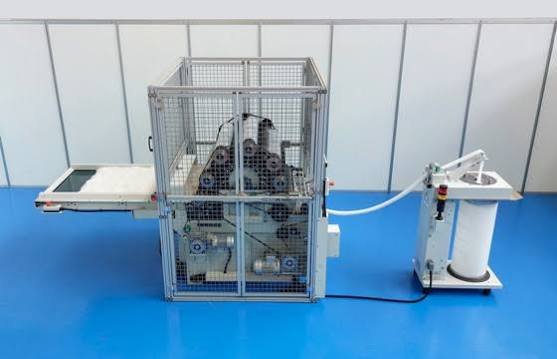
- Feed system. The feed section delivers fiber into the machine at a controlled rate. Even feeding is important, since uneven feeding creates uneven webs.
- Licker-in or opening roller. This roller takes the fed material and begins separating the fibers. It also helps release heavy trash.
- Main cylinder. This is the large rotating drum covered in fine wire teeth, known as card clothing. It carries the fibers around while the teeth hold and straighten them.
- Flats or worker and stripper rollers. Depending on the design, these components work against the cylinder to open fibers further, remove neps, and mix the material.
- Doffer. The doffer is a smaller cylinder that takes the carded fibers from the main cylinder and delivers them as a web.
- Web collection or sliver-forming unit. The finished web is either gathered into a rope-like sliver or collected as a flat sheet.
- Drive and control system. Motors, belts, and controls manage speeds so operators can set up different test conditions.
How a Lab Carding Machine Works, Step by Step
Step 1: Preparing the sample. The operator weighs a measured amount of fiber and loosens it by hand. Weighing the input and output later allows waste percentage to be calculated.
Step 2: Feeding. The fiber is placed on the feed table and enters the machine. The feed rate is set according to the fiber type and test objective.
Step 3: Opening. The first roller pulls the fibers apart. Large clumps are reduced, and heavy impurities may drop out.
Step 4: Carding action. The fibers are transferred to the main cylinder. The opposing wire teeth of the cylinder and working parts pull against each other, combing and straightening the fibers. This is the true carding action.
Step 5: Cleaning and neps removal. Short fibers, dust, and trash are separated. Small tangles of fiber, called neps, are reduced.
Step 6: Doffing. The doffer picks up the clean fibers and forms them into a thin, even web.
Step 7: Collection and evaluation. The web is collected and weighed. It can be inspected visually, or measured for uniformity, nep count, and waste.
Fibers You Can Test on a Lab Carding Machine
Depending on the machine design, a lab carding unit can process:
- Cotton and cotton blends
- Polyester and other synthetic staple fibers
- Viscose and other regenerated fibers
- Wool and animal fibers
- Recycled textile fibers
- Specialty fibers for nonwoven development
It is always best to confirm fiber length and type limits with the supplier before purchase.
Who Uses a Lab Carding Machine?
Spinning mills use it to evaluate cotton lots before purchase and to compare supplier quality.
Textile research institutes use it to develop new fiber blends and test processing behavior.
Nonwoven developers use it to make small carded webs for bonding trials.
Universities and technical schools use it to teach students the carding process practically.
Quality control labs use it to settle disputes about fiber quality using repeatable tests.
Advantages of Using a Lab Carding Machine
The biggest advantage is efficiency of testing. You use only a little fiber, so even costly or rare materials can be evaluated. You get results quickly, so many blends can be compared in a single day. And since the process is a miniature version of real production, the findings are relevant to what will happen on a larger machine.
There are also cost benefits. Running a trial on a production card wastes time, power, and material. A lab machine keeps trials small and cheap.
Choosing a Lab Carding Machine
When selecting a unit, consider the fibers you handle, the sample size you need, build quality, ease of cleaning, safety features, and after-sales support. If you are comparing options, you can check this laboratory carding machine and confirm that its specifications suit your work.
Final Thoughts
A lab carding machine brings the carding process into a controlled, small-scale environment. It helps textile professionals understand fiber behavior, catch quality problems early, and develop new products with less risk. Whether you run a testing lab, a university workshop, or a product development team, it is one of the most practical tools for working with fibers before they reach full production.