
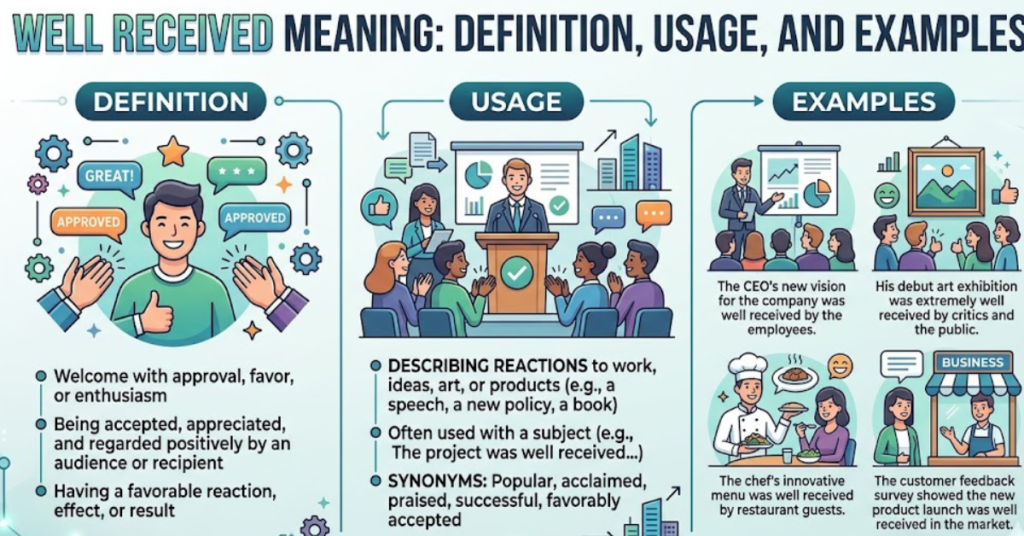
Have you ever received an email that simply says, “Well received, thank you” and wondered exactly what it means? You’re not alone. The phrase well received meaning is a common search query because this expression is frequently used in professional communication, business emails, and formal conversations.
In simple terms, “well received” means that something has been accepted, understood, appreciated, or responded to positively. Whether you’re writing emails, communicating with clients, or improving your English skills, understanding how and when to use this phrase can make your communication more effective and professional.
In this guide, we’ll explore the well received meaning, examples, synonyms, proper usage, and common mistakes to avoid.
What Does Well Received Mean?
The well received meaning refers to something that has been positively accepted or favorably regarded by another person or group.
Definition
Well received (adjective phrase):
A message, idea, product, event, or communication that is welcomed, appreciated, understood, or accepted positively.
Examples
- Your proposal was well received by the management team.
- The new product launch was well received by customers.
- Thank you for your email. It has been well received.
- Her presentation was well received by the audience.
In each example, the phrase indicates a positive reaction.
Why Is “Well Received” Common in Business Communication?
In professional environments, people often need to acknowledge information without writing lengthy responses. “Well received” provides a concise and polite way to do this.
Common Business Uses
- Acknowledging receipt of documents
- Confirming understanding of instructions
- Responding to client emails
- Recognizing proposals or reports
- Accepting invitations or requests
For example:
“Your report has been well received. We will review it and provide feedback shortly.”
This communicates acknowledgment and appreciation simultaneously.
How to Use “Well Received” Correctly
Understanding the correct usage helps avoid sounding awkward or overly formal.
In Emails
Many professionals use “well received” when responding to emails.
Examples:
- Well received, thank you.
- Your message has been well received.
- The attached documents were well received.
- Information received and understood.
In Presentations and Events
The phrase can describe audience reactions.
Examples:
- The keynote speech was well received.
- The training program was well received by employees.
- The conference received a well-received response from attendees.
Well Received Meaning in Emails
One of the most common contexts for this phrase is email communication.
What Does “Well Received, Thank You” Mean?
This phrase generally means:
- I received your message.
- I understand the information.
- Thank you for sending it.
For example:
Sender: Please find the updated contract attached.
Receiver: Well received, thank you.
The receiver confirms that the document arrived and has been acknowledged.
Is It Professional?
Yes, but some English speakers consider it slightly formal or old-fashioned. More natural alternatives are often preferred in modern business communication.
Alternatives to “Well Received”
Using different phrases can make your communication sound more natural and varied.
Professional Alternatives
- Thank you for your email.
- I have received your message.
- Noted with thanks.
- Acknowledged.
- Thank you for the update.
- I appreciate the information.
- Received and understood.
- Thank you for sharing.
Friendly Alternatives
- Got it, thanks.
- Thanks for letting me know.
- Sounds good.
- Thanks, I received it.
- Understood, thank you.
Common Situations Where “Well Received” Is Used
1. Receiving Documents
Example:
The contract was well received and will be reviewed shortly.
2. Acknowledging Instructions
Example:
Your instructions have been well received.
3. Evaluating a Product
Example:
The latest software update was well received by users.
4. Discussing Public Reactions
Example:
The movie was well received by critics and audiences alike.
5. Confirming Information
Example:
Your request has been well received and forwarded to the appropriate department.
Common Mistakes When Using Well Received
Although the phrase is simple, several errors occur frequently.
Mistake 1: Using It as a Complete Sentence Without Context
Less natural:
Well received.
Better:
Your email has been well received. Thank you.
Mistake 2: Overusing It
Repeating the phrase in every email can sound robotic.
Instead, rotate between:
- Thank you for your message.
- Noted.
- Received with thanks.
- Acknowledged.
Mistake 3: Using It Informally
When chatting with friends, “well received” may sound too formal.
Instead, use:
- Got it.
- Thanks.
- Understood.
Synonyms for Well Received
If you’re looking to expand your vocabulary, consider these alternatives.
Similar Words and Phrases
- Appreciated
- Accepted
- Welcomed
- Acknowledged
- Approved
- Favored
- Endorsed
- Embraced
- Recognized
- Positively received
Example Comparisons
| Phrase | Meaning |
| Well received | Positively accepted |
| Appreciated | Valued or liked |
| Acknowledged | Confirmed receipt |
| Accepted | Agreed to or approved |
| Welcomed | Received warmly |
Well Received vs. Noted
Many people wonder about the difference.
Well Received
Indicates:
- Receipt
- Understanding
- Positive acknowledgment
Example:
Your proposal was well received.
Noted
Indicates:
- Information has been seen
- May not necessarily imply approval
Example:
Noted. I’ll follow up tomorrow.
In many business situations, “well received” sounds slightly more positive than “noted.”
Examples of Well Received in Sentences
Here are practical examples you can use:
- The announcement was well received by employees.
- Your suggestions were well received during the meeting.
- The charity campaign was well received by the public.
- Thank you for the update. It has been well received.
- The training materials were well received by participants.
- The proposal was well received and is under review.
- Her speech was exceptionally well received by the audience.
- The new website design was well received by customers.
Benefits of Understanding the Well Received Meaning
Knowing how to use this phrase correctly can help you:
- Improve professional communication
- Write more effective emails
- Sound confident in business settings
- Avoid misunderstandings
- Communicate clearly with international colleagues
It is especially useful for professionals who frequently communicate through email.
Frequently Asked Questions FAQs
What is the exact well received meaning?
The phrase means something has been positively accepted, acknowledged, appreciated, or understood.
Is “well received” grammatically correct?
Yes. It is a grammatically correct English expression commonly used in business and formal communication.
What does “well received, thank you” mean?
It means the sender’s message, document, or information has been received and acknowledged with appreciation.
Can I use “well received” in an email?
Yes. It is widely used in professional emails to confirm receipt and understanding of information.
What are better alternatives to “well received”?
Some alternatives include:
- Thank you for your email.
- Acknowledged.
- Received with thanks.
- Noted with thanks.
- I have received your message.
Is “well received” formal or informal?
It is generally considered formal and is most common in professional or business communication.
Does “well received” mean approved?
Not always. It usually means positively acknowledged or accepted, but it does not necessarily indicate final approval.
Conclusion
Understanding the well received meaning can significantly improve your written and verbal communication. The phrase is commonly used to indicate that information, ideas, documents, products, or presentations have been positively accepted or acknowledged. While it remains a professional and effective expression, alternatives such as “acknowledged,” “received with thanks,” or “thank you for your email” can add variety to your communication.
Whether you’re writing business emails, responding to colleagues, or simply expanding your English vocabulary, knowing when and how to use “well received” will help you communicate with clarity and professionalism. For more language tips and communication guides, explore related articles on business English and workplace communication.