
As artificial intelligence (AI) and machine learning (ML) workloads push enterprise data centers and cloud service providers across North America and Europe into unprecedented scales, the underlying switching silicon acts as the beating heart of modern supercomputing. Training trillion-parameter Large Language Models (LLMs) and supporting real-time generative inference require massive east-west traffic distribution, demanding uncompromising bandwidth, ultra-low latency, and absolute deterministic routing.
The arrival of the 102.4 Terabits per second (Tb/s) switching class marks a monumental turning point in networking history. Leading merchant and vertically integrated silicon vendors have unleashed revolutionary platforms—specifically Broadcom’s Tomahawk-6 and NVIDIA’s Spectrum-6 series—to dominate AI scale-up and scale-out fabrics. This comprehensive comparison explores the architectural differences between these two 102.4T networking powerhouses and examines how physical layer copper and optical media evolve alongside them.
Architectural Blueprint: Broadcom Tomahawk-6 vs. NVIDIA Spectrum-6
To understand how modern data centers handle exascale AI computing, we must first analyze the silicon engineering driving these platforms. Both ASICs break the 100Tb/s barrier in a single chip, yet their design philosophies diverge significantly in ecosystem openness, packaging, and integration.
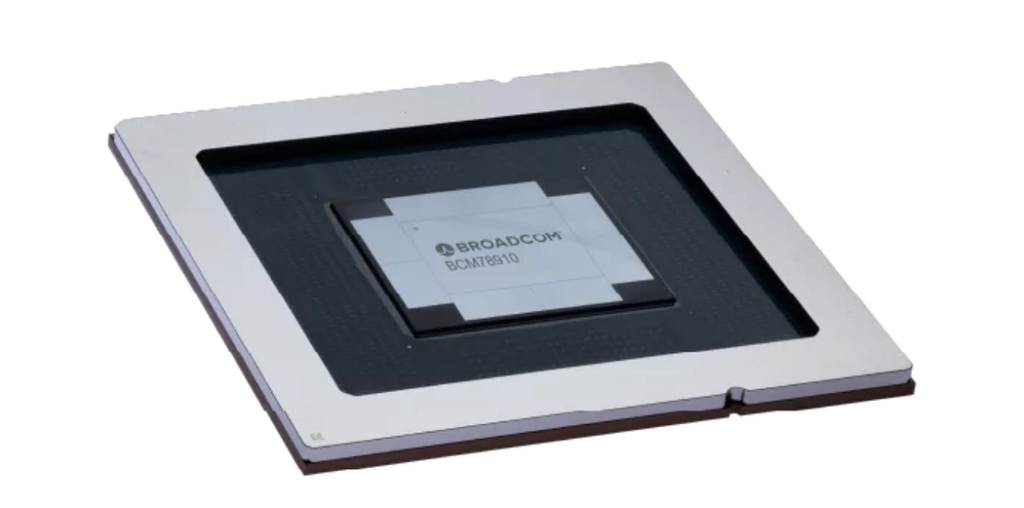
Broadcom Tomahawk-6 (BCM78910 Series)
Broadcom’s Tomahawk-6 is engineered as an open, standards-based merchant silicon architecture. Manufactured on an advanced 3nm process node, it delivers 102.4 Tb/s of aggregate switching capacity, doubling the bandwidth of its predecessor.
Port Flexibility and SerDes: Tomahawk-6 supports flexible configurations, including up to 128 ports of 800GbE, 256 ports of 400GbE, or 512 ports of 200GbE. It offers high-performance 200G and 100G PAM4 SerDes cores.
Cognitive Routing 2.0: Featuring advanced telemetry, dynamic congestion control, and rapid failure detection, Tomahawk-6 optimizes global load balancing across massive 100,000+ XPU clusters.
Ecosystem Openness: Designed to be fully compliant with Ultra Ethernet Consortium (UEC) specifications, it integrates seamlessly with any standards-based NIC, accelerator, or open-source orchestration framework.
NVIDIA Spectrum-6
NVIDIA’s Spectrum-6 platform, integrated within the broader Spectrum-X architecture, focuses on tight vertical integration and extreme hardware-software co-design.
Switching Capacity and Packaging: The flagship box switch (SN6810) and modular chassis (SN6800) harness 102.4T switching silicon to support dense 800G port layouts.
Co-Packaged Optics (CPO) Innovation: Spectrum-6 heavily emphasizes advanced packaging by integrating silicon photonics optical engines directly into the package using Micro Ring Modulator technology. This drastically improves energy efficiency compared to traditional pluggable designs.
AI Fabric Synergy: Optimized explicitly to work alongside NVIDIA ConnectX network adapters, BlueField DPUs, and GPU clusters, Spectrum-6 delivers deterministic low-latency performance tailored for tightly coupled AI training jobs.
Technical Comparison Matrix
| Feature / Specification | Broadcom Tomahawk-6 (BCM78910) | NVIDIA Spectrum-6 (SN6810 / SN6800) |
| Max Switching Capacity | 102.4 Tb/s (Single ASIC) | 102.4 Tb/s (SN6810); up to 409.6T (SN6800 Chassis) |
| Manufacturing Process | 3nm Node | Advanced Semiconductor Process |
| SerDes Speeds | 200G and 100G PAM4 Cores | 224G High-Speed SerDes Interfaces |
| Max 800G Port Density | 128 Ports (per 102.4T ASIC) | 128 Ports (SN6810) / 512 Ports (SN6800 Chassis) |
| Optical & CPO Integration | Standards-Based Pluggables & CPO Support | Integrated Silicon Photonics / CPO Engines |
| Ecosystem & Standards | Open Ecosystem, UEC Compliant, Vendor-Agnostic | NVIDIA-Centric Stack, ConnectX & BlueField Optimized |
The Physical Layer Evolution: Copper vs. Optics in 102.4T Fabrics
While high-speed ASICs provide the raw packet processing muscle, the physical layer media determines whether a data center can achieve error-free, energy-efficient transmission. When designing high-performance computing clusters, system architects often evaluate various physical media, ranging from specialized 800G DAC InfiniBand NDR configurations to standard Ethernet switching rails.
Advanced Copper Solutions for Intra-Rack and Row Connectivity
As SerDes speeds scale to 200G per lane, passive copper has proven remarkably resilient over short distances, reducing both power consumption and capital expenditure.
Passive Copper Interconnects: For very short-reach intra-rack connections connecting switches and accelerators within the same cabinet, traditional passive 800G DAC solutions remain the most cost-effective and zero-latency choice.
Equalized Copper Extensions: When physical distances stretch slightly beyond the limits of passive copper, engineers deploy 800G ACC (Active Copper Cable) assemblies featuring built-in equalization to maintain signal integrity.
Retimed Electrical Interconnects: Similarly, 800G AEC (Active Electrical Cable) options incorporate retiming chips to support longer cable runs across adjacent racks without transitioning prematurely to more expensive optical transceivers.
Coexistence with Legacy Enterprise Infrastructure
While modern AI superclusters operate at Terabit speeds, legacy management, storage, and auxiliary enterprise networks still incorporate older components such as 10G SR optical modules for short-reach server connectivity across traditional data center floors. These legacy infrastructure layers frequently utilize standard 10G SFP+ slots to manage peripheral traffic, proving that enterprise networks must support a diverse hierarchy of speeds while scaling their core AI fabrics.
Strategic Recommendations for Enterprise Network Architects
Selecting between merchant silicon solutions like Broadcom’s Tomahawk-6 and vertically integrated platforms like NVIDIA’s Spectrum-6 requires careful evaluation of organizational goals:
Evaluate Ecosystem Strategy: If your organization prioritizes vendor neutrality, multi-source hardware procurement, and open-source orchestration, a standards-compliant merchant silicon switch provides unmatched flexibility. Conversely, if your compute infrastructure is heavily anchored around proprietary GPU clusters and accelerated libraries, tightly integrated platforms maximize out-of-the-box performance.
Optimize Physical Layer Budgets: Balance your budget between passive copper, active copper, and optics. Utilizing 800G DAC for rack-level links and transitioning to single-mode or CPO solutions for longer runs keeps overall power density manageable.
Plan for Thermal Realities: 102.4T ASICs and high-speed pluggables dissipate substantial thermal energy. Ensure that your data center facility supports adequate airflow containment or liquid cooling to prevent thermal throttling under sustained AI training loads.
Conclusion
The debut of 102.4T switching platforms like Broadcom’s Tomahawk-6 and NVIDIA’s Spectrum-6 represents a watershed moment for enterprise data centers. By doubling throughput, enhancing telemetry, and integrating cutting-edge copper and optical interconnect technologies, these ASICs successfully eliminate the network bottlenecks that once constrained large-scale AI training. Whether deploying open Ethernet fabrics or tightly integrated AI superpods, network architects who carefully align their ASIC selection, physical media, and thermal strategies will lead the next generation of accelerated computing.