
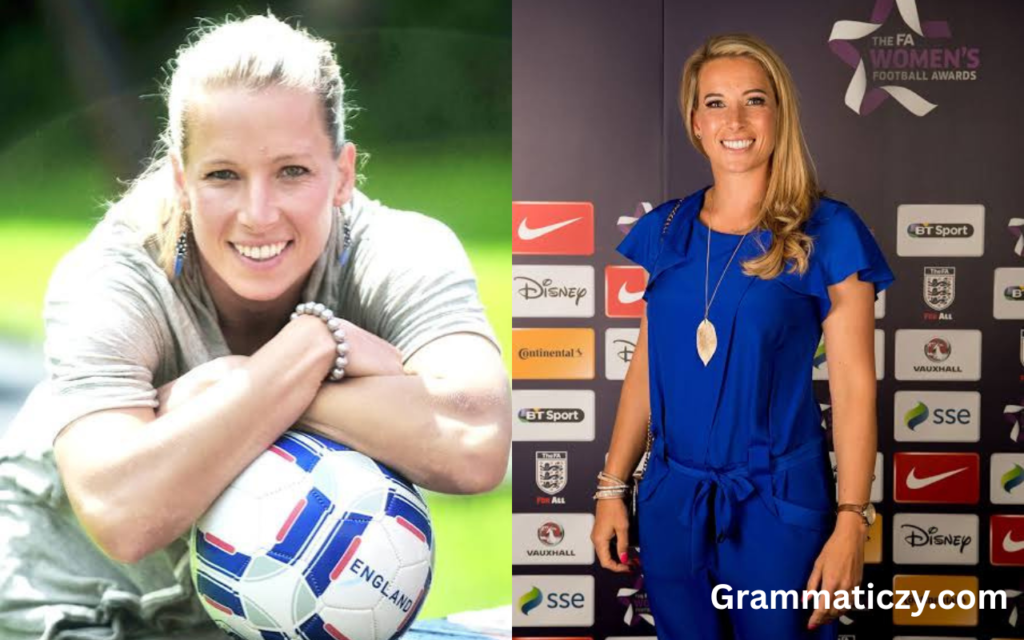
Rachel Brown-Finnis is a name closely connected with the remarkable rise of women’s football in England. Long before packed stadiums, record television audiences and the widespread popularity enjoyed by the Lionesses today, Brown-Finnis was already competing at the highest level. She entered senior football as a teenager, represented England for more than 16 years, played at World Cups and European Championships, competed at the London 2012 Olympics and eventually became a respected football broadcaster. Her story is therefore about much more than goalkeeping: it is about persistence, adaptation and witnessing the transformation of an entire sport from close range.
Born Rachel Laura Brown in Burnley, Lancashire, on July 2, 1980, she discovered football in an era when opportunities for girls were considerably more limited than they are today. She learned to handle the obstacles surrounding women’s participation in the sport while developing the qualities expected of a goalkeeper: courage, concentration, communication and resilience. Those qualities followed her from grassroots football to Liverpool, the American college system, Everton, England and eventually television broadcasting.
Today, Brown-Finnis is recognised not only as a former England goalkeeper but also as a prominent pundit and co-commentator. Her transition from professional football into broadcasting has given her career a second dimension, allowing her to analyse the same sport from a different perspective. Her continuing involvement in football development and sports media has also enabled her to influence younger generations who now have opportunities that were far less accessible when she began playing.
Rachel Brown-Finnis Quick Facts
| Category | Details |
|---|---|
| Full name | Rachel Laura Brown |
| Known as | Rachel Brown-Finnis |
| Date of birth | July 2, 1980 |
| Age | 46 years old in 2026 |
| Birthplace | Burnley, Lancashire, England |
| Nationality | English/British |
| Profession | Former professional football goalkeeper, pundit and broadcaster |
| Position | Goalkeeper |
| England career | 1997–2013 |
| England caps | 82 |
| Great Britain caps | 1 |
| Major clubs | Liverpool, Everton, ÍBV; American college teams Alabama Crimson Tide and Pittsburgh Panthers |
| Major honour | 2010 Women’s FA Cup with Everton |
| World Cups | 2007 and 2011 |
| European Championships | 2001, 2005, 2009 and 2013 |
| Olympics | London 2012 with Team GB |
| National Football Museum | Hall of Fame inductee, 2016 |
| Education | St Christopher’s C of E High School; University of Alabama; University of Pittsburgh; Liverpool John Moores University |
| Spouse | Ian Finnis |
| Parents | Her parents have been publicly described by Brown-Finnis as major supporters of her football career; their names are not reliably documented in major authoritative biographies |
| Siblings | No reliably sourced public information |
| Net worth | No verified public figure; online estimates are speculative |
| Broadcasting | BBC and TNT Sport, among other football media work |
| Public professional profile exists | |
| Instagram/X | Various third-party listings exist, but current official handles should be verified directly before publication |
Early Life and Family Background
Rachel Brown-Finnis grew up in Lancashire, a part of England where football has long been woven into everyday culture. Her early experiences with the sport, however, were shaped by the limitations placed on girls who wanted to play competitively. She initially played football with boys and had to deal with reluctance over allowing a girl to participate. Rather than being discouraged, she continued pursuing the game and eventually joined Accrington Ladies.
Her family played an important role during these formative years. Brown-Finnis has spoken about her parents as her biggest influence and described the support they gave her as she attempted to establish herself in football. That support became particularly important because her path was not always straightforward. She was trying to enter a sporting environment that offered far fewer established pathways for girls than today’s football system provides.
The early family environment appears to have encouraged determination rather than entitlement. Brown-Finnis had to prove herself repeatedly, and her later career suggests that she developed an ability to respond to setbacks without allowing them to define her. Information about her wider family, including siblings, is relatively private and is not consistently documented by authoritative sources. That makes it more appropriate to focus on the family support she has publicly acknowledged rather than repeat unverified claims about relatives.
Education and Discovering Her Talent as a Goalkeeper
Brown-Finnis attended St Christopher’s C of E High School in Accrington while developing her football skills. Her journey toward elite football accelerated when she attended a goalkeeping camp organised by former England goalkeeper Bob Wilson. She was the only girl among 48 participants and ended the camp by receiving the Player of the Camp award, presented by David Seaman. It was an early indication that she could compete with highly talented young male players.
Shortly after turning 15, Brown joined Liverpool Ladies. The move was extraordinary for a teenager who had only recently been fighting for opportunities in grassroots football. She made an immediate impression, appearing in an FA Cup final during the 1995–96 season. Liverpool ultimately lost to Croydon on penalties, but the experience gave the teenage goalkeeper an introduction to the pressure and intensity of major women’s football.
Education continued alongside her sporting ambitions. Brown-Finnis later studied in the United States, playing college soccer for Alabama and Pittsburgh, and she also studied at Liverpool John Moores University. Her educational background became another useful part of her professional identity because it gave her experience beyond competitive sport. The combination of academic study, teaching experience and elite football would eventually help her transition into broadcasting and football development.
Liverpool and the Move to America
Brown-Finnis’s first major club chapter came with Liverpool Ladies, where she joined at only 15. The timing of her arrival is significant because women’s football in England was still operating with considerably fewer resources and opportunities than today’s professional women’s game. To make an FA Cup final at that age demonstrated both exceptional ability and a willingness by her club to trust a young goalkeeper.
In 1998, she moved across the Atlantic to continue her football and education in the United States. She initially represented the Alabama Crimson Tide before transferring to the University of Pittsburgh Panthers. At Pittsburgh, she established a club record for the fewest goals conceded in a season, underlining her development as a technically capable and reliable goalkeeper.
The American experience was important because it exposed her to another sporting culture and a different model for combining education with football. Rather than following a single conventional route, Brown-Finnis built her career through a mixture of English club football, American college soccer and international competition. That adaptability became one of the defining characteristics of her career.
Everton and the Defining Years of Her Club Career
Brown-Finnis returned to England and joined Everton in 2003. She would spend roughly a decade associated with the club, becoming one of the most recognisable goalkeepers in its women’s team. Her long spell at Everton was particularly significant because the club became the setting for one of the most memorable achievements of her playing career.
Her road to success at Everton was not without major setbacks. Injuries, including serious knee problems, repeatedly tested her ability to continue at elite level. FIFA later noted that by the time of the 2012 Olympics she had undergone six knee surgeries, making her eventual selection for Team GB particularly meaningful. Her ability to return from repeated physical problems became a major part of the resilience associated with her career.
The breakthrough domestic achievement came in the 2010 Women’s FA Cup final. Everton defeated Arsenal after extra time, giving Brown-Finnis her first FA Cup winner’s medal. The National Football Museum identifies the triumph as the finest moment of her club career, and the victory provided a fitting reward after years of competition, injuries and earlier disappointment.
England International Career
Brown-Finnis made her England debut against Germany on February 27, 1997, at only 16 years old. Her international career eventually produced 82 caps, making her one of the most experienced England goalkeepers of her generation. England’s official legacy records confirm that her international career began in 1997 and ended with her final appearance against Belarus in September 2013.
She initially spent time competing for the goalkeeper position behind more established players, but gradually became a central figure for England. Her tournament record included four European Championships and two FIFA Women’s World Cups. She appeared at the 2005 European Championship and 2007 World Cup, while FIFA records her participation in the 2001, 2005, 2009 and 2013 European Championships and the 2007 and 2011 World Cups.
One of the most memorable moments of her international career came at UEFA Women’s Euro 2009, when England reached the final against Germany. Although England lost the final, reaching the championship match represented an important achievement during an era when the women’s national team was becoming increasingly competitive. Brown-Finnis’s long international career also meant she witnessed first-hand the gradual transformation of England from a developing women’s side into a major force in European football.
The London 2012 Olympics and a Career Pinnacle
Being selected for the Great Britain women’s football team for the London 2012 Olympics was one of Brown-Finnis’s most meaningful achievements. FIFA records her as having one Great Britain cap and identifies the Olympic tournament as the career highlight she particularly valued. Playing at a home Olympics gave her an opportunity to experience women’s football in front of huge crowds and a worldwide sporting audience.
The selection was especially remarkable considering the physical challenges she had already faced. By that point, Brown-Finnis had undergone six knee surgeries and had genuine doubts about whether she would be able to reach the required standard. She even left her teaching job to concentrate fully on preparing for selection, a decision that ultimately paid off.
The Olympics also represented something larger than an individual achievement. Brown-Finnis had begun playing at a time when women’s football received relatively little mainstream attention. By 2012, she was walking into Wembley as an international footballer at an Olympic Games hosted by her own country. For her, the moment symbolised not only personal perseverance but also how far women’s football had travelled.
Retirement From Professional Football
After an 18-year international career and a playing career spanning approximately two decades, Brown-Finnis announced her retirement in January 2015. She was 34 and explained that she did not believe her body could cope with another season of professional goalkeeping. For an athlete who had already experienced repeated knee operations, the decision reflected a realistic understanding of the physical demands of elite football.
Retirement did not mean abandoning the sport. Instead, Brown-Finnis began transferring the knowledge she had accumulated as a goalkeeper into new professional opportunities. Her understanding of tactics, preparation, psychology and the demands of elite competition gave her a strong foundation for analysing football for television audiences.
Her retirement also came at an interesting moment in women’s football. The sport was gaining momentum in England, and Brown-Finnis had spent much of her career helping to build that foundation. She could therefore leave playing football knowing she had been part of an important transitional generation while still finding ways to contribute to its next chapter.
Broadcasting Career and Media Work
Following retirement, Brown-Finnis established herself as a football pundit, analyst and co-commentator. Her broadcasting work has included BBC Sport and TNT Sport, where her experience as an international goalkeeper provides a perspective that is difficult to replicate through conventional sports journalism.
Her transition into television is particularly natural because goalkeepers spend much of a match reading the game from behind the action. They must organise defenders, anticipate attacks and understand tactical patterns before they unfold. Those skills translate effectively into football analysis, allowing Brown-Finnis to explain decisions and situations from the perspective of someone who has experienced them herself. FIFA has specifically highlighted how her goalkeeping background helped her transition into television.
Her media career has also included coverage of major women’s football events. The University of Lancashire notes that she has covered the Women’s World Cups in 2019 and 2023 as well as England’s Euro 2022 and Euro 2025 successes. Her broadcasting career therefore places her at the centre of the modern women’s football conversation, giving her an opportunity to compare today’s environment with the very different game she entered as a teenager.
Personal Life and Marriage
Rachel Brown-Finnis married professional golf caddie Ian Finnis in 2013. Her marriage took place while she was still an active international footballer, shortly before the final phase of her playing career. She has generally maintained a relatively private approach to her personal life rather than making family matters the centre of her public profile.
Her professional identity, however, has remained strongly connected to family and community values. She has repeatedly acknowledged the importance of the people who supported her throughout her football journey, particularly during the early years when pursuing the sport as a girl was not always straightforward. That background helps explain why she has subsequently shown interest in encouraging young people to participate in sport.
Brown-Finnis’s public career also suggests that football remains central to her personal interests. Even after leaving professional playing, she has continued to appear at football events, work in broadcasting and participate in initiatives designed to support the development of the game. Her life after retirement has therefore retained a clear connection with the sport that shaped her identity.
Net Worth and Sources of Income
There is no verified public figure for Rachel Brown-Finnis’s net worth. Various websites publish estimated amounts, but these figures are generally unsupported by audited financial information, public salary records or statements from Brown-Finnis herself. Consequently, presenting a specific dollar or pound figure as fact would be misleading.
Her income over the years has come from several professional areas. During her playing career, football contracts and related sporting activities formed the core of her professional earnings. Her later work has expanded into television punditry, co-commentary, public appearances, speaking engagements, football development and other sports-related activities. Her long career across playing and broadcasting has therefore created multiple professional income streams.
The most reliable conclusion is that Brown-Finnis has built a successful career in sport and media, but the exact size of her personal wealth remains private. A responsible biography should distinguish between confirmed career achievements and speculative celebrity-net-worth websites rather than treating online estimates as financial facts.
Social Media and Public Profile
Brown-Finnis maintains a professional public presence that reflects her continuing involvement in football. Her online profile is particularly useful for professional networking because her post-playing career has expanded into broadcasting, sports development, mentoring and football-related projects.
Her social-media presence is less important to her public identity than it is for many contemporary celebrities. Brown-Finnis has built her reputation primarily through football, television and professional sporting work. That gives her online activity a more career-focused character, with football and women’s sport remaining central themes.
Readers should nevertheless be careful with social-media handles attributed to her by third-party biography and influencer websites. Accounts can change names, become inactive or be incorrectly attributed. For an authoritative biography, official broadcaster, professional or verified social profiles are preferable to relying on unverified directories.
Awards, Recognition and Hall of Fame Status
Brown-Finnis’s playing achievements eventually earned formal recognition when she was inducted into the National Football Museum Hall of Fame in 2016. The honour recognised a career that included Liverpool and Everton, 82 England appearances and a major contribution to the development of women’s football.
The Hall of Fame recognition is particularly significant because the museum exists to celebrate people who have made an outstanding contribution to the national game. Brown-Finnis was inducted alongside other notable football figures, reinforcing her position as an important player in the history of English football.
Her honours also extend beyond the pitch. In December 2025, the University of Lancashire awarded Brown-Finnis an Honorary Fellowship in recognition of her contribution to football and sports broadcasting. The university specifically highlighted her work as a pioneering England and Team GB goalkeeper as well as her later role in media and mentoring.
Recent Career and Work in Women’s Football
Brown-Finnis has remained active in football long after her playing retirement. Her broadcasting work has allowed her to cover a new generation of England players and major women’s tournaments, creating an unusual link between different eras of the women’s game. She can discuss the modern success of the Lionesses while drawing on personal experience from the period when England’s women’s team had far fewer resources and expectations.
Her work also extends into mentoring and community football. The University of Lancashire has described her as a passionate advocate for women’s football, while its 2025 honorary fellowship recognised her wider contribution to the sport. These activities demonstrate that her post-playing career is not limited to television appearances but includes helping others understand and develop within the game.
Brown-Finnis’s continued relevance is perhaps best understood through the changing landscape of women’s football itself. When she made her England debut in 1997, the national team was still developing and the professional infrastructure was limited. Today she works in an environment where women’s football receives major broadcast coverage, large crowds and much greater commercial attention. Her career effectively connects those two eras.
Rachel Brown-Finnis’s Legacy
Rachel Brown-Finnis’s legacy cannot be reduced to the number 82, although her 82 England caps are an impressive measure of longevity. Her greater significance comes from the era in which she played and the barriers she helped overcome. She was a teenage goalkeeper when opportunities for girls were far more restricted, yet she progressed into elite football and remained at international level for more than 16 years.
Her career also demonstrates how setbacks can become part of a successful story rather than its ending. Knee surgeries threatened her progress, yet she returned repeatedly. Losing an early FA Cup final did not prevent her from eventually winning the competition with Everton. Being a young player outside the traditional pathway did not stop her from becoming an England international. Each stage required another adjustment.
Perhaps her most lasting contribution is the example she provides to the generations who followed. Brown-Finnis has moved from playing football herself to helping explain, promote and develop the sport for others. Through broadcasting, mentoring and public engagement, she continues to participate in the growth of women’s football rather than simply looking back at her own achievements.
Conclusion
Rachel Brown-Finnis’s journey is a powerful example of how sporting careers can evolve over time. From playing football as a girl in Lancashire to joining Liverpool at 15, studying and playing in the United States, becoming an Everton FA Cup winner, earning 82 England caps and representing Great Britain at the Olympics, she built a career through persistence rather than a straightforward path.
Her retirement in 2015 did not close the story. Instead, it opened another chapter in which her experience became a professional asset in broadcasting. Today, her work with BBC and TNT Sport, alongside her involvement in mentoring and football development, allows her to influence the sport from outside the playing area. Her 2016 National Football Museum Hall of Fame induction and 2025 University of Lancashire Honorary Fellowship demonstrate how widely her contribution has been recognised.
Ultimately, Rachel Brown-Finnis represents more than a successful former goalkeeper. Her life and career illustrate the value of perseverance, education, adaptability and giving something back. She entered football when the pathway for girls was far narrower, fought through injuries and professional uncertainty, and emerged not only as an accomplished England international but as a respected voice in the sport. As women’s football continues to grow, her story remains a reminder that today’s opportunities are often built on the determination of those who came before. Her legacy is therefore found not only in trophies, caps and tournaments, but in the doors she helped open for the players and football professionals who came after her.