
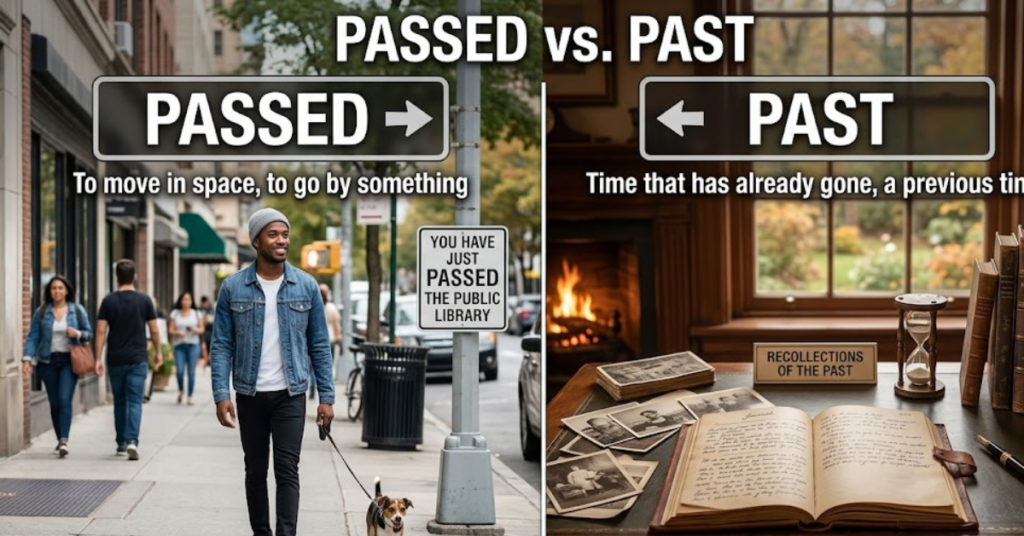
English can be tricky, especially when two words sound exactly alike but mean completely different things. One of the most common grammar mix-ups is passed vs past. Since both words are pronounced the same, it’s easy to confuse them in writing.
If you’ve ever wondered about passed vs past, you’re not alone. These words have different meanings, grammatical roles, and sentence uses. Understanding the distinction can help you write more clearly and avoid common mistakes.
In this guide, we’ll break down the meanings, explain the grammar rules, provide easy examples, and show you exactly when to use each word.
Passed vs Past Meaning
At first glance, these words seem interchangeable because they sound identical. However, their meanings are very different.
- Passed is the past tense of the verb pass. It refers to an action.
- Past usually functions as a noun, adjective, adverb, or preposition, and it refers to time, position, or something gone by.
A simple way to remember this is:
- If it describes an action, use passed
- If it refers to time, place, or direction, use past
This basic rule solves most confusion.
What Does “Passed” Mean?
Passed is a verb. It is the past tense of pass, which means to move, go by, succeed, transfer, or complete something.
Common uses of “passed”
- Moved by something
- Completed successfully
- Handed something to someone
- Reached a point
- Died (in a respectful expression)
Examples of “passed” in sentences
- She passed the exam after weeks of studying.
- The car passed us on the highway.
- He passed the salt across the table.
- Time passed quickly during vacation.
- Her grandfather passed away last year.
In all these examples, passed shows an action that happened.
What Does “Past” Mean?
Past is not usually a verb. It refers to time that has already happened, a position beyond something, or a previous period.
Common uses of “past”
- Referring to earlier time
- Describing position beyond something
- Talking about history or previous events
Examples of “past” in sentences
- Let go of the past.
- It’s half past five.
- We walked past the library.
- In the past, people wrote letters more often.
- She moved past the difficult experience.
In these examples, past refers to time or position, not an action.
Passed vs Past Difference in Grammar
Understanding grammar makes the difference much easier.
“Passed” as a verb
A verb shows action.
Examples:
- He passed the ball.
- She passed her driving test.
- The train passed the station.
In each case, something happened.
“Past” as other parts of speech
Past can work in several ways:
Noun
- We cannot change the past.
Adjective
- The past year was challenging.
Adverb
- He walked past without speaking.
Preposition
- The store is just past the bank.
Notice that none of these use past as the action itself.
When to Use Passed vs Past
A quick rule can help:
Use “passed” when:
- There is an action happening
- You can replace it with another verb
- It is the past tense of pass
Examples:
- She passed the note.
- The students passed the test.
Use “past” when:
- Referring to time gone by
- Showing movement beyond something
- Talking about previous events or locations
Examples:
- We drove past the school.
- Forget the past.
Passed vs Past Examples in Sentences
Here are some side-by-side examples to make the difference clearer.
- He passed the house. (action)
- He walked past the house. (position)
- She passed the exam. (action)
- Her exam is now in the past. (time)
- The car passed me quickly. (action)
- The car drove past me quickly. (position)
These comparisons show how grammar changes meaning.
Common Mistakes People Make
Because the words sound the same, writers often use the wrong one.
Incorrect:
- We walked passed the park.
Correct:
- We walked past the park.
Why? Because this sentence refers to moving beyond a location, not performing the verb pass in that grammatical structure.
Another common mistake:
Incorrect:
- The past the exam easily.
Correct:
- They passed the exam easily.
Here, an action is taking place, so the verb is needed.
Special Case: Passed Away vs Past Away
This is one of the most searched grammar questions.
Correct:
- He passed away peacefully.
Incorrect:
- He past away peacefully.
Why? Because passed away uses the verb pass in the past tense. It refers to the action in the expression.
So if you’re asking about passed vs past away, the correct phrase is always passed away.
Walked Passed vs Past
This mistake happens often because the phrase sounds natural when spoken.
Incorrect:
- We walked passed the store.
Correct:
- We walked past the store.
In this sentence, walked is already the verb. Past shows direction or position.
The same rule applies to:
- look past
- walk past
- drive past
- run past
Easy Memory Trick for Passed vs Past
A simple memory trick:
Passed = action (contains “-ed,” like many past tense verbs)
Past = time or place
Ask yourself:
“Is something being done?”
- Yes → passed
- No → past
This quick check works most of the time.
Quick Quiz: Choose the Correct Word
Test yourself:
- She ______ the finish line first.
- We drove ______ the museum.
- He ______ away peacefully.
- The best years are in the ______.
- The teacher ______ out the papers.
Answers
- passed
- past
- passed
- past
- passed
FAQs
What is the difference between passed and past?
Passed is a verb and shows action. Past refers to time, place, or something beyond a point.
When should I use passed?
Use passed when talking about an action, such as moving by something, completing something, or handing something over.
When should I use past?
Use past when referring to time gone by, position, direction, or previous events.
Is it passed away or past away?
The correct phrase is passed away because passed is the verb in the expression.
Is it walked past or walked passed?
The correct phrase is walked past because walked is already the action, and past indicates direction.
Why do people confuse passed and past?
They are homophones, meaning they sound the same but have different meanings and grammar functions.
Conclusion
The confusion between passed vs past usually comes down to grammar. If you’re describing an action, use passed. If you’re referring to time, direction, or position, use past.
A quick memory trick helps: passed does something, past points to something.
Mastering this difference can instantly improve your writing and help you avoid one of the most common English grammar mistakes. Keep practicing with examples, and soon choosing the correct word will feel natural.