
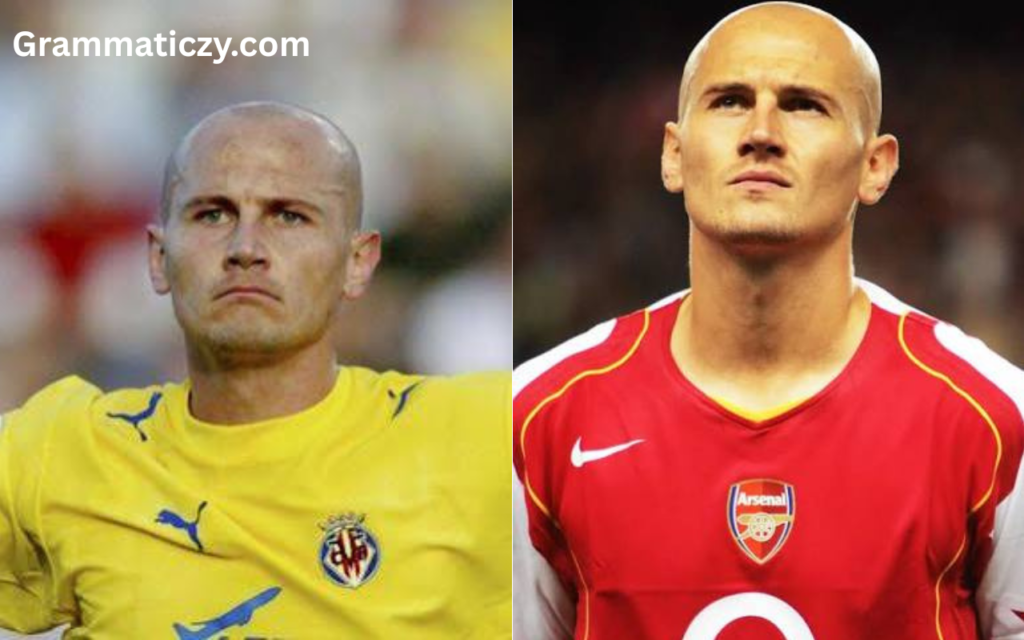
For a player who arrived at Arsenal relatively late in his career, Pascal Cygan became part of one of the most memorable periods in English football. A tall, left-footed French defender who had built his reputation patiently at Lille, Cygan moved to North London in 2002 and found himself playing alongside some of the biggest names of the Arsène Wenger era. His career was not the conventional story of a teenage wonderkid rising rapidly to international fame. Instead, it was built on persistence, tactical discipline and the willingness to keep developing long after many players might have been overlooked.
Cygan’s story is particularly interesting because his career reached its most famous chapter at Arsenal, where he became part of the squad that completed the extraordinary 2003–04 Premier League season without losing a match. He later continued his career in Spain with Villarreal and Cartagena before moving toward coaching. Today, his playing career is remembered through his years at Lille, Arsenal and Villarreal, while his post-playing path has added another dimension to his football story. Arsenal’s own historical profile describes him as a French central defender who played a significant squad role during the club’s record-breaking 2003–04 Premier League title campaign.
Pascal Cygan Facts at a Glance
| Fact | Details |
|---|---|
| Full name | Pascal Édouard Cygan |
| Date of birth | April 29, 1974 |
| Age | 52 years old in 2026 |
| Birthplace | Lens, Pas-de-Calais, France |
| Nationality | French |
| Height | Approximately 1.92–1.93 m |
| Profession | Former professional footballer; football coach |
| Playing position | Centre-back; also capable of playing left-back |
| Preferred foot | Left |
| Youth club | ES Wasquehal |
| Major clubs | Lille, Arsenal, Villarreal, Cartagena |
| Professional career | 1994/95–2011 |
| Career league appearances | 345 |
| Career league goals | 15 |
| Arsenal appearances | 63 Premier League appearances; 3 goals |
| Major honour | 2003–04 Premier League with Arsenal |
| Other Arsenal honours | 2002 and 2004 Community Shield |
| Lille honour | French Division 2, 1999–2000 |
| Family | Brother Thierry Cygan was also a professional footballer |
| Parents | His father worked for the French Mobile Gendarmerie; his mother’s publicly documented details are limited |
| Children | Public sources have reported that Cygan had two daughters during his Arsenal years |
| Estimated net worth | No reliable, independently verified public figure is available |
| No reliably verified official public account identified | |
| X/Twitter | No reliably verified official account identified |
| No reliably verified public professional account identified |
The basic biographical information is consistent across major football databases. The Premier League lists Cygan’s date of birth as April 29, 1974, while L’Équipe records him as a 52-year-old former French defender standing 1.92 metres tall.
Early Life and Family Background
Pascal Édouard Cygan was born on April 29, 1974, in Lens in northern France. His birthplace is significant because the region has a deep football culture, and Lens itself has long been associated with passionate support for the sport. Cygan grew up in an environment connected not only with football but also with a disciplined family background. According to biographical information reported about his early life, his grandparents were of Polish ancestry, while his father worked for France’s Mobile Gendarmerie. The family also lived in accommodation associated with the gendarmerie’s headquarters in Villeneuve-d’Ascq.
That background provides useful context for understanding the personality often associated with Cygan during his playing career. Professional football requires considerable discipline, but Cygan’s path was particularly different from that of modern academy prospects who are identified as elite talents from childhood. He did not immediately become a household name. Instead, he developed through regional football and gradually earned opportunities at higher levels.
Football was also a family connection. His brother Thierry Cygan became a professional footballer as well, meaning that competition, training and the demands of professional sport were not unfamiliar subjects within the family. Public information about Cygan’s mother, childhood schooling and formal education is considerably more limited, so it would be misleading to fill those gaps with speculation. What is clear is that his development was shaped primarily through football rather than a highly publicized youth-career narrative.
Beginning of His Football Career at Wasquehal
Cygan’s professional journey began with ES Wasquehal. Unlike many famous defenders who enter a major club’s academy at a very young age, Cygan’s route to elite football was gradual. His early years helped him develop the physical and tactical qualities that would eventually make him attractive to Lille.
His first professional spell at Wasquehal came during the 1994–95 period. He subsequently moved to Lille in 1995, beginning what would become the most important developmental chapter of his early career. Lille provided the platform for Cygan to establish himself as a serious professional defender and eventually attract attention outside France.
The move was important because Cygan was not simply being judged on physical strength. He developed a reputation as a composed defender who could operate in central defence while also offering versatility on the left. At roughly 1.92 metres tall, his height made him valuable in aerial situations, while his left-footed profile gave managers additional tactical flexibility. Transfermarkt records central defence as his primary position and left-back as his secondary role.
Rise to Prominence With Lille
Cygan spent seven seasons with Lille, from 1995 to 2002, and accumulated 179 league appearances and 10 league goals. Those numbers tell only part of the story. His importance increased as Lille developed into a stronger French side, and he became closely associated with the club during the era of coach Vahid Halilhodžić. His consistency eventually transformed him from a relatively unknown defender into one of the more respected centre-backs in French domestic football.
One of the defining moments came in the 1999–2000 campaign, when Lille won the French Division 2 title. Promotion provided the club with a platform for greater ambition, and Cygan was increasingly trusted at the highest level of French football. His performances over the following seasons helped Lille establish itself as a competitive team rather than simply a newly promoted side.
By the beginning of the 2000s, Cygan’s reputation had grown considerably. He was reportedly recognised with the Étoile d’Or distinction as the leading player in France’s top division for the 2001–02 season, a remarkable achievement for a defender who had taken such a long route to the top. Contemporary reports surrounding his transfer to Arsenal also described him as a player who had impressed in the Champions League.
That European experience mattered. Arsenal manager Arsène Wenger was looking for defensive depth during a period when the club was dealing with major changes in its back line. Cygan’s performances for Lille convinced Wenger that the French defender could handle a higher level of competition.
The Move to Arsenal
In July 2002, Pascal Cygan joined Arsenal on a four-year contract. UEFA reported that the transfer was estimated at around €3 million, while contemporary British reports placed the fee at approximately £2.1 million.
The timing of the transfer was significant. Arsenal were the reigning English champions, and Cygan arrived at Highbury during a transitional moment for the club’s defence. Veteran captain Tony Adams was nearing retirement, while Lee Dixon had already departed. Cygan therefore joined a squad containing enormous expectations and world-class players.
Wenger spoke highly of the signing, describing Cygan as a defender with the ability to compete at the highest level and pointing to his Champions League performances with Lille. Contemporary reports also noted that Cygan had been voted player of the year in France’s top division before making the move.
His Arsenal debut came in September 2002 in a 1–1 Premier League draw against Chelsea. Over four seasons, he made 63 Premier League appearances and scored three goals. Across all competitions, Arsenal’s historical records credit him with 98 appearances and three goals.
Pascal Cygan and the Arsenal Invincibles
The most important achievement of Cygan’s career came during Arsenal’s extraordinary 2003–04 campaign. Arsenal went through the entire Premier League season unbeaten, becoming known as the “Invincibles.” Cygan was not the first-choice star of that legendary side, but he was an important squad member and made 18 league appearances during the title-winning season.
That distinction matters when evaluating his Arsenal career. Cygan was sometimes remembered by supporters for mistakes or difficult individual performances, but judging him only through those moments overlooks his actual contribution. Arsenal needed reliable squad players capable of stepping into a demanding team, and Cygan fulfilled that role during one of the greatest seasons in English football history.
He also won the Community Shield with Arsenal in 2002 and again in 2004. The Premier League’s historical records confirm his Arsenal career and appearances, while Arsenal’s own archive specifically identifies his contribution to the club’s 2003–04 title campaign.
Cygan’s most memorable goals for Arsenal came in unusual circumstances. In August 2005, he scored twice against Fulham in a 4–1 victory at Highbury. Arsenal’s official history notes that he scored three Premier League goals in total.
His ability to fill in at left-back was another useful quality. Injuries to Ashley Cole and Gaël Clichy during the 2005–06 season created a need for defensive versatility, and Cygan was deployed in a wider defensive role. His adaptability helped extend his usefulness to the squad even when competition for central-defensive positions was intense.
Arsenal Reputation and Public Perception
Cygan’s Arsenal years demonstrate how reputation can sometimes become detached from the full statistical record of a player’s career. Among some supporters, his name became associated with defensive mistakes and an old terrace chant. Modern online discussions still revisit his Arsenal performances, with opinions ranging from harsh criticism to recognition that he was a useful squad defender during a highly successful period.
A more balanced assessment is that Cygan was never intended to be the defining defensive superstar of the Arsenal side. Wenger signed him as experienced defensive cover at a relatively modest transfer fee. He ultimately played almost 100 competitive matches for the club, won the Premier League and two Community Shields, and was part of the Invincibles squad.
That makes his Arsenal legacy more nuanced than either extreme. He was neither the defensive centerpiece of the team nor an irrelevant player. His contribution was that of an experienced professional who provided depth during a period in which Arsenal competed simultaneously in domestic and European football.
Villarreal and Spanish Football
After four seasons in England, Cygan moved to Villarreal in 2006, following Robert Pirès to Spain. His transfer fee was reported at approximately £2 million.
Villarreal represented a different challenge. La Liga demanded tactical awareness, technical quality and composure in possession, particularly from defenders involved in building play from the back. Cygan adapted to Spanish football and made 46 league appearances for Villarreal between 2006 and 2009, scoring twice. His total competitive appearances for the club were higher when cup and European matches are included.
His time at Villarreal also extended his exposure to European competition. He remained an experienced defensive option for a club that had established itself as an ambitious force in Spanish football.
Although his Villarreal period did not produce the same famous trophy as his Arsenal years, it was an important continuation of his career. Moving to another major European league in his early thirties demonstrated that his value extended beyond English football.
Final Playing Years at Cartagena
In 2009, Cygan joined FC Cartagena, then competing in Spain’s Segunda División. He spent the final two seasons of his professional playing career there, making 57 league appearances without scoring.
His final years at Cartagena are important because they show that Cygan remained committed to competitive football well beyond his most visible Arsenal period. Rather than ending his career immediately after leaving Villarreal, he continued playing regularly and accumulated significant match experience in Spain’s second tier.
Cygan retired from professional football in 2011. Across his league career with Lille, Arsenal, Villarreal and Cartagena, he accumulated 345 appearances and 15 goals. Including cup and European matches, his overall competitive appearance total was approximately 414.
International Career and France
One of the interesting aspects of Pascal Cygan’s career is that, despite becoming a prominent defender at Lille, Arsenal and Villarreal, he did not establish a senior France national-team career comparable with some of his contemporaries.
The timing was particularly difficult. French football possessed an extraordinary generation of defenders and midfielders during Cygan’s peak years. Breaking into the national team required competing with established international stars, and his career remained primarily a club-football story.
This is an important reminder that international recognition is not the only measure of a footballer’s quality. Cygan won a major European domestic title with Arsenal, established himself across three major football countries and played more than 400 competitive matches at club level when all competitions are considered.
Life After Professional Football
Retirement from professional football did not mean leaving the sport altogether. Cygan subsequently moved toward coaching and football management. Transfermarkt currently lists his last managerial position as CS Avion, reflecting his transition from player to coach.
That transition makes natural sense given the experience he accumulated over a 17-year professional playing career. Cygan worked under managers including Vahid Halilhodžić and Arsène Wenger and played in Ligue 1, the Premier League, La Liga, European competitions and Spain’s Segunda División. Those experiences gave him an unusually broad understanding of different football cultures and tactical systems.
There is comparatively little reliable public information about his current coaching activities or a large-scale managerial project in 2026. Consequently, claims about a specific current club, coaching ambition or future appointment should be treated cautiously unless confirmed by an official club or credible football source.
Pascal Cygan’s Family and Personal Life
Cygan has generally maintained a lower public profile than many former Premier League players. During his Arsenal years, reports described him as married and the father of two young daughters. His family life, however, has not been extensively documented in mainstream football sources, and he has largely avoided turning private family matters into a major part of his public identity.
That relative privacy is worth respecting. There is plenty of verified information available about his football career, but considerably less about his everyday life, personal routines, financial arrangements or private relationships.
His family background does offer one interesting detail: his brother Thierry Cygan was also a professional footballer. That shared sporting experience adds another layer to Pascal’s story and suggests that football was a significant part of the family’s environment.
Pascal Cygan Net Worth and Income
There is no reliable, independently verified public figure for Pascal Cygan’s current net worth. Websites sometimes publish precise celebrity wealth estimates, but such numbers are generally unsupported by audited financial records, official disclosures or credible reporting.
For that reason, it is more responsible to avoid presenting an invented figure as fact.
During his professional career, Cygan’s income would have come primarily from football contracts, including his spells at Lille, Arsenal, Villarreal and Cartagena. Transfer fees should not be confused with a player’s personal earnings: the reported £2.1 million Arsenal transfer fee, for example, was money paid by Arsenal to Lille rather than a direct payment to Cygan.
His long career in top-level European football almost certainly provided substantial professional earnings, but without dependable salary information and details of investments or assets, calculating a current net worth would be speculation.
Social Media and Public Presence
Unlike many contemporary football personalities, Pascal Cygan does not appear to maintain a strongly documented public social-media presence across the major platforms. No reliably verified official Instagram, X/Twitter or LinkedIn profile was identified in the principal sources reviewed for this biography.
That is consistent with the broader public image of Cygan. He has never appeared to pursue the celebrity-influencer model that has become common among former professional footballers. His public identity remains closely tied to his football career rather than constant social-media activity.
For fans searching for Pascal Cygan online, historical Arsenal records, football databases and archived interviews are therefore generally more useful sources than unverified social-media profiles.
What Makes Pascal Cygan’s Career Significant?
Cygan’s career is significant precisely because it was not built around instant fame. He developed slowly, became a leading player at Lille, earned a move to Arsenal at the age of 28 and then contributed to one of the most extraordinary teams in Premier League history.
His career statistics show the breadth of that journey: 179 league appearances for Lille, 63 for Arsenal, 46 for Villarreal and 57 for Cartagena. Those numbers represent years of professional adaptation across different leagues and football cultures.
His story also highlights the importance of squad players. Football history often celebrates the stars who score the decisive goals or dominate headlines, but championship teams also depend on experienced players who can step into difficult situations. Cygan’s 18 league appearances during Arsenal’s unbeaten 2003–04 campaign illustrate that role.
The fact that he also transitioned toward coaching reinforces another lesson: a football career does not necessarily end when a player’s playing days are over. Experience can be transferred into another role, allowing former players to continue contributing to the sport.
Recent Perspective on Pascal Cygan
As of 2026, Pascal Cygan is 52 and is best understood as a former professional footballer whose most prominent achievements belong to his playing career. Major football databases continue to list his professional career as ending in 2011, while coaching records associate him with CS Avion.
Interest in Cygan also continues among Arsenal supporters. His name periodically resurfaces in discussions about the Invincibles era, Arsenal’s early-2000s squad and memorable cult figures from the Wenger years. Recent online discussions demonstrate that, even decades later, supporters still have strong opinions about his performances and place in Arsenal history.
That enduring interest says something about football memory. Players do not have to be global superstars to remain part of a club’s story. Sometimes a player’s importance comes from the period in which he played, the teammates around him, the trophies he helped win and the memories created along the way.
Conclusion: The Lasting Legacy of Pascal Cygan
Pascal Cygan’s football journey is a story of patience, adaptation and persistence. Born in Lens and developed through Wasquehal and Lille, he gradually built himself into an accomplished professional defender before receiving the opportunity to play for Arsenal. There, he became part of the Invincibles squad and experienced the extraordinary achievement of winning the Premier League without losing a match.
His later career in Spain showed that his ambitions extended beyond one famous chapter. Villarreal gave him another opportunity to compete in a major European league, while Cartagena provided the final stage of his playing career. After retirement, his move toward coaching demonstrated a continuing connection with the game.
Perhaps the most valuable lesson from Cygan’s career is that football success does not always follow a straight line. He was not a teenage superstar, did not become a France regular and was never the headline name at Arsenal. Yet he built a career spanning 17 years, more than 400 competitive appearances across all competitions, major domestic honours and some of the biggest clubs and leagues in Europe.
His story also reminds us that every successful team is made up of more than its biggest stars. The Invincibles are remembered for Thierry Henry, Patrick Vieira, Dennis Bergkamp, Robert Pirès and other legendary figures, but the squad also depended on players such as Cygan who provided depth, experience and professionalism.
As Pascal Cygan’s playing career becomes part of football history, his journey remains a reminder that perseverance can be just as important as early recognition. His path from northern France to Lille, Highbury, Villarreal and Cartagena shows what can happen when a player continues developing, embraces new challenges and remains committed to the sport. His legacy may not be defined by individual superstardom, but by longevity, resilience and his place in one of English football’s greatest unbeaten teams.