Noele Gordon Biography: The Extraordinary Life and Career of the Crossroads Star
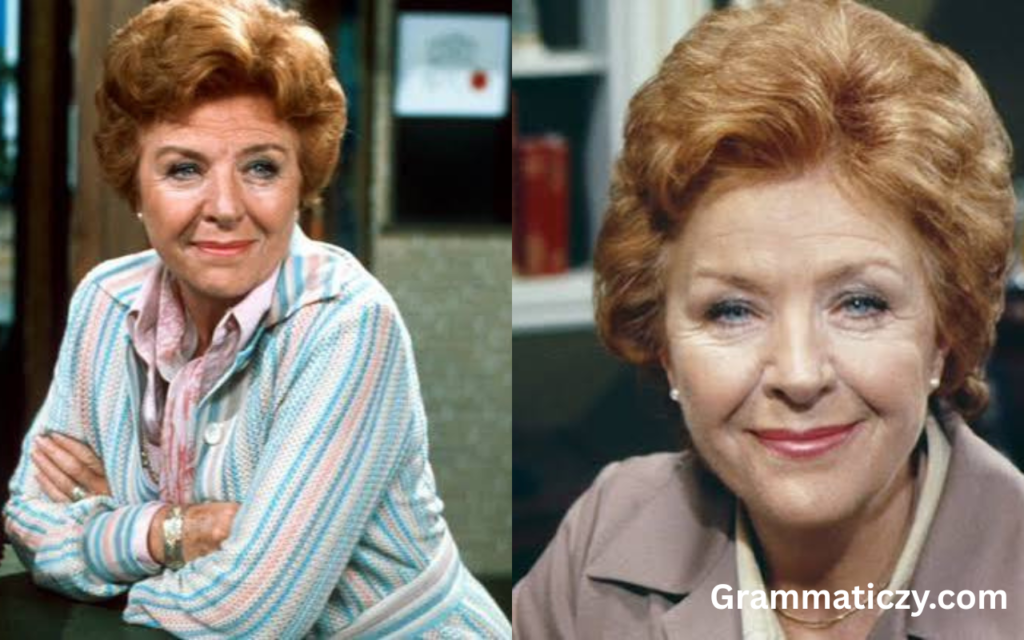
Noele Gordon’s story is one of the most fascinating chapters in British television history. Long before she became famous as Meg Richardson in Crossroads, she had already established herself as a stage actress, television presenter, producer, executive and broadcasting pioneer. She was involved with some of the earliest experiments in colour television, hosted one of ITV’s pioneering chat shows, interviewed Prime Minister Harold Macmillan and became one of the biggest television personalities in the Midlands.
Yet Gordon’s career was also marked by a dramatic fall from power. At the height of her fame, when Crossroads was attracting enormous audiences and Gordon had become known as the “Queen of the Midlands,” she was unexpectedly removed from the programme in 1981. Her dismissal generated widespread public reaction and eventually became the central subject of the 2023 ITVX drama Nolly, starring Helena Bonham Carter.
Noele Gordon Facts at a Glance
| Category | Details |
|---|---|
| Full name | Joan Noele Gordon |
| Known as | Noele Gordon / Nolly |
| Born | December 25, 1919 |
| Birthplace | East Ham, Essex, England |
| Died | April 14, 1985 |
| Age at death | 65 |
| Profession | Actress, television presenter, producer and television executive |
| Best known for | Meg Richardson/Meg Mortimer in Crossroads |
| Father | James Gordon, a Scottish engineer in the Merchant Navy |
| Mother | Joan Gordon |
| Siblings | No reliably documented siblings |
| Education | Convent schooling and Royal Academy of Dramatic Art (RADA) |
| Major programme | Crossroads |
| Earlier television success | Tea With Noele Gordon and Lunchbox |
| Major stage role | Meg Brockie in Brigadoon |
| Marital status | Never married |
| Children | None publicly documented |
| Net worth | No reliable historical figure is publicly established |
| Social media | None; Gordon died in 1985, before social media existed |
| Notable achievements | Several television firsts, including pioneering colour television appearances and interviewing Harold Macmillan |
Early Life and Family Background
Joan Noele Gordon was born on Christmas Day in 1919 in East Ham, Essex. Her unusual middle name was connected to the date of her birth, and the young girl who would eventually become one of Britain’s most recognizable television personalities showed an interest in performance remarkably early. She made her first public appearance as a toddler and later developed her abilities through dance and stage training. Her father, James Gordon, was Scottish and worked as an engineer in the Merchant Navy, while her mother was Joan Gordon.
Gordon’s childhood gave early indications that performing was not simply a passing interest. She attended a convent school in Ilford and received dance training from Maude Wells. Her family encouraged her theatrical ambitions, and she eventually moved toward professional performance. Rather than following an ordinary career path, Gordon entered an entertainment industry that demanded confidence, discipline and an ability to adapt to changing circumstances.
Her training eventually included the Royal Academy of Dramatic Art, widely known as RADA. After completing her theatrical education, she worked in regional repertory before progressing to London’s West End. These early experiences were important because they gave Gordon the foundation for the versatility that would later define her career. She was not simply an actress; she became someone who understood performance, production and the relationship between performers and audiences.
Noele Gordon and the Birth of Colour Television
One of the most extraordinary parts of Noele Gordon’s biography happened before she became a household name. During the late 1930s, she became involved with experiments by television pioneer John Logie Baird. Gordon was selected because of her distinctive appearance, including her dark hair, fair skin and blue eyes, which made her useful for experimental colour-transmission tests.
According to accounts preserved by the Noele Gordon Archive and other historical sources, Gordon travelled to Baird’s studio after theatrical performances and participated in experiments involving brightly coloured costumes, hats and make-up. These were not glamorous television appearances in the modern sense; they were technological experiments designed to discover how colours and human features would appear through an emerging television system.
Her involvement gave her a remarkable place in broadcasting history. She has been credited as the first woman to appear on colour television, making her connection with Baird far more than an interesting footnote in her career. Decades before colour television became an everyday household technology, Gordon had already stood in front of an experimental camera and contributed to the development of a medium that would eventually define her professional life.
Noele Gordon’s Theatre Career
Before television transformed her into a national celebrity, Gordon developed a substantial theatrical career. She worked in repertory and then moved into West End productions, where she demonstrated her ability to perform in musical theatre as well as more traditional dramatic settings. Her stage experience proved invaluable later because live television required many of the same skills as theatre: timing, preparation, confidence and the ability to respond immediately when something went wrong.
One of the biggest milestones came in 1949 when Gordon took the role of Meg Brockie in the original London production of Brigadoon. The production ran for hundreds of performances at Her Majesty’s Theatre before Gordon continued with the show on tour. Her success demonstrated that she could hold the attention of large audiences in major theatrical productions.
Her theatre background remained important throughout her career. Gordon later returned to the stage after leaving Crossroads, appearing in productions including Gypsy, Call Me Madam and No, No, Nanette. Even after television had made her famous, she never completely abandoned theatre, which remained one of the strongest foundations of her professional identity.
Studying Television Production in America
A particularly revealing decision came in 1954, when Gordon spent a year in New York studying television production at New York University. This was an ambitious move because television was developing rapidly in America, and Gordon wanted to understand the medium from the inside rather than simply appear in front of cameras.
Her time in the United States exposed her to American programming ideas, including the popularity of daily television drama. She returned to Britain with knowledge that would later become highly relevant to her work with ATV and Crossroads. Her approach was forward-looking: instead of treating television as an extension of theatre, she recognized that it had its own language, formats and commercial possibilities.
That understanding helped distinguish Gordon from many performers of her generation. She wanted to know how programmes were made, how schedules worked and what viewers wanted to watch. This combination of performer and producer instincts eventually helped her become one of ITV’s early female television executives, making her influence much broader than her acting credits alone suggest.
Joining ATV and Becoming a Television Pioneer
In 1955, Gordon joined Associated Television, commonly known as ATV. She presented The Weekend Show, which was associated with the launch of ATV, and also worked behind the scenes as Head of Lifestyle programming. Her dual position was unusual and significant because she was both a visible television personality and an executive involved in programming decisions.
When ATV expanded its operations into the Midlands, Gordon became a central figure in the new Birmingham-based television service. She presented Tea With Noele Gordon, a programme that became a major success. What had initially been conceived as a relatively practical scheduling solution developed into a popular programme that established Gordon as one of the most recognizable faces of regional ITV.
Gordon’s success was particularly impressive because she was operating in a period when television was still establishing its relationship with British audiences. She helped demonstrate that viewers could develop strong personal connections with presenters and television personalities. Her warmth, confidence and live broadcasting skills made her ideally suited to a medium that was becoming increasingly important in everyday British life.
Lunchbox and the Rise of the Midlands Television Star
After the success of her earlier programmes, Gordon became the face of Lunchbox, a daily live entertainment programme that became one of her greatest broadcasting achievements. The show ran for more than 2,000 episodes and featured a remarkable range of entertainment personalities. It helped transform Gordon from a respected broadcaster into a major regional television celebrity.
The programme also demonstrated her ability to manage the unpredictable nature of live broadcasting. Lunchbox combined interviews, music and entertainment, requiring Gordon to maintain momentum and audience interest while working within the limitations of live television. She was comfortable interacting with performers and guests, and her theatrical background gave the programme a strong sense of occasion.
Gordon’s television activities extended well beyond Lunchbox. She became associated with programmes including Midland Sport, Midland Profile and Midland Scene. Her work in sport was particularly notable because she has been described as Britain’s first female sports presenter. Her career was therefore helping expand the range of television roles available to women at a time when broadcasting leadership was overwhelmingly male.
Interviewing Prime Minister Harold Macmillan
Another landmark in Gordon’s broadcasting career came through her work with ATV News. She interviewed British Prime Minister Harold Macmillan and became the first woman to interview a British prime minister on British television. This was a major achievement in an era when political broadcasting was dominated by men.
The interview demonstrated that Gordon’s abilities extended beyond entertainment. She could operate in a serious journalistic environment and engage with one of the country’s most senior political figures. Her career consequently crossed boundaries between entertainment, journalism, television production and executive management.
This achievement is particularly important when considering Gordon’s wider legacy. She is often remembered primarily as the woman who played Meg in Crossroads, but her television career contained numerous pioneering accomplishments that came before the soap opera. Her work helped establish the role of women as presenters, interviewers and decision-makers in British commercial television.
The Beginning of Crossroads
In 1964, Lunchbox came to an end after more than 2,000 episodes, making way for Crossroads, a new daily serial created for ATV. Gordon was cast as Meg Richardson, a motel proprietor, in a role that had effectively been developed with her in mind. Reg Watson, one of the programme’s key creative figures, believed the character suited Gordon’s personality and theatrical experience.
The transition from television presenter to soap-opera actress was a major turning point. Gordon had already been one of the Midlands’ best-known personalities, so the challenge was to persuade viewers to see her not as “Auntie Nolly,” the familiar presenter, but as Meg Richardson, a fictional character. The transition worked remarkably well. Gordon quickly became identified with Meg and helped make Crossroads a major television phenomenon.
Meg was a strong and capable woman who ran the Crossroads Motel while navigating complicated family relationships, romances and business problems. The role allowed Gordon to combine her authority as a television personality with the emotional demands of continuing drama. Over time, Meg became one of the most recognizable characters in British soap history.
Noele Gordon’s Extraordinary Crossroads Popularity
Crossroads became an important part of British television viewing. Unlike many traditional weekly dramas, it appeared frequently and became woven into the routines of millions of viewers. Gordon was at the centre of the programme and became widely associated with the Midlands, earning the affectionate reputation of the “Queen of the Midlands.”
Her popularity was reflected in the TV Times awards. Gordon won the award for her portrayal of the programme’s compelling character on eight occasions and was subsequently placed in the TV Times Hall of Fame, making her ineligible for further wins in that category. The repeated awards were an unusually direct demonstration of her connection with viewers.
The scale of Gordon’s popularity is difficult to appreciate from a modern perspective. Contemporary television had far fewer channels, and programmes such as Crossroads could attract enormous audiences. Gordon was consequently not merely a soap actress; she was a national celebrity whose face and character were familiar to millions of people.
Noele Gordon’s Marriage Story and Personal Life
Despite her enormous public profile, Gordon’s personal life was considerably more private than her television career. She never married. She had been engaged to Captain Robertson Crichton in 1941, but the engagement ended before the wedding was due to take place.
Gordon maintained a close relationship with her mother, Joan, for many years. During part of her career, her mother lived at the family’s large home near Ross-on-Wye, and Gordon spent time there when her television commitments allowed. This relationship provides an important counterpoint to her highly public professional life.
Her private life also illustrates how much of her identity was tied to work. Gordon devoted decades to acting, presenting and television production, frequently taking on demanding professional responsibilities. She was an intensely ambitious woman in an industry that was still developing, and her willingness to work across different areas helped make her such a distinctive figure.
The Controversial Crossroads Dismissal
The most dramatic chapter of Gordon’s career came in 1981, when she was dismissed from Crossroads. The decision was controversial because Meg had become the programme’s most recognizable figure and Gordon remained enormously popular with viewers. Her departure generated strong press coverage and negative reactions from many fans.
The circumstances surrounding her dismissal have continued to attract debate. Historical accounts have described disagreements within ATV and the emerging Central Independent Television organization about the future direction of Crossroads. Some executives wanted to move toward more expensive and ambitious drama, while Gordon’s dominant presence was viewed by some as a problem.
The decision became one of the most memorable controversies in British soap history. Gordon’s supporters regarded her removal as unfair, while the television industry moved forward without her. The episode also raised broader questions about age, power, celebrity and the treatment of successful women who had accumulated substantial influence within entertainment.
Life After Crossroads
Gordon did not simply disappear after leaving the soap. She returned to the stage and continued performing. She appeared as Mama Rose in Gypsy at Leicester’s Haymarket Theatre and later performed in a revival of Call Me Madam, which moved to the West End. Her determination to continue working demonstrated that Crossroads had been one chapter of her career rather than the entirety of it.
She also remained interested in television presenting. Interviews from the period indicate that she was considering future broadcasting opportunities, including breakfast television. This is another reminder of her adaptability: even after leaving the programme that had defined her public image, she was already thinking about the next stage of her professional life.
Her final stage production was No, No, Nanette at Plymouth’s Theatre Royal. Unfortunately, Gordon became ill during the run and had to be replaced. Her career was entering its final period at the same time that serious health problems were beginning to affect her ability to work.
Illness and Death
Gordon’s illness became publicly known in 1982, when she was diagnosed with cancer. She underwent two major operations and later spent more time at her home in Birmingham. Despite her health problems, plans were eventually being developed for her return to Crossroads.
The proposed return was particularly poignant because it suggested that the story of Meg Richardson might not have been finished. Scripts had reportedly been prepared and plans were well advanced for Gordon to return to the programme in some capacity. However, her declining health prevented the comeback from taking place.
Noele Gordon died on April 14, 1985, at the age of 65, from stomach cancer. She was buried in the churchyard of St Mary’s parish church in Ross-on-Wye, beside her mother. Her death ended a career that had stretched from stage performance to pioneering television and one of Britain’s most famous soap operas.
Noele Gordon’s Net Worth and Sources of Income
There is no dependable historical record establishing an exact Noele Gordon net worth. Modern websites sometimes publish estimated figures for celebrities from previous generations, but these numbers generally lack sufficient documentary evidence. For that reason, a precise dollar or pound amount would be misleading rather than informative.
Gordon’s professional income came from a wide variety of sources over several decades. These included theatre performances, film work, television presenting, production responsibilities, executive employment with ATV and her long-running role in Crossroads. Her career was unusually diverse, which makes it difficult to reduce her financial success to a single source of income.
Her greatest legacy is therefore better measured through professional influence than speculative wealth. Gordon became one of ITV’s most important early personalities, built a long-running career and achieved popularity that few television performers of her generation could match. Her financial records may be incomplete, but her cultural impact is exceptionally well documented.
Noele Gordon’s Social Media and Online Legacy
Noele Gordon could not have had Instagram, Facebook, Twitter/X or LinkedIn accounts because she died in 1985, long before the emergence of social media. Any online profile using her name today should therefore be understood as an archive, fan page, historical resource or modern tribute rather than an account personally operated by Gordon.
Her legacy has instead survived through television archives, fan organizations, historical articles and preserved episodes of Crossroads. The Noele Gordon Archive has played an important role in keeping information about her career accessible, including material relating to Lunchbox and her television work.
Interestingly, the digital age has also introduced Gordon to audiences who were not alive during her period of greatest fame. Clips, archive material and modern television retrospectives have allowed younger viewers to discover why she was once such a major British celebrity.
Nolly and the Return of Noele Gordon
Gordon’s story received a remarkable modern revival through Nolly, the three-part ITVX drama starring Helena Bonham Carter. Written by Russell T Davies, the drama focused particularly on Gordon’s time on Crossroads and the circumstances surrounding her controversial dismissal.
The production was important because it challenged the idea that Gordon should be remembered merely as a difficult television personality. Davies became interested in the gap between the powerful woman described in old stories and the more complex person revealed through research and conversations with people who had known her.
The renewed attention also demonstrated the continuing power of Gordon’s story. More than three decades after her death, her career was being examined through modern television drama. Her experiences with fame, workplace power and public perception suddenly became relevant to a new generation.
The Lasting Legacy of Noele Gordon
Noele Gordon’s legacy rests on far more than Meg Richardson. She was involved in pioneering colour television, helped establish ITV broadcasting, became a female television executive, hosted major entertainment programmes, presented sport and interviewed a British prime minister. She also became the first woman to host the Royal Variety Performance, adding another landmark to an already remarkable career.
Her contribution to Crossroads remains particularly significant. The programme became a cultural institution, while Gordon’s Meg Richardson became its emotional centre. More than 10,000 fans reportedly gathered to watch the character’s fictional wedding, demonstrating just how deeply audiences had connected with Gordon and the world of Crossroads.
Her story also offers a broader lesson about women in television. Gordon entered broadcasting when women had considerably fewer opportunities to exercise creative and executive authority. Instead of limiting herself to one role, she moved between acting, presenting, producing and management. Her career shows what can happen when talent is combined with confidence, curiosity and a willingness to take risks.
Conclusion: Why Noele Gordon Still Matters
Noele Gordon’s life was extraordinary because it crossed so many boundaries. She began as a child performer, trained as an actress, succeeded in the West End, participated in pioneering colour television experiments, became a television executive and presenter, interviewed a prime minister and eventually became the beloved face of one of Britain’s most famous soaps.
Her career was not without disappointment. Her controversial dismissal from Crossroads remains one of the defining moments of her story, but it should not overshadow everything that came before or after it. Gordon continued performing, remained interested in television and was preparing for another professional chapter when illness intervened.
Today, Noele Gordon is remembered as one of the pioneering women of British television. Her journey demonstrates that careers are built through reinvention, courage and persistence rather than through one moment of success. From the earliest days of television technology to the enormous popularity of Crossroads and the modern rediscovery of her story through Nolly, Gordon’s influence has proved remarkably durable. Her life remains a powerful reminder that passion can open doors, resilience can survive setbacks, and a person who helps shape an industry can leave a legacy that continues long after the cameras stop rolling.