Liza Todd has lived a life that seems almost impossible to separate from Hollywood history, yet her own story has unfolded far away from the conventional world of celebrity. Born Elizabeth Frances Todd on August 6, 1957, she is the only child of legendary actress Elizabeth Taylor and theatrical producer Mike Todd. Her father died in a plane crash when she was still an infant, while her mother went on to become one of the most famous actresses and cultural icons of the twentieth century. Despite growing up surrounded by extraordinary fame, Liza eventually chose a very different path, establishing herself as a professional sculptor with a particular talent for equestrian and animal art.
What makes Liza Todd particularly interesting is that her identity has never depended entirely on her famous surname. She grew up with an unusual mixture of privilege, family upheaval and relentless public attention, but as an adult she deliberately developed a quieter life centered around art, animals and family. Her professional name, Liza Todd-Tivey, became associated with finely observed bronze sculptures of horses, dogs and wildlife. Over the years, her work has been exhibited in the United States and Europe, placed in private collections and commissioned by prominent horse farms and institutions.
Her career also reveals an important evolution. What began as a childhood fascination with horses eventually became a sophisticated artistic discipline, and her interests later expanded into wildlife conservation. Since 2016, her official biography says, much of her work has focused on benefiting African wildlife, particularly orphaned elephants protected by HERD, South Africa’s first elephant orphanage. This combination of artistic achievement, animal advocacy and deliberate privacy gives Liza Todd a story that reaches well beyond the familiar headline of being Elizabeth Taylor’s daughter.
Liza Todd at a Glance
Liza Todd was born in New York in 1957 and is known professionally as Liza Todd-Tivey. She is an American sculptor specializing in equestrian and animal sculpture, and her career has been closely connected to bronze as a medium. Her official biography explains that her involvement with horses began during childhood in England and Switzerland before she pursued formal art training in London and Los Angeles.
Her family background is extraordinary. Her mother was Elizabeth Taylor, one of the most celebrated actresses in Hollywood history, while her father was Mike Todd, the producer whose relationship with Taylor became one of the great stories of the era. Taylor’s official biography confirms the birth of Elizabeth Frances Todd in 1957 and Mike Todd’s subsequent death in a plane crash.
Although public interest naturally follows her family connection, Liza’s professional biography stands on its own. Artsy describes her as an American artist born in 1957 and identifies her work with equestrian sculpture and animal subjects. Her official website currently organizes her work into categories including elephants, equine sculpture, canine sculpture, other animals, portraits, drawings and monuments.
Early Life and a Remarkable Family Background
Liza Todd entered the world at a moment when her mother’s fame was already enormous. Elizabeth Taylor and Mike Todd married in February 1957, and their daughter was born later that year. Tragically, Mike Todd died in March 1958 when his private aircraft crashed in New Mexico. Liza was less than a year old, meaning that one of the defining facts of her childhood was the absence of her biological father.
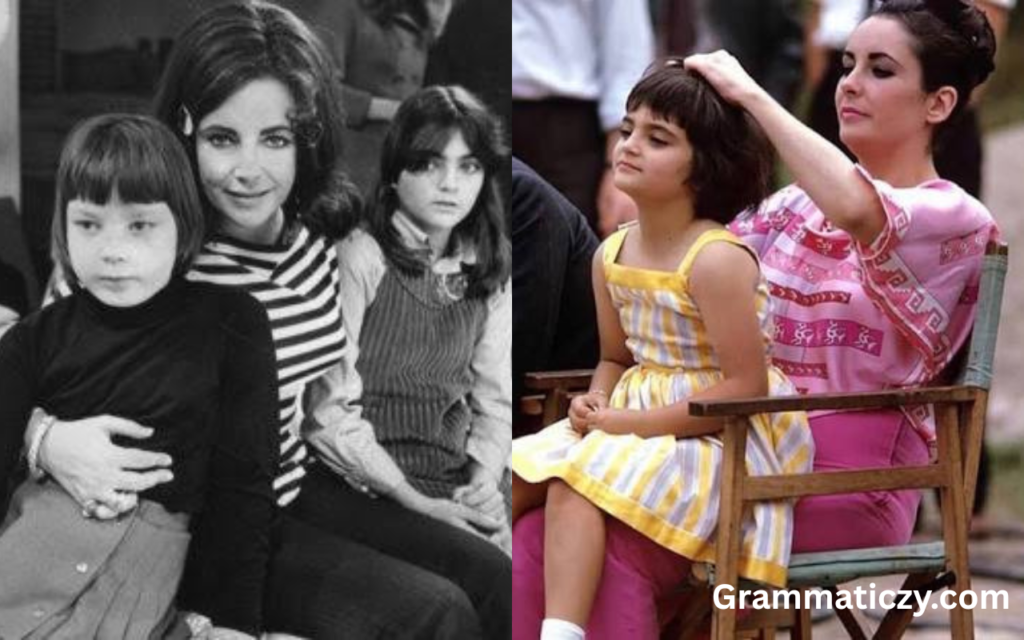
Her childhood subsequently unfolded within an extraordinary blended family. Elizabeth Taylor had children from other relationships, and Liza grew up alongside Michael Wilding Jr., Christopher Wilding and Maria Burton. Taylor later became closely associated with Richard Burton, who helped raise Liza and adopted her, adding another layer to a family already surrounded by enormous public fascination. Recent coverage of Taylor’s children continues to identify Liza as one of the actress’s four children.
Growing up as Elizabeth Taylor’s daughter meant that privacy was difficult to achieve. The romance between Taylor and Richard Burton generated intense international attention, and the family’s movements were frequently of interest to newspapers and magazines. Yet biographical accounts of Liza’s adult life suggest that she responded to that environment by choosing the opposite direction. Rather than making celebrity the center of her identity, she pursued a life connected to animals, rural surroundings and creative work.
Education and Her Early Love of Horses
Horses were not simply a subject Liza discovered after becoming a professional artist. Her official biography says that her understanding, knowledge and involvement with horses began during childhood in England and Switzerland. That early exposure became the foundation for an artistic career that would eventually make her one of the better-known sculptors working in the specialized field of equestrian art.
She later studied at Hornsey College of Art in London and continued her education at the Art Institute in Los Angeles, with archived biographies identifying the Los Angeles institution as the Otis Institute. After completing her studies in 1979, she began her professional career as a sculptor, initially creating bronze editions of famous racehorses for The Newmarket Gallery.
This educational path was important because sculpting a horse convincingly requires considerably more than artistic enthusiasm. An accomplished equestrian sculptor needs to understand skeletal structure, musculature, balance, posture and movement. Liza’s long experience around horses gave her an advantage that could not be gained solely from photographs or conventional studio exercises. Her later recognition for anatomical accuracy suggests that her childhood passion eventually became a serious technical skill.
Building a Career as an Equestrian Sculptor
After completing her formal studies, Liza Todd began establishing herself professionally through bronze sculpture. Her work quickly became associated with thoroughbred racing, a world where the physical characteristics and individual identities of famous horses matter enormously. Her official biography lists private commissions involving celebrated racehorses such as Northern Dancer, Seattle Slew, John Henry and Secretariat.
One particularly notable commission was a half-life-size memorial of Nashua for Spendthrift Farm. The work illustrates the type of subject that made Liza’s career distinctive: she was not merely sculpting generic horses, but creating works connected to animals with established histories and reputations in racing. The connection between sculpture and equestrian heritage gave her work a specialized audience of breeders, owners, collectors and racing enthusiasts.
Her reputation eventually reached beyond individual commissions. Artsy notes that she became recognized for equestrian sculpture and that her work was highly exhibited and sought after. Her official biography also records recognition from English racing historian John Farley, who included Liza alongside John Skeaping as one of only two modern sculptors from a 45-year period represented in his book Great Racehorses in Art.
Artistic Recognition and Understanding of Horse Anatomy
One of the strongest themes in Liza Todd’s career is her understanding of horse anatomy. Her official biography says her knowledge of the subject has been compared with that of master artist George Stubbs, whose detailed depictions of horses became influential in the history of animal art. Such a comparison is significant because Stubbs is renowned for combining artistic observation with an unusually precise understanding of equine anatomy.
Liza’s achievement therefore lies not simply in producing attractive bronze objects. Her sculptures depend on observation and structural knowledge. A horse’s character can change dramatically depending on the position of its head, the tension of its muscles, the placement of its legs and the rhythm implied by its movement. Translating those details into three-dimensional sculpture requires both artistic sensitivity and anatomical discipline.
This is also why her work has remained relevant within the specialized equestrian-art market. Artsy identifies her as an artist whose works have been exhibited extensively and sought after, while her official site continues to showcase equine pieces alongside wildlife, canine and portrait work. Her career demonstrates how specialization can become a strength when it is supported by deep knowledge and genuine passion.
“Rosie” and the Gstaad Commission
Liza’s artistic interests have never been limited exclusively to racehorses. In 1999, the Swiss village of Gstaad commissioned her to create a life-size bronze calf for its town square. Her official biography identifies the sculpture as “Rosie” and notes that it became a beloved tourist attraction in the village.
The Gstaad project is revealing because it demonstrates Liza’s ability to take the same principles of animal sculpture and apply them to a different species. A cow may not possess the glamour associated with a champion thoroughbred, but capturing its body, weight and personality presents its own artistic challenges. The result became part of the local environment rather than existing only as an object in a private collection.
“Rosie” also helped broaden the public dimension of Liza’s work. While equestrian sculpture naturally appeals to a specialized community, a life-size animal monument placed in a town square can engage a much wider audience. It shows how animal art can become part of public life and cultural identity rather than remaining confined to galleries and collectors.
The 9/11 Rescue Dog Sculpture
One of Liza Todd’s most emotionally significant works came after the September 11 attacks. In response to the tragedy, she created a life-size sculpture of a rescue dog descending onto a base incorporating actual rubble from the World Trade Center. The work connected her longstanding knowledge of animals with one of the most painful events in modern American history.
According to her official biography, the sculpture was produced as an edition of two. The first entered a private collection in upstate New York, while the second was donated by Theresa Santmann to Farmingdale State University on Long Island. The sculpture stands as an artistic tribute not only to the victims of the attacks but also to the search-and-rescue animals and handlers who became symbols of courage and service.
The piece also illustrates an important dimension of Liza’s work: her animals can carry emotional meaning beyond their physical appearance. A horse can symbolize athleticism and heritage, while a rescue dog can represent loyalty, courage and hope. In this sense, her sculptures are not merely studies of anatomy. They can also become monuments to memory.
Turning Toward African Wildlife and Elephant Conservation
In the later part of her career, Liza Todd expanded her artistic focus toward African wildlife. Her official biography states that since 2016, her work has focused on benefiting African wildlife, particularly orphaned elephants cared for and protected by HERD, described by her site as the first elephant orphanage in South Africa.
Her elephant work is prominently represented on her official website. Pieces such as Head Above Water, dated 2018, and Call for Help, dated 2017, are bronze sculptures that demonstrate her continuing interest in translating animal vulnerability and strength into three-dimensional form. The existence of a dedicated elephant section on her site shows that wildlife has become a substantial part of her artistic identity rather than a temporary departure from equestrian sculpture.
This transition also gives her later career a philanthropic dimension. Instead of creating animal art solely for collectors, Liza has connected her creative work with wildlife protection. Her approach suggests that an artist’s subject can become a bridge between aesthetics and advocacy, using sculpture to encourage people to think about endangered animals and the organizations working to protect them.
Her Relationship With Elizabeth Taylor
For obvious reasons, Liza Todd’s relationship with her mother remains one of the most frequently discussed aspects of her biography. Elizabeth Taylor’s fame was extraordinary, spanning decades of Hollywood history and producing an enormous cultural legacy. Yet recent coverage of Taylor’s children emphasizes that the actress considered her four children among her greatest personal achievements.
Liza’s relationship with her mother was therefore more complicated and meaningful than a simple celebrity-family connection. She grew up around Taylor’s enormous fame but ultimately made choices that distinguished her from it. Archived biographical material describes her as someone who rarely emphasized her famous lineage and instead concentrated on her own work and family.
There were nevertheless moments when their creative worlds overlapped. An archived account reports that Liza once worked with her mother on jewelry projects and enjoyed the collaboration. That detail provides a more personal picture of their relationship: beyond the headlines and Hollywood mythology, mother and daughter could share creative interests and spend time working together.
Marriage, Children and Family Life
Liza Todd married Hap Tivey in 1984, and the marriage eventually ended in divorce in 2003. The couple had two sons, Rhys Tivey and Quinn Tivey. Her role as a mother became an important part of the quieter life she created away from Hollywood’s constant attention.
Unlike her mother, Liza has generally kept her personal life away from the center of public discussion. Archived reporting describes her as a private person living in the Hudson Valley, surrounded by animals and focused on her children and work. That portrait fits closely with the broader pattern of her adult life: her sculptures receive attention, but she has not attempted to turn herself into a conventional celebrity personality.
Her children have also remained connected to the broader Taylor family legacy. Recent People coverage identifies Quinn Tivey as someone involved with Elizabeth Taylor’s estate and foundation. This means that although Liza chose a different professional direction from her mother, the next generation continues to participate in preserving and extending aspects of Elizabeth Taylor’s cultural and philanthropic legacy.
Liza Todd’s Net Worth and Income
There is no authoritative public figure that establishes Liza Todd’s exact net worth. Online celebrity websites may publish numerical estimates, but those figures are not sufficiently documented to be treated as reliable financial facts. A responsible biography should therefore describe her net worth as undisclosed rather than present speculation as certainty.
Her professional income has most plausibly been connected to her work as a sculptor, including private commissions, gallery representation, limited-edition bronze works and other artistic projects. Her official biography confirms that her pieces have entered private collections, been displayed at horse farms and been exhibited in galleries throughout the United States and Europe.
The economics of sculpture can also vary widely. A commissioned monumental work, a limited-edition bronze and a smaller gallery piece can have very different prices. One published example from POLO Magazine listed a limited-edition Todd-Tivey bronze at $14,000, but a single listed work cannot be used to calculate an artist’s total wealth or annual income.
Social Media and Public Presence
Liza Todd has never cultivated the kind of highly visible social-media presence associated with modern entertainment celebrities. Her public identity remains centered primarily on her art rather than frequent personal posts, interviews or celebrity branding. There is no reliably established verified Instagram, X/Twitter or LinkedIn profile that should be confidently presented as her official personal account.
Her official website serves as the most useful online source for understanding her current artistic work. It includes sections dedicated to elephants, equine sculpture, canine sculpture, other animals, portraits, drawings, monuments and rescue-themed projects. The site therefore functions less like a celebrity profile and more like a professional artist portfolio.
This restrained online presence is actually consistent with her broader personality as described in biographical accounts. Liza appears to have chosen a life where the work speaks louder than the individual. For an artist whose career has always existed in the shadow of an internationally famous mother, that decision may be one of the clearest expressions of independence.
Liza Todd’s Career Today
Liza Todd continues to be represented professionally through the art world, with her official biography stating that William Secord Gallery in New York City represents her work. Her portfolio remains focused on animal subjects, including horses, elephants, dogs and other wildlife.
Her current artistic direction is particularly interesting because it brings together several decades of experience. The technical foundation developed through equestrian sculpture remains visible, but her later wildlife work gives her art a broader conservation message. The elephant sculptures currently featured on her website show that African wildlife has become an important part of her creative output.
At the same time, renewed public interest in Elizabeth Taylor’s family continues to bring Liza’s name back into the cultural conversation. A 2026 People profile identifies her as a professional sculptor known for equine art and notes that she lives in upstate New York. The attention, however, remains secondary to her actual artistic career, which has developed independently over decades.
Liza Todd’s Artistic Legacy
Liza Todd’s legacy is ultimately about far more than being Elizabeth Taylor’s daughter. Her family history gave her an extraordinary beginning, but her professional identity was built through education, observation, patience and years of sculptural practice. From famous thoroughbreds to rescue dogs and African elephants, she has consistently used animals as a central language of her art.
Her career also demonstrates the power of specialization. She did not need to become a household-name celebrity to achieve recognition. Instead, she became known within the specialized world of equestrian and animal sculpture, earning inclusion in important discussions of racehorse art and developing commissions that connected her work to prominent horses, farms and institutions.
Perhaps the most inspiring part of Liza Todd’s story is the independence behind it. Born into one of Hollywood’s most famous families, she could easily have allowed her inherited identity to determine her future. Instead, she followed her own interests and created a professional life around animals and art. Her journey is a reminder that a person’s legacy does not have to imitate the achievements of their parents. It can emerge from discovering what genuinely matters to them and pursuing it with patience and purpose. As Liza Todd continues to create work inspired by horses, wildlife and conservation, her story stands as an example of how perseverance, artistic discipline and a deeply personal passion can transform a famous family name into something uniquely one’s own.