
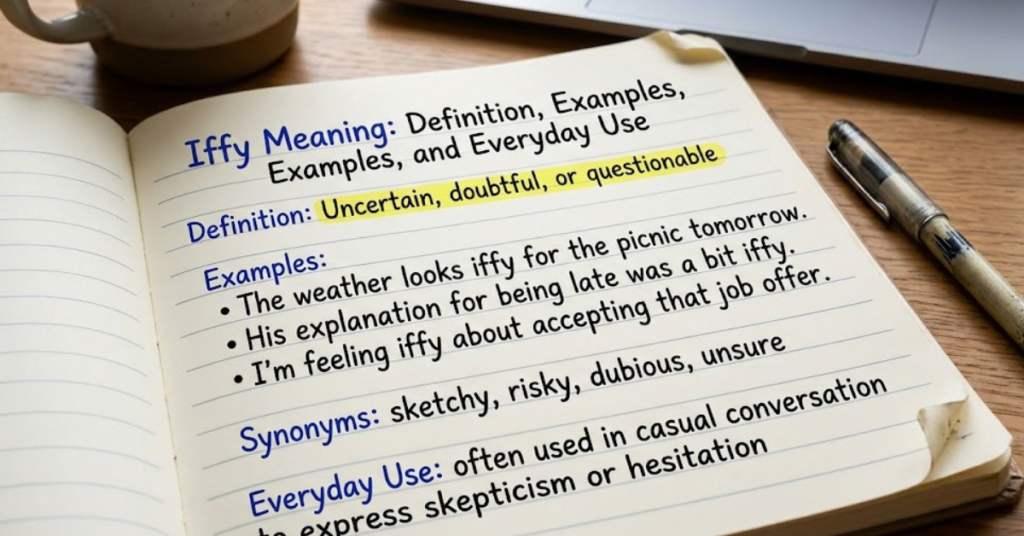
Have you ever heard someone say, “That sounds a little iffy,” and wondered what they meant? The iffy meaning is often connected to uncertainty, doubt, or something that seems questionable. It is a popular informal English word used in daily conversations to describe situations, decisions, or things that are not completely reliable or certain.
Understanding the meaning of “iffy” can help you communicate more naturally, especially when speaking with native English speakers. In this article, we’ll explore its definition, origin, examples, synonyms, and the best ways to use it.
What Is the Meaning of Iffy?
The word “iffy” is an informal adjective that describes something that is doubtful, uncertain, risky, or not entirely trustworthy.
In simple terms, if something is iffy, it may not work out as expected, or there might be a reason to be cautious about it.
Dictionary Definition of Iffy
Most dictionaries define iffy as:
- Uncertain or doubtful
- Questionable in quality or reliability
- Not very convincing or dependable
For example:
- “The weather forecast looks iffy, so we might cancel our picnic.”
- “I’m not sure about buying that old car because its condition seems iffy.”
- “His excuse for arriving late sounded a bit iffy.”
In each case, the word suggests a lack of confidence or certainty.
The Origin of the Word “Iffy”
The term iffy comes from the word “if,” which naturally relates to conditions and uncertainty. It began appearing in English slang during the early 20th century and became widely used in British and American English.
The idea behind the word is simple: when there are too many “ifs” surrounding a situation, the outcome is uncertain.
For example:
- “If the project receives funding, it will continue.”
- “If the weather improves, the event will happen.”
When there are many conditions or doubts, people may describe the situation as iffy.
How to Use Iffy in a Sentence
The word iffy is commonly used in casual conversations. It can describe people, ideas, plans, explanations, or objects.
Examples of Iffy in Everyday English
- The internet connection at the hotel was iffy.
- I’m feeling iffy about investing my money in that company.
- The restaurant had good reviews, but the service was a little iffy.
- Her story sounded iffy, so I asked more questions.
- The road conditions are iffy because of the heavy rain.
These examples show that iffy usually carries a sense of caution or hesitation.
Iffy Meaning in Different Contexts
The meaning of iffy can change slightly depending on the situation.
1. Iffy as Uncertain
It can refer to something that may or may not happen.
Example:
- “Our travel plans are still iffy because we haven’t booked the tickets.”
2. Iffy as Questionable
It can describe something that seems suspicious or not believable.
Example:
- “The information from that website seems a little iffy.”
3. Iffy as Poor Quality
It may also describe something unreliable or not functioning properly.
Example:
- “The old laptop is a bit iffy and often shuts down.”
Synonyms of Iffy
Depending on the context, several words can have a similar meaning to iffy.
Common synonyms include:
- Uncertain
- Doubtful
- Questionable
- Risky
- Unreliable
- Suspicious
- Unclear
- Shaky
- Unpredictable
- Doubtful
For example:
- “The deal seems iffy.”
- “The deal seems questionable.”
Both sentences express concern or uncertainty.
Iffy vs. Similar Words: What Is the Difference?
Many people confuse iffy with other words that express uncertainty. However, there are small differences.
| Word | Meaning |
| Iffy | Informal; uncertain or questionable |
| Doubtful | Unlikely to be true or happen |
| Risky | Involves possible danger or loss |
| Unreliable | Cannot be consistently trusted |
| Suspicious | Seems dishonest or strange |
Iffy is generally more casual and is commonly used in everyday speech rather than formal writing.
When Should You Use the Word Iffy?
Use iffy when speaking informally about situations that are not completely certain or trustworthy.
Good situations to use “iffy” include:
- Talking about uncertain plans
- Describing unreliable products
- Expressing doubt about a story or explanation
- Discussing risky decisions
Avoid using it in very formal documents, business reports, or academic writing. In those cases, words like “uncertain,” “questionable,” or “unreliable” are usually more appropriate.
Common Phrases With Iffy
English speakers often use “iffy” in these expressions:
- A bit iffy – somewhat doubtful or unreliable
- Looks iffy – appears uncertain or questionable
- Sounds iffy – does not seem believable
- Feeling iffy about something – having doubts or concerns
Examples:
- “The deal looks a bit iffy.”
- “I’m feeling iffy about making that decision.”
FAQs About Iffy Meaning
What does “iffy” mean in slang?
In slang or informal English, iffy means something is uncertain, doubtful, suspicious, or not very reliable.
Is iffy a negative word?
Not always. It generally suggests caution or uncertainty, but it does not necessarily mean something is bad. It simply means there are doubts about it.
Can you describe a person as iffy?
Yes. You can describe a person as iffy if their behavior, explanation, or reliability seems questionable.
Example:
“His reasons for missing the meeting seemed iffy.”
Is “iffy” a formal word?
No. Iffy is considered an informal word and is best used in casual conversations. Formal writing usually uses alternatives like “uncertain” or “questionable.”
What is another word for iffy?
Some common alternatives include uncertain, doubtful, unreliable, risky, and questionable.
Conclusion
The iffy meaning revolves around uncertainty, doubt, and something that may not be completely trustworthy or reliable. Whether you’re talking about an uncertain plan, a questionable explanation, or a product that doesn’t work well, iffy is a useful informal word that helps express hesitation.
Learning everyday words like “iffy” can make your English sound more natural and conversational. Keep exploring similar expressions and slang terms to improve your understanding of real-world English communication.