
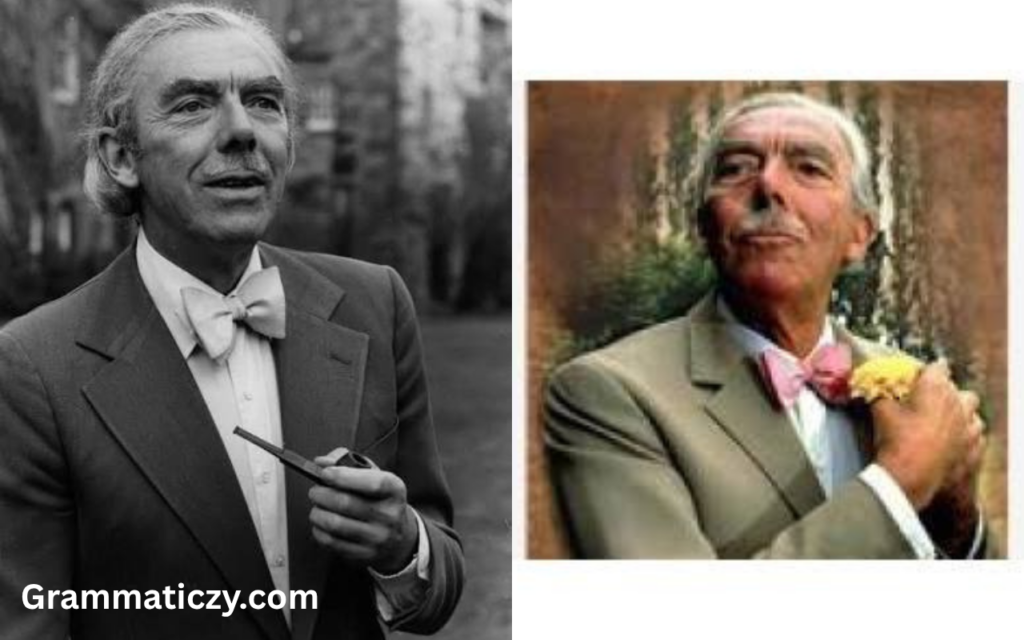
Frank Muir was the kind of entertainer whose career cannot be explained by a single profession. He was a comedy writer, broadcaster, television executive, author, editor and raconteur, but above all he was a master of language. With his tall frame, distinctive voice, colourful bow ties and remarkable ability to turn an ordinary phrase into an elaborate joke, Muir became one of the most recognisable personalities in British broadcasting. Yet his journey to national fame was far from conventional. Born in Kent in 1920, he left formal education relatively young after the death of his father, served in the Royal Air Force during the Second World War and eventually became one of the most influential comedy writers of post-war Britain.
Much of Frank Muir’s reputation was built through his extraordinary partnership with Denis Norden. Together they wrote the hugely successful BBC radio comedy Take It from Here, a programme that ran for 12 years and became an important part of British popular culture. Muir later became equally famous as a panellist on My Word! and My Music, where his literary knowledge, quick wit and outrageous puns made him a favourite with radio audiences. His career also included important executive positions at the BBC and London Weekend Television, meaning he influenced British comedy both from behind the scenes and directly in front of the microphone.
What makes Frank Muir’s story particularly interesting is the contrast between his beginnings and his eventual achievements. He did not follow an elite academic route into literature or broadcasting. Instead, he developed his extraordinary knowledge through curiosity, reading, observation and decades of professional experience. His life demonstrates how creativity can grow outside conventional pathways and how a fascination with words can become the foundation of an enduring career. Even decades after his death, his work remains part of the history of British radio comedy and television entertainment.
Frank Muir Facts at a Glance
| Category | Details |
|---|---|
| Full Name | Frank Herbert Muir |
| Born | 5 February 1920 |
| Birthplace | Ramsgate, Kent, England |
| Died | 2 January 1998 |
| Age at Death | 77 |
| Profession | Comedy writer, broadcaster, author, television executive and raconteur |
| Nationality | British |
| Father | Charles James Muir |
| Mother | Margaret Muir |
| Spouse | Polly McIrvine |
| Children | Jamie Muir and Sally Muir |
| Military Service | Royal Air Force during the Second World War |
| Best-Known Writing Partner | Denis Norden |
| Famous Programmes | Take It from Here, My Word!, My Music, Call My Bluff |
| Major Literary Work | The Oxford Book of Humorous Prose |
| Children’s Books | What-a-Mess series |
| Honour | CBE, 1980 |
| Height | Approximately 6 ft 6 in |
| Estimated Net Worth | No reliable public figure available |
| No verified personal account | |
| X/Twitter | No verified personal account |
| No verified personal account | |
| Status | Died in 1998 |
Early Life and Family Background
Frank Herbert Muir was born on 5 February 1920 in Ramsgate, Kent, although some biographical records have also described him as being born in nearby Broadstairs. He grew up in a family with practical working roots rather than the privileged literary environment that might later have been expected of a celebrated writer. His father, Charles James Muir, worked as a steam tug engineer and had New Zealand connections, while his mother was Margaret Muir. The Kent surroundings of Muir’s childhood would remain important to his identity, something that was reflected years later in the title of his autobiography, A Kentish Lad.
Muir attended Chatham House Grammar School before later attending Leyton County High School for Boys. His education was disrupted by tragedy when his father died from pneumonia while Frank was still young. The family circumstances meant that he had to leave formal schooling earlier than expected and begin working. This detail became an important part of the contrast surrounding his later career: the man who would eventually become famous for his knowledge of literature, language and social history did not receive an uninterrupted academic education.
Rather than allowing his limited formal education to define him, Muir developed an extraordinary appetite for reading and learning throughout adulthood. His later career suggests that he treated life itself as a classroom. He absorbed information about literature, history, popular culture, music and everyday behaviour and eventually transformed that knowledge into material for comedy. That intellectual curiosity became one of the qualities that separated him from many conventional comedy performers and helped create the sophisticated style for which he became famous.
Frank Muir and His Wartime Experience
The Second World War became an important stage in Muir’s development. He served with the Royal Air Force between 1939 and 1945, and during his wartime service he became involved with broadcasting for troops. His early relationship with radio therefore developed before he became a professional comedy writer. The experience introduced him to an environment in which communication, performance and entertainment had a practical purpose, helping establish a foundation for his later career.
The war years also exposed Muir to people from very different backgrounds and circumstances. This would later become valuable to a writer whose comedy depended heavily on observing personalities and understanding how people spoke. His humour was rarely based simply on a punchline. It often came from the character behind the words, the unexpected meaning of a phrase or the absurdity hidden within an apparently ordinary situation.
When the war ended, Muir did not immediately become the famous television personality audiences would later recognise. Instead, he worked his way into professional writing. He wrote material for performers such as Jimmy Edwards and gradually became established within the British comedy industry. His wartime experience had provided a doorway into broadcasting, but his writing ability was what eventually allowed him to stay there.
Frank Muir and Denis Norden
One of the most important turning points in Frank Muir’s career was his meeting with Denis Norden. The two writers were introduced through the broadcasting world and soon discovered that their contrasting but complementary talents worked exceptionally well together. Muir had a particularly strong instinct for verbal humour, while Norden brought his own sharp sense of structure, timing and comic construction. Their partnership would eventually last for decades.
Their most famous early achievement was Take It from Here. The BBC Light Programme first broadcast the series in 1948, and the programme continued for 12 years. Muir and Norden’s scripts created memorable characters and situations, including the Glums, a dysfunctional working-class family whose domestic struggles became some of the show’s best-known comedy. The series became one of the most popular radio programmes of its period.
The importance of Muir and Norden went beyond the success of one radio programme. Their partnership helped establish comedy writing as a respected creative profession in Britain. Rather than being regarded merely as people who supplied jokes for performers, the writers became recognised as creative forces in their own right. The Independent later noted that before Muir and Norden, scriptwriting was not widely regarded as a profession in the same way, and their work helped change that perception.
The Success of Take It from Here
Take It from Here became a landmark in British radio comedy because it demonstrated how much could be achieved through writing alone. Radio audiences could not see the performers, so the scripts had to create characters and environments through dialogue, sound and imagination. Muir and Norden understood this medium exceptionally well. Their writing combined everyday situations with carefully constructed jokes, wordplay and memorable characterisation.
The Glums became particularly significant because their dysfunctional family dynamics anticipated themes that would later become familiar in television sitcoms. The programme’s humour explored relationships, domestic frustrations and social behaviour through exaggerated characters. Contemporary commentators later credited Muir with helping establish important foundations for the development of the situation comedy in Britain.
The success of the series also gave Muir and Norden a professional platform from which they could experiment with other forms of comedy. They worked on additional radio and television projects, including Whack-O! and other programmes associated with Jimmy Edwards. Their collaboration demonstrated that strong comedy could move successfully between radio, television and written formats without losing its identity.
Frank Muir’s BBC Career and Television Work
Muir eventually moved beyond writing scripts and began taking on senior broadcasting responsibilities. During the 1960s he became Assistant Head of the BBC Light Entertainment Group, giving him an opportunity to influence the development of television comedy from an executive position. He was no longer simply writing jokes for established performers; he was helping determine what kinds of entertainment reached British television audiences.
His television career also brought him into contact with some of the most important comic talent of the period. Muir was associated with programmes including The Frost Report, and his influence extended into a generation of writers and performers who would go on to reshape British comedy. He was particularly respected for recognising talent and understanding the importance of strong writing behind successful performers.
Muir later became Head of Entertainment at London Weekend Television. His executive career showed that his abilities were broader than performance. He understood programming, production and the business of entertainment, while his years as a writer gave him a practical understanding of what performers and audiences needed. His career therefore moved naturally between creative work and broadcasting management.
My Word! and the Art of Storytelling
For many listeners, Frank Muir became inseparable from My Word!, the BBC radio panel programme that allowed him to display his extraordinary command of language. Rather than depending on conventional stand-up comedy, Muir entertained audiences through anecdotes, wordplay, literary references and elaborate explanations. His performance often appeared effortless, but it reflected decades of reading and an enormous store of general knowledge.
One of the defining features of Muir’s humour was his ability to build a story around a phrase. Instead of simply giving an answer, he could invent an elaborate explanation and deliver it with complete confidence. The result was often deliberately ridiculous, but the humour depended on his ability to maintain the illusion that the story might actually make sense. His famous punning style became one of his trademarks.
His work on My Word! also revealed an important aspect of his personality. Muir was not simply trying to make people laugh as quickly as possible. He enjoyed language for its own sake. He seemed fascinated by the history of words, the possibilities of double meanings and the strange connections between apparently unrelated ideas. That love of language became one of the most enduring elements of his professional identity.
My Music and Frank Muir’s Radio Legacy
Muir’s partnership with Denis Norden continued into My Music, another successful BBC radio panel show. The programme combined musical knowledge with humour and gave Muir another opportunity to demonstrate the breadth of his interests. He could move comfortably between classical music, popular songs, performers and obscure cultural references while maintaining the relaxed tone of a conversational entertainer.
Together, My Word! and My Music helped establish Muir as one of the great personalities of British radio. His voice became instantly recognisable, while his intellectual approach to humour attracted audiences who enjoyed comedy based on wit rather than spectacle. The programmes also reached audiences outside Britain through public radio distribution, demonstrating that his particular style of British humour could travel internationally.
His radio legacy is especially important because modern entertainment has become increasingly visual. Muir proved that a distinctive voice and a compelling personality could hold an audience without elaborate production or visual effects. His greatest tools were timing, knowledge, imagination and language. Those qualities remain relevant to anyone interested in the craft of comedy writing and audio storytelling.
Books and Literary Career
Frank Muir’s fascination with language eventually developed into a significant literary career. He wrote books for both adults and children and edited collections of humour. Among his best-known works was The Frank Muir Book, which explored social history through humorous anecdotes and quotations. The book reflected his tendency to treat seemingly ordinary subjects as opportunities for cultural observation and comedy.
Another major achievement was The Oxford Book of Humorous Prose. The collection represented years of reading and research and demonstrated that Muir’s interest in comedy extended far beyond his own work. He was interested in how humour had developed throughout English literature and how different writers had used language to entertain readers. His literary reputation therefore rested not only on his ability to create jokes but also on his ability to recognise and explain good humour in the work of others.
Muir also reached younger audiences through the What-a-Mess children’s books. The stories centred on an untidy Afghan hound and eventually became an animated television series. This side of his career showed that his storytelling ability was not limited to adult radio audiences. He could create memorable characters and comic situations that appealed to children while maintaining the warmth and verbal playfulness associated with his wider body of work.
Frank Muir’s Family and Personal Life
Frank Muir married Polly McIrvine in 1949, and the couple remained together until his death in 1998. They had two children, Jamie and Sally. Jamie went into television production, while Sally became an artist and later became associated with the Muir and Osborne knitwear design company.
Muir’s family life was largely kept separate from the public performance of his career. Although audiences knew his comic persona extremely well, he was not primarily a celebrity who built his reputation around revealing intimate details of his private life. Instead, the public knew him through his writing, broadcasting and distinctive personality. This separation helped preserve an element of privacy around his family.
Outside broadcasting, Muir was also interested in theatre, books, music, gardening and animals. Accounts of his life frequently describe his love of words and his enjoyment of ordinary domestic interests. That combination is revealing because his public persona could appear highly intellectual, while his interests remained grounded in everyday life and observation. His humour often came from precisely that meeting point between serious knowledge and ordinary human behaviour.
Frank Muir’s Awards and Achievements
Muir’s contribution to British entertainment was formally recognised when he was appointed a Commander of the Order of the British Empire, or CBE, in 1980. The honour recognised his contribution to broadcasting and reflected the extent to which his work had become part of British cultural life. By that point, he had already established himself as a successful writer, broadcaster and television executive.
His professional achievements were not limited to awards. His greatest accomplishment was arguably the influence he had on the craft of comedy writing. Alongside Denis Norden, he helped demonstrate that the writer behind a successful comedian could be just as important as the performer standing in front of the microphone or camera. Their work contributed to a broader professionalisation of British comedy scriptwriting.
His influence also extended through the talent he encountered during his broadcasting career. Muir was associated with a period in which British comedy was changing rapidly, and he played a role in creating opportunities for writers and performers who would become major figures. His contribution therefore belongs not only to the programmes that carry his name but also to the wider development of British television comedy.
Frank Muir’s Net Worth and Income
There is no dependable public record that establishes Frank Muir’s exact net worth when he died in 1998. Online estimates that provide a precise figure should therefore be treated cautiously. Unlike some modern celebrities, Muir did not leave behind a publicly documented financial profile that would allow a reliable calculation of his assets, investments and lifetime earnings.
His income would have come from several professional sources over a career lasting roughly five decades. These included comedy writing, radio appearances, television work, executive broadcasting positions, publishing royalties, books and children’s literature. His long-running programmes and bestselling publications clearly established him as a commercially successful creative professional, but there is not enough reliable evidence to attach a specific fortune to his name.
A more meaningful way to assess Muir’s professional success is to look at the breadth and longevity of his work. He moved from wartime broadcasting to radio comedy, television production, senior executive positions, panel shows, children’s publishing and literary anthologies. Financial figures may be uncertain, but the scale of his professional achievement is not.
Frank Muir and Social Media
Frank Muir died on 2 January 1998, more than a decade before social-media platforms such as Twitter and Instagram became major parts of popular culture. As a result, he never had personal Instagram, Facebook, LinkedIn or X accounts. Any modern account using his name should therefore be considered unofficial unless it is clearly an archival or tribute project.
In a modern context, Muir’s digital presence exists primarily through archives, recordings, books and online discussions of classic British comedy. His radio appearances continue to attract interest from people exploring the history of British broadcasting, while clips and references to My Word! and My Music help introduce his style to audiences who were born long after his death.
This is an interesting form of legacy because Muir built his career without the tools modern entertainers use to maintain a direct relationship with audiences. He did not have social media followers or a personal website. His relationship with the public was created through broadcasts, books and performances, and the continued interest in those works has allowed his reputation to survive naturally across generations.
Frank Muir’s Final Years and Death
Muir remained creatively active into his later years. His autobiography, A Kentish Lad, was published shortly before his death and offered readers a personal account of his childhood, career and experiences in broadcasting. The book was particularly valuable because it allowed Muir’s own voice and sense of humour to shape the story of his life rather than leaving his biography entirely to later commentators.
He died in his sleep at his home in Surrey on 2 January 1998, aged 77. His death came only a short time after the publication of his memoir. Denis Norden, his longtime writing partner, described him with deep affection, reflecting the unusually close relationship they had developed after decades of working together.
Muir’s death marked the end of one of the most distinctive careers in British comedy. Yet it did not end his influence. His programmes continued to be repeated, his books remained available, and his work with Norden continued to be discussed as an important chapter in the history of British comedy writing. His final years therefore became a transition rather than an ending: the working career concluded, but the cultural legacy continued.
Frank Muir’s Lasting Legacy
Frank Muir’s influence can be seen in the way British comedy treats writing, language and intelligent humour. He belonged to a generation that demonstrated that comedy could be sophisticated without becoming inaccessible. His scripts were carefully constructed, his radio performances were intellectually playful and his television career showed an understanding of both creative talent and production.
His partnership with Denis Norden remains central to that legacy. Together they produced years of radio and television comedy and helped create a model in which writers were recognised as central creative figures. Their collaboration was so long-lasting that Norden later compared the partnership to a marriage, reflecting how completely their professional lives had become intertwined.
Perhaps the most inspiring part of Muir’s story is that his greatest education was self-directed. He left formal schooling early, yet became an author, literary editor and broadcaster celebrated for his knowledge. He turned curiosity into expertise and expertise into entertainment. His life therefore offers a lesson that remains relevant long after the broadcasts themselves: success does not always follow the conventional route, and a person’s willingness to learn can matter as much as the opportunities they receive.
Conclusion
Frank Muir’s life was a remarkable journey from a Kent childhood shaped by family hardship to the highest levels of British broadcasting. He became a defining voice of post-war comedy through Take It from Here, developed a legendary partnership with Denis Norden, entertained generations through My Word! and My Music, influenced television programming as an executive and established himself as a successful author and editor. His career crossed radio, television, literature and children’s entertainment without losing the quality that made him distinctive: an extraordinary love of language.
His achievements also demonstrate why comedy writers deserve recognition alongside the performers who deliver their material. Muir understood that a great joke begins with observation, structure and language. He helped establish scriptwriting as an important creative profession and showed that intellectual curiosity could become a source of popular entertainment. His influence reached far beyond his own performances and became part of the wider history of British comedy.
Frank Muir died more than two decades ago, but the qualities that defined him have not disappeared. His wit, curiosity, storytelling ability and dedication to words continue to make his work worth revisiting. From difficult beginnings to a celebrated career, his story is ultimately a reminder that talent can emerge from unexpected places and that lifelong curiosity can become a powerful form of education. Frank Muir’s legacy is not simply that he made people laugh; it is that he proved knowledge, imagination and humour could work together to create something that outlives its creator.