
Have you ever been asked to disenroll or unenroll from a class, membership, insurance plan, or online service and wondered if there is a difference between the two terms? You’re not alone. These words often appear in educational, healthcare, and subscription-related contexts, leaving many people unsure about which one is correct.
The short answer is that both disenroll and unenroll generally mean the same thing: to remove yourself or someone else from an enrollment, registration, or membership. However, there are slight differences in preference, usage, and context that are worth understanding.
What Does Disenroll Mean?
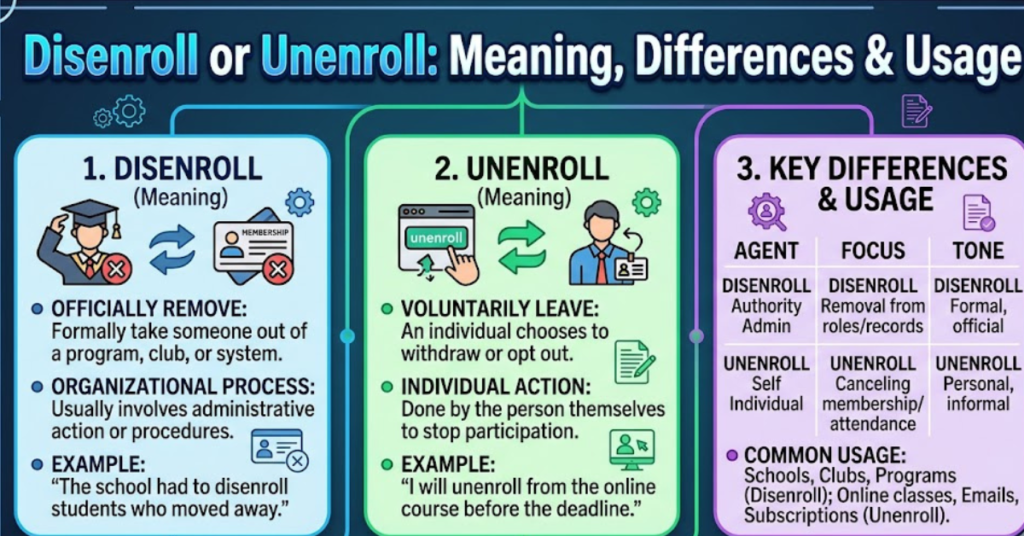
Disenroll is a verb that means to remove a person from a school, program, organization, insurance plan, or other form of enrollment.
For example:
- A student may disenroll from a college before the semester begins.
- A patient may disenroll from a healthcare plan during an allowed enrollment period.
- A member may be disenrolled from a service for failing to meet certain requirements.
The prefix “dis-“ commonly means “opposite of” or “removal,” which makes the meaning of disenroll straightforward: removing an existing enrollment.
What Does Unenroll Mean?
Unenroll has nearly the same definition as disenroll. It refers to canceling or ending a person’s participation in a course, program, or service.
Examples include:
- You can unenroll from an online course at any time.
- Parents may request to unenroll a child from a school district.
- A subscriber can unenroll from a membership program.
The prefix “un-“ also means reversal or removal, making unenroll another logical way to describe ending an enrollment.
Disenroll vs. Unenroll: Is There a Difference?
Although people often search for disenroll or unenroll as if one is right and the other is wrong, both terms are accepted in modern English. The difference mostly comes down to preference, region, and industry-specific language.
| Disenroll | Unenroll |
| More commonly used in healthcare and official institutions | Often used in online platforms and educational services |
| Frequently appears in legal or administrative documents | Sounds slightly more informal to many speakers |
| Common in terms like Medicare disenrollment | Common in digital course platforms |
In everyday conversation, most people will understand either word.
Which Is More Common: Disenroll or Unenroll?
The choice between disenroll or unenroll depends largely on the organization using the term.
Situations where “disenroll” is common:
- Health insurance and Medicare plans
- Universities and government systems
- Official administrative records
Situations where “unenroll” is common:
- Online learning platforms
- Software subscriptions
- Membership websites
- Personal account settings
If you are writing for a specific organization, it is best to follow the terminology that organization uses.
How to Disenroll or Unenroll From a Program
The process of removing yourself from an enrollment generally follows these steps:
- Review the cancellation policy to understand deadlines and possible penalties.
- Contact the organization through its official website, office, or customer support.
- Submit any required forms for withdrawal or cancellation.
- Request confirmation that your enrollment has been removed.
- Keep records of emails, documents, or reference numbers.
The exact procedure may vary depending on whether you are leaving a school, insurance plan, subscription, or another service.
Common Contexts Where Disenroll and Unenroll Are Used
Educational Programs
Students may need to disenroll or unenroll from:
- Colleges and universities
- Online classes
- Training programs
- School districts
Rules often include deadlines for tuition refunds or academic withdrawals.
Healthcare and Insurance
Healthcare providers frequently use the word disenrollment when a person leaves a health plan, changes coverage, or loses eligibility.
Examples include:
- Medicare disenrollment
- Medicaid plan changes
- Private insurance cancellations
Online Services and Memberships
Digital platforms often use unenroll when users remove themselves from:
- Online courses
- Email lists
- Membership programs
- Subscription services
Similar Words Related to Disenroll or Unenroll
You may also encounter related terms, including:
- Withdraw – to officially leave a course or program
- Cancel membership – to end a subscription or service
- Terminate enrollment – to formally stop participation
- Opt out – to choose not to participate
- Remove registration – to cancel a previous sign-up
These terms may be more appropriate depending on the situation.
Is Disenroll or Unenroll More Grammatically Correct?
From a grammar standpoint, both disenroll and unenroll are correct English words. Dictionaries recognize both forms, although certain institutions may favor one over the other.
The most important factor is consistency. If a school, healthcare provider, or company uses “disenroll” in its policies, use that term when communicating with them. If an online platform says “unenroll,” follow its wording.
FAQs About Disenroll or Unenroll
Are disenroll and unenroll the same thing?
Yes. Both words mean removing a person from a program, course, membership, or other type of enrollment. The difference is mainly a matter of usage and preference.
Is disenroll a real word?
Yes, disenroll is a recognized English word commonly used in education, healthcare, and administrative settings.
Is unenroll correct English?
Yes. Unenroll is also correct English and is frequently used by online learning platforms and digital services.
Which should I use: disenroll or unenroll?
Use the term preferred by the organization you are dealing with. If there is no preference, either word is generally acceptable.
What is the noun form of disenroll and unenroll?
The common noun forms are disenrollment and unenrollment, referring to the act or process of ending an enrollment.
Conclusion
Understanding disenroll or unenroll is simpler than it may seem. Both terms mean ending an enrollment, membership, or registration, and both are considered correct in English. The choice between them usually depends on the industry, organization, or style preference.
Whether you need to disenroll from a healthcare plan, unenroll from an online course, or cancel a membership, always check the specific rules and procedures involved. Knowing the right terminology can make the process smoother and help you communicate clearly with the organization involved.