
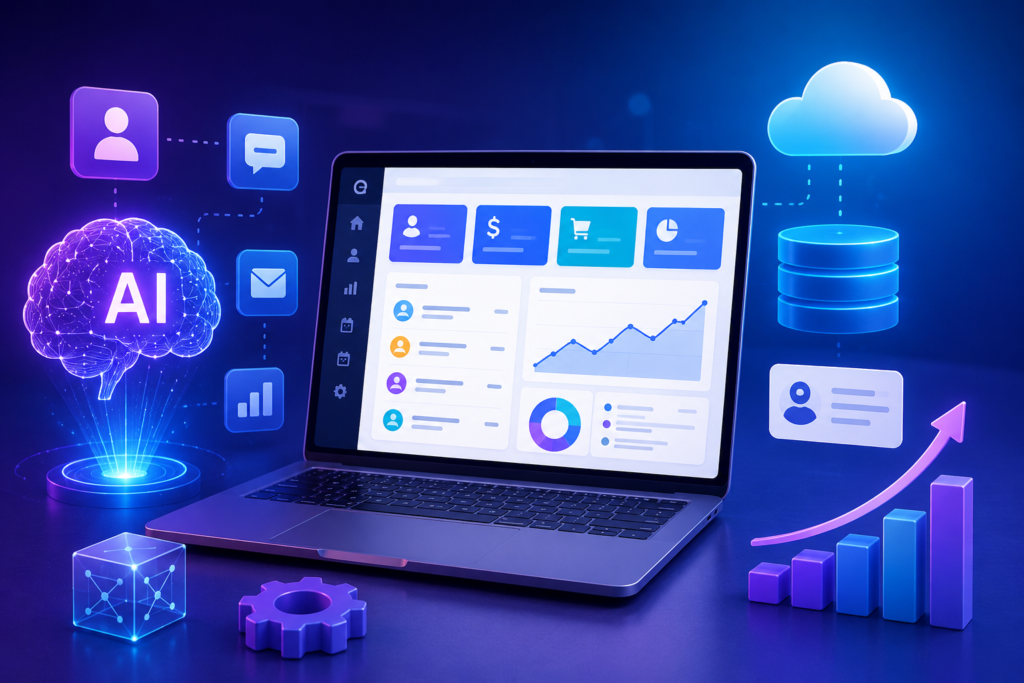
Customer relationship management has evolved far beyond storing contact information and tracking sales activities. Modern businesses increasingly want CRM platforms that can understand customer behavior, automate repetitive work, generate insights, and assist employees in real time. This is where custom Generative AI CRM development is becoming a major technology opportunity.
By combining generative AI capabilities with CRM software, businesses can create intelligent platforms that automate communication, summarize customer interactions, generate content, predict customer needs, and help sales and support teams make faster decisions.
However, developing a custom AI-powered CRM requires more than simply connecting a large language model to an existing CRM. Businesses need to consider features, AI architecture, data security, integrations, technology choices, development processes, and long-term maintenance.
This guide explains the major features, technology stack, development process, and estimated cost of building a custom Generative AI CRM.
What Is Generative AI CRM Software?
Generative AI CRM software is a customer relationship management platform enhanced with artificial intelligence models capable of understanding business data and generating useful outputs.
Traditional CRM systems primarily depend on predefined workflows, dashboards, filters, and manually entered data. A Generative AI-powered CRM can interact with users through natural language and assist with tasks such as:
- Writing personalized customer emails
- Summarizing sales calls
- Generating meeting notes
- Creating sales proposals
- Analyzing customer conversations
- Answering questions about customer accounts
- Identifying potential sales opportunities
- Generating follow-up recommendations
- Creating marketing content
- Providing AI-powered customer support
The goal is not simply to add AI as an extra feature. Instead, generative AI can become an intelligent layer across the CRM ecosystem, helping teams work with customer data more efficiently.
Why Invest in Custom Generative AI CRM Development?
Off-the-shelf CRM platforms can be useful for common sales and customer-management requirements. However, organizations with specialized workflows may need more flexibility.
Custom development allows businesses to design CRM functionality around their specific processes, data structures, user roles, and industry requirements.
Some key advantages include:
1. Business-Specific AI Workflows
A custom CRM can be trained or configured around an organization’s workflows. For example, a real estate company may require AI to summarize property inquiries, while a B2B company may need AI-generated sales proposals.
2. Improved Employee Productivity
Generative AI can automate repetitive administrative tasks. Sales representatives can generate follow-up emails, summarize calls, and retrieve customer information without manually searching through multiple CRM records.
3. Personalized Customer Experiences
AI can analyze customer history and interactions to help businesses provide more relevant recommendations and communications.
4. Better Decision-Making
AI-powered analytics can identify patterns across customer data and provide actionable insights to sales, marketing, and support teams.
5. Flexible Integrations
A custom CRM can be integrated with ERP systems, communication platforms, payment gateways, marketing tools, cloud services, business intelligence systems, and other enterprise applications.
Key Features of a Custom Generative AI CRM
The features of an AI-powered CRM depend on the organization’s requirements. However, several capabilities are becoming increasingly important.
AI Sales Assistant
An AI sales assistant can help representatives research customers, prepare for meetings, create follow-ups, and identify potential opportunities.
Employees can ask questions using natural language instead of manually navigating multiple CRM screens.
Intelligent Lead Management
Generative AI can analyze lead information, previous interactions, engagement activity, and other available data to help sales teams prioritize prospects.
The system can also generate recommendations for the next best action.
AI Email Generation
Users can provide a short instruction such as the purpose of an email and customer context. The AI can generate a professional draft that the employee can review and customize.
This can significantly reduce the time required for routine communication.
Conversation Summarization
AI can process meeting transcripts, chat conversations, and call recordings to generate concise summaries.
Important information such as customer requirements, objections, commitments, and follow-up actions can be automatically captured in CRM records.
AI-Powered Customer Support
A Generative AI CRM can support customer service teams through intelligent chatbots and agent-assistance tools.
AI can retrieve relevant customer information and knowledge-base content to help agents respond more quickly.
Customer Sentiment Analysis
AI can analyze customer communications to identify sentiment and potential dissatisfaction.
Support managers can use these insights to identify accounts that may require immediate attention.
Automated CRM Data Entry
Instead of manually entering every meeting detail, employees can use AI to convert conversations and documents into structured CRM information.
This reduces administrative work and can improve data consistency.
AI-Powered Reporting
Users can ask natural-language questions such as:
- Which leads generated the highest revenue this quarter?
- Which accounts have declining engagement?
- What are the most common customer complaints?
- Which sales opportunities need attention?
The CRM can convert relevant data into understandable answers and reports.
Technology Stack for Generative AI CRM Development
Choosing the right technology stack is critical for building a scalable and secure AI-powered CRM.
Frontend Development
Common technologies include:
- React.js
- Next.js
- Angular
- Vue.js
- Flutter for cross-platform mobile applications
The frontend should provide intuitive dashboards, AI chat interfaces, customer profiles, reporting screens, and workflow management tools.
Backend Development
Popular backend technologies include:
- Node.js
- Python
- Java
- .NET
Python is particularly useful for AI-related services because of its extensive machine learning and natural language processing ecosystem.
AI and Machine Learning
The AI layer may include:
- Large language models
- Natural language processing
- Machine learning models
- Retrieval-Augmented Generation (RAG)
- Embedding models
- Vector databases
- AI agents
- Speech-to-text systems
Businesses can use third-party foundation models or deploy customized models depending on their data, security, and performance requirements.
Databases
CRM systems commonly use relational databases such as PostgreSQL or MySQL for structured customer information.
For AI applications, vector databases can be added to store embeddings and support semantic search across documents and customer-related knowledge.
Cloud Infrastructure
Cloud platforms such as AWS, Microsoft Azure, or Google Cloud can provide infrastructure for application hosting, databases, AI services, storage, security, monitoring, and scalability.
APIs and Integrations
APIs are essential for connecting the CRM with:
- Email platforms
- Calendars
- Communication tools
- Payment systems
- Marketing automation platforms
- ERP systems
- Customer support software
- Analytics platforms
Custom Generative AI CRM Development Process
Building an intelligent CRM typically involves several stages.
Step 1: Requirement Analysis
The development team identifies business objectives, user roles, workflows, existing software, customer-data sources, and AI requirements.
Step 2: UI/UX Design
Designers create interfaces for dashboards, customer profiles, AI assistants, reports, automation workflows, and administrative controls.
Step 3: CRM Architecture
Developers define the application architecture, database structure, APIs, AI services, security model, and integration framework.
Step 4: AI Model Integration
The selected AI models are integrated into relevant CRM workflows. RAG can be implemented when the AI needs to retrieve information from proprietary company data.
Step 5: CRM Development
Core modules such as lead management, customer profiles, sales pipelines, communication management, reporting, and user administration are developed.
Step 6: Testing
The system should undergo functional, security, performance, integration, and AI-response testing.
AI outputs should also be evaluated for accuracy, relevance, privacy, and reliability.
Step 7: Deployment
After testing, the CRM is deployed to the selected cloud or enterprise environment.
Step 8: Maintenance and Optimization
AI models, integrations, security policies, prompts, knowledge sources, and application components require ongoing monitoring and optimization.
How Much Does Custom Generative AI CRM Development Cost?
The cost of developing a custom Generative AI CRM can vary significantly based on project complexity.
A basic AI-enhanced CRM may cost approximately $30,000–$60,000, while a medium-complexity platform can range from $60,000–$120,000. Advanced enterprise CRM solutions with multiple AI agents, extensive integrations, custom AI models, advanced analytics, and high-level security can exceed $150,000.
Typical factors affecting development costs include:
| Factor | Impact on Cost |
| CRM complexity | High |
| Number of AI features | High |
| AI model integration | Medium–High |
| Custom model development | Very High |
| Third-party integrations | Medium–High |
| Web and mobile applications | High |
| Data migration | Medium–High |
| Security requirements | High |
| Analytics and reporting | Medium |
| Cloud infrastructure | Ongoing |
| Maintenance | Ongoing |
AI API usage, cloud infrastructure, vector databases, data storage, monitoring, and model optimization may also create recurring operational expenses.
Therefore, businesses should evaluate both initial development costs and long-term AI infrastructure expenses.
How to Choose a Generative AI Software Development Company
Selecting the right development partner can strongly influence the success of an AI CRM project.
Businesses should evaluate a Generative AI development Company based on its experience with AI applications, CRM platforms, APIs, cloud technologies, data security, and enterprise integrations.
Before selecting a vendor, consider:
- Previous AI and CRM projects
- Technical expertise
- AI model integration experience
- Security practices
- Development methodology
- Portfolio and client reviews
- Post-launch support
- Scalability capabilities
- Communication and project management
A reliable development partner should also be able to explain why a particular AI model, architecture, or technology is appropriate for the business rather than simply recommending AI because it is currently popular.
Similarly, working with an experienced CRM Software Development company can help organizations create a CRM architecture that supports current requirements while remaining flexible for future AI capabilities.
Future of Generative AI in CRM
Generative AI is likely to become increasingly integrated into CRM workflows. Future systems may rely more heavily on autonomous AI agents capable of coordinating tasks across sales, marketing, customer service, and business operations.
Instead of simply showing information, CRM platforms could proactively recommend actions, identify risks, prepare communications, and automate multi-step workflows.
However, successful adoption will depend on data quality, responsible AI implementation, privacy controls, human oversight, and reliable system architecture.
Conclusion
Custom Generative AI CRM development can transform a conventional customer-management platform into an intelligent business system. From AI sales assistants and automated data entry to personalized communication, conversation summaries, and intelligent analytics, generative AI can improve how organizations manage customer relationships.
The development cost depends on the CRM’s complexity, AI capabilities, integrations, security requirements, technology stack, and infrastructure needs. Businesses should therefore define their use cases and technical requirements before estimating the overall budget.
With the right strategy and an experienced development partner, organizations can build a scalable Generative AI CRM that not only automates routine processes but also helps employees make faster, more informed customer-related decisions.