
There are some lives that unfold under the spotlight, while others become memorable precisely because they remain largely outside it. Ann Donoghue belongs to the second category. Best known as the longtime wife of British entertainer Tommy Steele, she has spent more than six decades connected to one of the most important figures in the history of British popular entertainment. Yet Ann has never attempted to turn that connection into a celebrity career of her own. Her story is quieter, more private and, in many ways, more intriguing because of it.
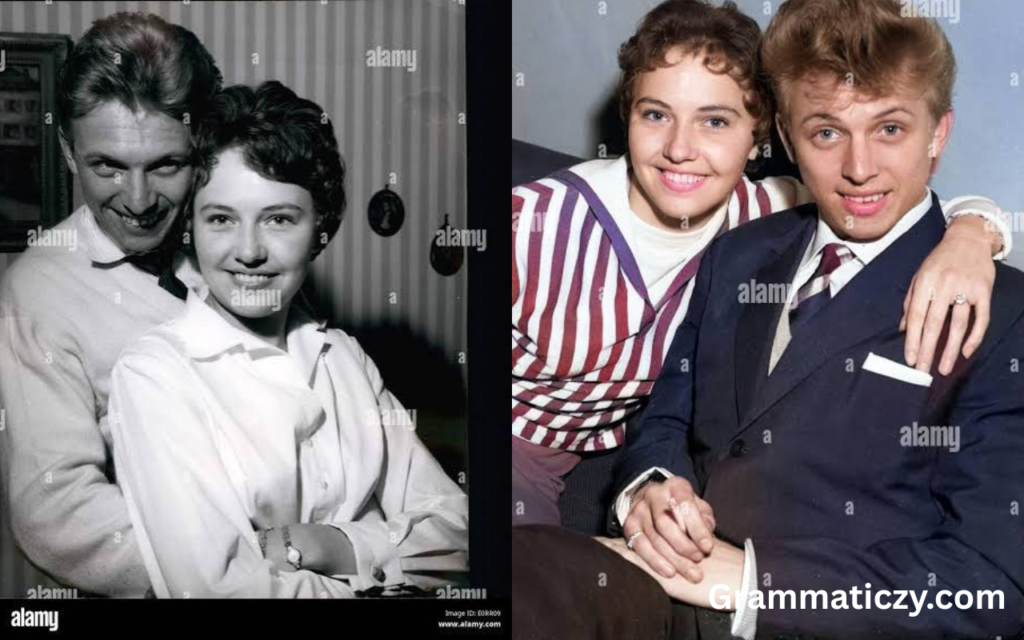
Ann Donoghue was already connected with the entertainment world before her marriage. She is described in biographical sources as a dancer and former Windmill girl, placing her within London’s famous post-war variety and theatre culture. Her relationship with Tommy Steele began while his career was rapidly gathering momentum, and their marriage in 1960 came at a fascinating moment in British music history. Archival photographs preserved by Getty Images document Ann and Tommy during their engagement, wedding and later family life, providing a rare visual record of their relationship across the decades.
What makes Ann Donoghue particularly interesting is the contrast between her private personality and the enormous public career of her husband. Tommy Steele became a singer, actor, stage performer and one of Britain’s earliest major pop stars, while Ann largely remained away from interviews and celebrity publicity. The available evidence suggests a woman who valued family and privacy rather than personal fame. Many details about her childhood, parents, education, personal finances and current daily life have never been reliably documented, and separating established facts from internet speculation is therefore essential when telling her story.
Ann Donoghue Quick Facts
| Fact | Details |
|---|---|
| Full name | Winifred Ann Donoghue / Donoughue |
| Known as | Ann Donoghue Steele |
| Birth year | 1936 |
| Age in 2026 | About 90 |
| Nationality | British |
| Profession | Former dancer; former Windmill girl |
| Best known for | Marriage to Tommy Steele |
| Husband | Tommy Steele |
| Married | June 18, 1960 |
| Wedding venue | St Patrick’s Church, Soho Square, London |
| Daughter | Emma Elizabeth |
| Daughter’s birth | 1969 |
| Birthplace | Not reliably established in major public sources |
| Parents | Not reliably documented |
| Siblings | Not reliably documented |
| Education | Not publicly documented in reliable sources |
| Personal net worth | Not independently verified |
| No verified public account identified | |
| X/Twitter | No verified public account identified |
| No verified public account identified |
Who Is Ann Donoghue?
Ann Donoghue is primarily recognized as Tommy Steele’s wife, but her identity predates and extends beyond that famous relationship. She had a professional connection to the performing arts as a dancer, and contemporary references describe her as a former Windmill girl. This detail is significant because it means Ann was not a complete outsider to show business when she met Steele. She understood the rhythms, demands and culture of professional entertainment from personal experience.
Her life subsequently became intertwined with one of Britain’s most fascinating entertainment careers. Tommy Steele emerged during the 1950s as a British answer to the explosion of rock and roll, becoming one of the country’s earliest home-grown pop stars. His career would later expand into film, television and theatre, including major musical productions. Ann was alongside him as that transformation took place, beginning with their relationship before their 1960 wedding and continuing through the many decades that followed.
Unlike many modern celebrity spouses, Ann did not build a public brand around her marriage. There is no substantial body of interviews, television appearances or social-media activity that allows the public to follow her personal opinions and everyday routine. That privacy has created gaps in the public record, but it also tells us something important about her approach to fame. She appears to have been comfortable allowing Tommy to occupy the public stage while maintaining a considerably more private personal world.
Early Life and Family Background
Reliable information about Ann Donoghue’s childhood remains limited. Public biographies generally identify her as having been born in 1936, but major sources do not provide a sufficiently detailed account of her birthplace, parents, siblings or formal education. It would therefore be misleading to present unverified names or locations that circulate on low-quality biography websites as established facts. Her early years remain one of the least documented parts of her life.
What is clearer is her connection to London’s entertainment culture. Being identified as a dancer and former Windmill girl places Ann within a professional environment that was an important part of Britain’s mid-century theatrical tradition. Dancers working in London had to develop discipline, confidence, stage awareness and the ability to perform consistently before demanding audiences. This professional background would have given Ann an understanding of the pressures that accompanied life in show business.
The absence of detailed childhood information should not be mistaken for a lack of importance. In Ann’s case, it is better understood as a consequence of her decision—or circumstances—to live outside the intense documentation that surrounded her husband. Tommy’s rise generated newspaper coverage, photographs and biographies, whereas Ann’s story remained much more personal. The surviving record consequently begins to become substantially clearer around the period when she entered London’s entertainment world and met the young performer who would become her husband.
Ann Donoghue’s Career as a Dancer
Ann Donoghue’s career as a dancer is an important part of her biography because it establishes that she had an identity within entertainment before her marriage. The term “Windmill girl” refers to performers associated with the Windmill Theatre in London, an institution famous for variety entertainment and its long history within British popular culture. Ann’s association with that environment places her within the professional theatre and variety scene of the period.
Working as a dancer required considerably more than appearance or glamour. Performers had to maintain physical discipline, learn choreography and work within the demanding schedules of live entertainment. The theatre world of the era was highly competitive, and performers often developed strong professional resilience simply by working consistently in front of audiences.
Although Ann’s dancing career did not produce the same level of public documentation as Tommy Steele’s music career, it is an important reminder that she entered their relationship with her own experience and ambitions. Her connection to the stage also meant that she understood the entertainment profession from the inside. When Tommy’s career expanded into touring, recording, television and theatre, Ann was familiar with the unusual demands that accompanied a performer’s life.
Meeting Tommy Steele
Ann Donoghue and Tommy Steele met during a period when the young entertainer was rapidly becoming a major British star. Some relationship accounts state that they were introduced by songwriter Lionel Bart, who was an important figure in Steele’s early career. Those accounts also describe an immediate sense of humor and companionship between the pair, although such personal anecdotes should be treated as secondary accounts rather than independently verified historical records.
The timing of their relationship was significant. Tommy had become one of the leading faces of Britain’s emerging rock-and-roll culture, and his success was part of a wider transformation in youth entertainment. His career was developing quickly, meaning that Ann’s relationship with him unfolded alongside increasing public attention.
Getty’s historical archive contains photographs of Tommy and Ann from their engagement period in 1958. The collection specifically records photographs of the couple together in June and August of that year, demonstrating that their relationship had already attracted public interest well before their wedding.
Ann Donoghue and Tommy Steele’s Wedding
Ann Donoghue and Tommy Steele married on June 18, 1960, at St Patrick’s Church in Soho Square, London. The wedding was not a quiet private occasion because Tommy had already become a major entertainment personality. Getty’s archive preserves photographs of Ann arriving at the church and images of the couple after the ceremony.
The atmosphere surrounding the wedding demonstrates just how famous Tommy had become. Archival photographs show crowds gathering around St Patrick’s Church, with fans waiting outside to see the young rock-and-roll star marry Ann. Their wedding therefore became part of the public story surrounding one of Britain’s earliest pop celebrities.
After the ceremony, Ann and Tommy were photographed together at their reception at the Savoy Hotel. The image provides a fascinating snapshot of the beginning of their married life and captures Ann beside Tommy at a moment when his career was entering another important phase.
Marriage to Tommy Steele
Ann’s marriage to Tommy Steele has lasted for more than six decades, making it one of the longest-running celebrity marriages associated with Britain’s entertainment industry. IMDb lists their marriage as beginning on June 18, 1960, and identifies one child from the relationship.
The durability of their marriage is particularly notable because Tommy’s professional life was exceptionally demanding. His career did not remain confined to recording studios or concert stages. He moved into film and theatre and developed into a versatile entertainer whose career lasted for generations. His work included major films such as The Happiest Millionaire and Half a Sixpence, while his stage career became an equally important part of his reputation.
For Ann, this meant living alongside a man whose professional identity was constantly changing. She was there during his transition from young rock-and-roll star to established stage performer and later elder statesman of British entertainment. Their longevity suggests a partnership that successfully adapted to different stages of professional and family life, even though the private details of that relationship have largely remained away from public scrutiny.
Family Life and Daughter Emma
Ann and Tommy have one daughter, Emma Elizabeth. Getty’s photographic archive records the christening of their daughter in June 1969, confirming the family milestone and providing an important historical glimpse into their life away from Tommy’s professional performances.
Two years later, Ann, Tommy and their daughter were photographed together at Heathrow Airport on June 30, 1971. The archival photograph shows the family travelling together and provides one of the clearest public images of Ann in her role as a mother.
The family photographs are valuable because they reveal a side of Ann’s life that newspaper stories about Tommy’s career could easily overlook. Instead of appearing beside a celebrity on a stage, she is shown as part of a family unit. These moments suggest that although the entertainment industry was an important part of their lives, family remained a significant private dimension of the relationship.
Life Alongside Tommy Steele’s Successful Career
Tommy Steele’s career developed rapidly during the 1950s. According to AllMusic, his career moved beyond rock and roll partly because he wanted a broader future as an entertainer and because the long-term durability of early rock-and-roll fame was uncertain. He subsequently built a career across music, film and stage entertainment.
One of the most important aspects of his career was his ability to reinvent himself. Rather than remaining solely a pop singer, he became associated with musical theatre and screen acting. His performance in Half a Sixpence became particularly important, and he later appeared in productions that demonstrated his range as a performer.
Ann’s marriage therefore spanned an unusually broad period of British entertainment history. She married Tommy when he was still relatively young and at the height of early pop culture, then remained with him as his career matured. Their story reflects not only personal longevity but also the ability of a relationship to survive dramatic changes in the entertainment industry.
Tommy Steele’s Achievements and Recognition
Tommy Steele eventually became one of Britain’s best-known all-round entertainers. His early recording success helped establish him as a pioneer of British rock and roll, while his later work in theatre and film gave his career considerable longevity. His second single, “Singing the Blues,” reached number one in Britain in 1956, helping establish his position at the forefront of the country’s early pop era.
His theatre achievements were equally significant. IMDb notes that his one-man show An Evening with Tommy Steele ran for fourteen months at the Prince of Wales Theatre in 1979–80 and was recognized in the Guinness Book of Theatre Facts and Feats as the longest-running one-man show in West End history. He was also nominated for a Tony Award in 1965 for his Broadway performance in Half a Sixpence.
Steele’s later honors reflected the scale of his contribution. He was appointed an OBE in the 1979 New Year Honours and was knighted in the 2020 Birthday Honours for services to entertainment and charity. He was also awarded the Freedom of the City of London, with the ceremony taking place in 2021 after pandemic-related delays.
Ann Donoghue’s Private Personality
One of the strongest themes running through Ann Donoghue’s biography is privacy. There is comparatively little evidence that she sought the public attention that naturally accompanied her husband’s fame. Instead, her public appearances were generally connected to important family occasions or Tommy’s career.
That approach is especially striking when viewed against today’s celebrity culture. Modern public figures and celebrity partners frequently use Instagram, TikTok, YouTube and other platforms to communicate directly with audiences. Ann belongs to an earlier generation in which a private family life could remain genuinely private, particularly for someone who was not independently pursuing a public entertainment career.
Because so little is known about her personal beliefs, hobbies and routines, responsible biography writing requires restraint. There is no reliable evidence that allows a detailed account of her everyday schedule or private interests. Rather than inventing those details, it is more meaningful to recognize that maintaining privacy appears to have been one of the defining characteristics of her public life.
Ann Donoghue on Social Media
There is no confidently verified Instagram, X/Twitter or LinkedIn account that can be attributed to Ann Donoghue. This is consistent with the broader pattern of her life, in which she has generally remained outside the public-facing celebrity culture surrounding her husband.
That absence is worth mentioning because online searches can produce profiles belonging to people with similar names. A social-media account should not be identified as Ann’s simply because the name matches. Without clear verification, doing so could incorrectly associate a private individual with a public figure.
In practical terms, Ann’s story therefore exists mainly through historical photographs, biographies and records connected to Tommy Steele. Getty Images has preserved a particularly useful collection of photographs showing the couple at different stages of their relationship, from their engagement and wedding to later family appearances.
Ann Donoghue’s Net Worth and Income
There is no independently verified public figure for Ann Donoghue’s personal net worth. Various celebrity and biography websites may publish estimates, but these figures generally do not provide audited financial information, property records or other evidence sufficient to establish an exact personal fortune.
It is also important to distinguish Ann’s personal finances from Tommy Steele’s career earnings. Tommy has enjoyed income from decades of music, film, television and theatre work, but that does not mean his earnings can automatically be described as Ann’s individual net worth. Household wealth, jointly owned assets and personal income are separate concepts.
The most accurate description, therefore, is that Ann Donoghue’s net worth is not publicly verified. Her financial privacy is consistent with the overall private nature of her life. Rather than presenting an attractive but unsupported number, a responsible biography should acknowledge the uncertainty and focus on the documented aspects of her career and family history.
Ann Donoghue’s Life in the Public Record
Historical photography provides some of the clearest evidence of Ann’s role in Tommy’s life. Getty’s archive lists 24 photographs associated with her name, including engagement photographs from 1958, wedding images from 1960 and family photographs from 1971.
These photographs effectively create a visual timeline. In 1958, Ann appears as Tommy’s fiancée during the early years of his rising fame. In 1960, she becomes his bride at the St Patrick’s Church wedding that attracted crowds of fans. By 1971, she is photographed with Tommy and their young daughter, offering a glimpse of the family life that developed after their marriage.
The record is valuable because it shows that Ann was present through multiple chapters of Tommy’s career without attempting to compete for attention. Her public significance comes from continuity rather than publicity. She represents the private side of a career that was otherwise lived in front of enormous audiences.
Where Is Ann Donoghue Now?
As of 2026, Ann Donoghue remains a highly private figure. There has been no major, reliably documented announcement indicating that she has launched a new career, public project or social-media presence of her own. Her public identity continues to be strongly connected to her long marriage to Tommy Steele.
Tommy, meanwhile, remains an important figure in British entertainment history. His career has continued to attract interest because of its extraordinary length and range, from early rock and roll to West End theatre, film and national honors. His achievements naturally keep Ann’s name connected with his story.
For readers searching for “Ann Donoghue now,” the most important point is that there is relatively little reliable information about her current private activities. That should not be filled with speculation. Her absence from public life appears to be part of the way she has chosen to live, and respecting that boundary is more informative than inventing details.
What Makes Ann Donoghue’s Story Remarkable?
Ann Donoghue’s story is remarkable because she experienced the extraordinary transformation of British entertainment from a position close to one of its central figures while remaining personally outside the spotlight. She married Tommy Steele at the beginning of the 1960s, when British rock and roll was still developing its identity, and remained with him through his transformation into a major theatre and film performer.
Her own background as a dancer gives the story another dimension. She understood the entertainment business personally rather than simply entering it through marriage. That experience may have helped her understand the unusual pressures associated with a performer’s career, although the private dynamics of their marriage remain their own.
Most importantly, Ann’s story illustrates that fame and influence are not always measured by headlines. Some people contribute to a remarkable life without becoming famous themselves. Their importance can be seen through continuity, family and the ability to remain grounded while someone close to them lives under intense public attention.
Ann Donoghue’s Legacy
Ann Donoghue’s legacy is closely connected to the enduring story of Tommy Steele, but it should not be reduced to a celebrity marriage. She had her own professional background as a dancer, experienced the entertainment industry from an early age and subsequently became part of a family that remained together for more than sixty years.
Her relationship with Tommy began at a pivotal moment in British popular culture. Their 1960 wedding became part of the historical record, their daughter Emma became another chapter of their family story, and photographs preserved from the period allow later generations to see fragments of a life that was otherwise deliberately kept private.
Perhaps the most enduring lesson from Ann Donoghue’s life is that a meaningful legacy does not necessarily require constant visibility. Her story demonstrates the value of partnership, resilience and privacy in a world increasingly fascinated by celebrity exposure. She shared the journey of one of Britain’s pioneering entertainers while maintaining a quieter identity of her own.
Conclusion
Ann Donoghue’s life offers a fascinating perspective on British entertainment history. From her early connection with the world of dance and the Windmill Theatre tradition to her marriage to Tommy Steele in 1960, her journey has unfolded alongside one of the country’s most enduring entertainment careers. Although much of her early life and private world remains undocumented, the evidence that survives paints a picture of a woman who chose family and privacy over celebrity status.
Her marriage to Tommy Steele has endured through extraordinary changes in music, theatre, television and popular culture. She was beside him as he moved from being one of Britain’s first major rock-and-roll stars to becoming an accomplished actor and West End performer, and later as he received some of the country’s highest honors for his contribution to entertainment and charity.
Ultimately, Ann Donoghue’s story reminds us that not every important life is lived on stage. Sometimes the most lasting stories exist in the background—in long relationships, family photographs, private sacrifices and decades of shared experience. As Ann Donoghue continues to be remembered alongside Tommy Steele’s remarkable career, her life stands as a reminder that perseverance, companionship and a commitment to one’s own values can shape a meaningful legacy just as powerfully as fame itself.