
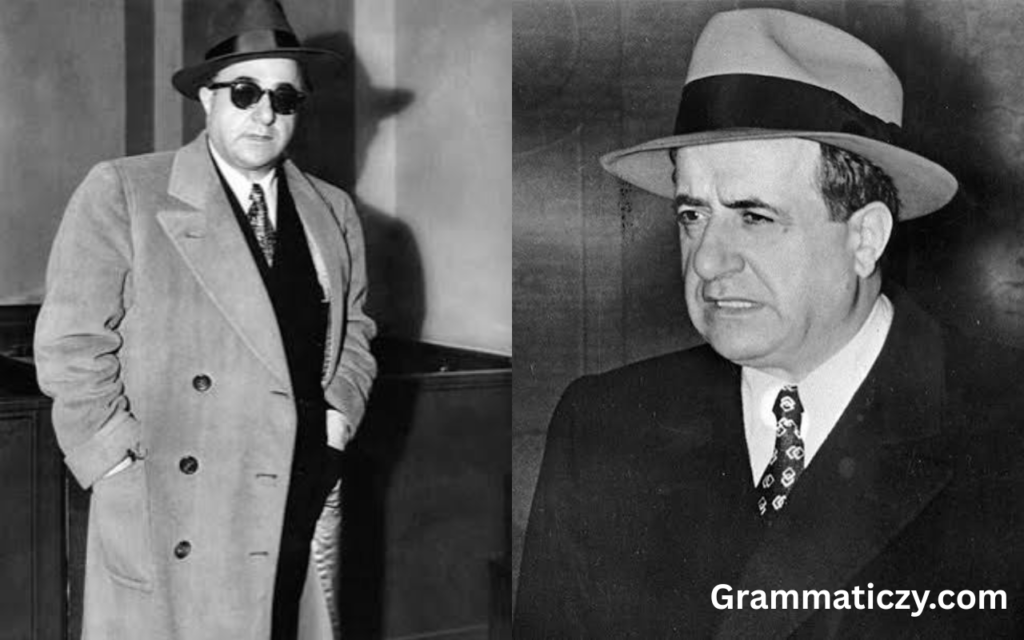
Albert Anastasia was one of the most feared and controversial figures in the history of American organized crime. Born Umberto Anastasio in Calabria, Italy, in 1902, he came to the United States as a young immigrant and eventually rose from work on the Brooklyn waterfront to become the leader of one of New York’s most powerful Mafia organizations. His name became inseparable from Murder, Incorporated, labor racketeering, waterfront influence and the violent internal politics of the American Mafia. The Federal Bureau of Investigation’s historical files describe Anastasia as a leading figure in organized crime on the New York waterfront and in the organization popularly known as Murder, Incorporated.
What makes Albert Anastasia’s biography particularly fascinating is the extraordinary transformation that took place over the course of his life. He began in a large working-class Italian family, survived a death sentence after a 1921 murder conviction, developed powerful relationships with figures such as Lucky Luciano, Frank Costello and Vito Genovese, and eventually became boss of the organization that would later be known as the Gambino crime family. His career was filled with violence, courtroom escapes, political and labor connections, shifting alliances and underworld rivalries.
Yet Anastasia’s story ultimately ended in a manner that seemed almost symbolic of the world in which he had operated. On October 25, 1957, he was attacked while sitting in a Manhattan barber’s chair and was fatally shot by two gunmen. The killing has remained one of the most famous unsolved episodes in American Mafia history, although historical accounts have long associated the murder with Vito Genovese and Carlo Gambino.
Albert Anastasia Facts at a Glance
| Category | Details |
|---|---|
| Full Name | Umberto Anastasio |
| Known As | Albert Anastasia |
| Born | September 26, 1902 |
| Birthplace | Parghelia, Calabria, Italy |
| Died | October 25, 1957 |
| Place of Death | New York City, New York |
| Age at Death | 55 |
| Nationality | Italian-born American |
| Occupation | Organized-crime figure and Mafia boss |
| Parents | Bartolomeo Anastasio and Marianna Polistena |
| Wife | Elsa Bargnesi |
| Children | Four |
| Siblings | Several brothers and a sister |
| Military Service | U.S. Army, 1942–1944 |
| Major Associations | Murder, Incorporated, Luciano organization, New York waterfront |
| Nicknames | “Mad Hatter,” “Lord High Executioner,” “One-Man Army” |
| Crime Family | Later became the family that would be known as the Gambino family |
| Cause of Death | Gunshot wounds |
| Estimated Net Worth | No reliable historical figure |
| None — died decades before social media | |
| X/Twitter | None |
| None |
Early Life and Family Background
Albert Anastasia was born Umberto Anastasio on September 26, 1902, in Calabria, southern Italy. Historical sources identify his parents as Bartolomeo Anastasio and Marianna Polistena. His father worked on the railroad, and the family was large, with Anastasia growing up alongside numerous siblings. The environment was working class, and the family’s circumstances were typical of many southern Italian households of the period in which economic opportunity could be limited and emigration increasingly attractive.
His early family environment is important because Anastasia did not begin life with wealth, privilege or an established criminal empire waiting for him. His eventual power was built much later through relationships, labor connections and organized crime. Several of his brothers also became involved in waterfront life after the family moved toward the United States, and his brother Anthony Anastasio eventually became an important figure on the Brooklyn waterfront. The family’s connection to maritime work would prove particularly significant in Albert’s later career.
Little reliable evidence exists to describe Anastasia’s education in detail, and there is no well-documented academic career associated with him. His biography instead becomes clearer once he enters the world of work and immigration. The young Umberto eventually made his way to the United States, where the Brooklyn waterfront offered employment but also exposed ambitious young men to an environment in which labor disputes, political influence, extortion and organized crime could overlap.
Immigration to America and the Brooklyn Waterfront
Anastasia’s arrival in the United States was one of the decisive turning points of his life. Historical accounts state that he came to New York with brothers and soon found work as a longshoreman on the Brooklyn waterfront. The waterfront was an especially important economic environment in early twentieth-century New York because enormous amounts of cargo moved through the city’s docks, creating opportunities for legitimate businesses as well as criminal organizations seeking control over workers and labor unions.
Working as a longshoreman placed Anastasia close to the kind of labor structure that later became central to his criminal influence. The FBI’s historical records describe him as a leading figure in racketeering, strike-breaking and strong-arm activities connected with the New York waterfront. Control over waterfront workers could provide criminal groups with leverage over employers, unions, shipping operations and individuals who depended upon access to dock jobs.
The Brooklyn waterfront therefore became much more than a workplace for Anastasia. It became the foundation of his power. As his reputation grew, he developed relationships with people operating in New York’s criminal underworld. These relationships eventually connected him with the emerging Mafia structure associated with Lucky Luciano, Frank Costello, Vito Genovese and other major figures. Anastasia’s ability to combine waterfront influence with underworld connections would become one of the defining characteristics of his career.
The 1921 Murder Conviction and Death Sentence
Anastasia’s criminal record became serious very early. In 1921, he was convicted of murdering longshoreman George Turino following a dispute and received a death sentence. He was sent to Sing Sing Prison to await execution, meaning that at only about nineteen years old, Anastasia was already facing the possibility of being permanently removed from society.
The case took an unexpected turn when a legal technicality resulted in a retrial. By the time the case was reconsidered, several prosecution witnesses were no longer available, and Anastasia was released. This extraordinary escape became an important part of the mythology surrounding him because a young man who had been condemned to death suddenly found himself back on the streets. The experience may have reinforced the reputation for survival that followed him throughout his later career.
His legal troubles did not end there. In 1923, he was convicted of illegal possession of a firearm and sentenced to two years in prison. He was also charged with another murder in Brooklyn in 1928, but the case did not result in a conviction because witnesses either disappeared or refused to testify. These episodes demonstrate an important pattern in Anastasia’s biography: he repeatedly came under serious suspicion or prosecution but avoided the kind of lengthy imprisonment that might otherwise have interrupted his rise.
Rise Through the New York Underworld
By the late 1920s, Anastasia had become increasingly influential in the Brooklyn waterfront world. Historical accounts connect him with control over several local chapters of the International Longshoremen’s Association and with criminal exploitation of waterfront labor. His growing influence brought him into contact with established underworld figures and helped him become part of the network that would eventually form the modern American Mafia.
Among his important associates were Joe Adonis, Lucky Luciano, Vito Genovese and Frank Costello. These relationships mattered because the New York underworld was not simply a collection of isolated street gangs. Powerful criminal figures increasingly cooperated across territories and specialized in different forms of organized activity. Anastasia’s role increasingly involved enforcement, labor influence and violence, while his alliances gave him access to a broader criminal network.
The violent Castellammarese War of the early 1930s further changed New York’s organized-crime landscape. The Mob Museum reports that Anastasia was reportedly one of four men involved in the 1931 assassination of Giuseppe “Joe the Boss” Masseria, although accounts of the event belong partly to the extensive mythology surrounding Mafia history. After the conflict, Luciano emerged as one of the dominant figures in the reorganization of New York’s Mafia, and Anastasia’s position within that emerging structure strengthened considerably.
Murder, Incorporated and the “Lord High Executioner”
Perhaps no part of Albert Anastasia’s career is more famous than his association with Murder, Incorporated. The term was popularized by the press to describe a network of professional killers connected to organized crime. The FBI’s historical material describes the group as specializing in intimidation, extortion, violence and murder and identifies Anastasia as the leader of the Brooklyn “troops” and a chief executioner.
The organization operated in an era when organized crime was becoming increasingly structured. Rather than violence always being carried out by the same neighborhood gang, criminal leaders could rely on specialized people to enforce decisions, intimidate opponents and eliminate individuals viewed as threats. The Mob Museum notes that the exact origins and structure of Murder, Inc. are complicated and that the group was known within the underworld as “The Combination.”
Anastasia’s reputation grew enormously because of this association. Newspapers and later historians attached nicknames such as “Lord High Executioner” and “Mad Hatter” to him. However, it is important to distinguish documented historical facts from stories repeated through Mafia folklore. Anastasia was unquestionably a major organized-crime figure and was linked by law enforcement to Murder, Incorporated, but not every killing later attributed to him was proven against him in court. The FBI itself records that he faced several murder-related cases in which prosecution ultimately failed.
The Collapse of Murder, Incorporated
Murder, Incorporated began attracting enormous attention from law enforcement in the early 1940s. The organization was exposed through the cooperation of members and associates who provided information to prosecutors. Among the most important witnesses was Abe Reles, whose testimony helped authorities understand how killings were commissioned and carried out.
The resulting prosecutions were devastating for the organization. Several members were convicted and executed, while others received prison sentences. The trials revealed the degree to which organized crime could use professional violence as an internal enforcement mechanism. The FBI’s historical monograph estimates that dozens of murders were associated with the organization and identifies Anastasia as one of its leading figures.
Anastasia himself managed to avoid the fate that overtook many other figures connected with Murder, Incorporated. His survival helped distinguish his career from many of the organization’s lower-level killers. While the collapse damaged the network around him, Anastasia’s broader influence over the waterfront and his relationships with senior Mafia leaders allowed him to continue operating in New York organized crime.
Military Service During World War II
One of the most unusual chapters in Albert Anastasia’s life was his service in the United States Army during World War II. He entered the Army in 1942 and served as a technical sergeant. According to historical records, his wartime role involved training longshoremen, connecting his military service with the waterfront experience he had accumulated before the war.
In 1943, Anastasia received American citizenship while serving in the Army, and he was honorably discharged in 1944. This part of his biography is particularly striking because it existed alongside his longstanding reputation as an organized-crime figure. His service also demonstrates how individuals with complicated backgrounds could occupy very different positions within American society during wartime.
The wartime waterfront was strategically important because New York’s docks handled enormous amounts of military cargo. The Mob Museum reports that Anastasia was involved in efforts related to keeping the waterfront secure and connects him to the broader story surrounding Lucky Luciano and wartime dock security. Some aspects of that story remain debated, so they are best presented as historical accounts rather than unquestioned fact.
Marriage, Children and Family Life
Albert Anastasia married Elsa Bargnesi in 1937. Historical sources report that they had four children: two sons, Umberto and Richard, and two daughters, Joyana and Gloriana. While Anastasia’s public life was dominated by organized crime, his family existed largely outside the public narrative surrounding his career.
The contrast between his criminal reputation and his private family life is one of the more interesting aspects of his biography. Public accounts concentrated heavily on violence, labor racketeering and Mafia politics, leaving comparatively little reliable information about his ordinary routines at home. Unlike modern public figures, Anastasia did not leave behind interviews, social-media posts or a large archive of personal statements explaining his beliefs or daily life.
His family nevertheless became part of the historical record because Anastasia’s criminal identity continued to affect the people around him. After his death, his widow and children lived beyond the period in which Albert himself had exercised power. Their lives demonstrate that the consequences of a high-profile criminal career can extend far beyond the individual who builds the reputation.
Becoming Boss of the Future Gambino Crime Family
A major turning point occurred in 1951, when Vincent Mangano disappeared and his brother Philip Mangano was found dead. Anastasia had previously served as Mangano’s underboss. Although Anastasia was never indicted for the brothers’ deaths, he was widely believed to have been responsible and subsequently assumed control of the organization.
Under Anastasia, the organization became one of the most important Mafia families in New York. The group would eventually become known as the Gambino crime family, although that name is associated primarily with Carlo Gambino, who succeeded Anastasia. Gambino had served as Anastasia’s underboss and was already an influential figure within the organization.
Anastasia’s position also placed him within the larger struggle for power among New York Mafia leaders. He was allied with Frank Costello, while Vito Genovese was seeking to challenge Costello. The changing alliances became increasingly important during the 1950s, and Anastasia’s aggressive reputation may have made him more vulnerable as other leaders considered how the balance of power should develop.
Conflict With Vito Genovese and Carlo Gambino
The mid-1950s were a period of increasing instability within the New York Mafia. Frank Costello, one of Anastasia’s longtime associates, faced pressure from Vito Genovese. In May 1957, Costello survived an assassination attempt but subsequently stepped away from leadership, changing the political landscape surrounding Anastasia.
Carlo Gambino’s position was also becoming increasingly important. As Anastasia’s underboss, Gambino was close enough to understand the organization’s internal structure and finances while simultaneously developing relationships with other powerful Mafia figures. Historical sources later connected Gambino with the plot against Anastasia, although details surrounding the murder have never been fully established in court.
The situation demonstrates how organized crime could turn on its own leaders. The same alliances that had enabled Anastasia’s rise could be reversed when circumstances changed. In a world where loyalty was frequently tested by money, territory and power, maintaining authority could become increasingly difficult once influential rivals decided that a different leadership arrangement served their interests.
The Murder of Albert Anastasia
On October 25, 1957, Albert Anastasia entered a Manhattan barbershop at the Park Sheraton Hotel, now associated with the Park Central Hotel area. While he sat in the barber’s chair, two gunmen entered and opened fire. Anastasia was fatally wounded and died at the age of 55. The assassination immediately became one of the most recognizable Mafia killings in American history.
The details surrounding the murder have generated decades of speculation. The Mob Museum identifies the killing as a plot involving Vito Genovese and Carlo Gambino, while historical accounts have also discussed various possible gunmen. Because no one was ultimately convicted of killing Anastasia, some aspects of the assassination remain unresolved. The exact identity of the shooters is therefore better described as disputed rather than presented as a settled fact.
The location of the murder added to its historical impact. Anastasia had built much of his reputation around the use and threat of violence, and his death in a public place while sitting in a barber’s chair became a powerful image of the dangers within the Mafia hierarchy. His death also cleared the way for Carlo Gambino to take control of the organization, beginning another important chapter in the history of what became the Gambino crime family.
Albert Anastasia Net Worth and Sources of Income
There is no trustworthy historical document establishing a precise personal net worth for Albert Anastasia. Modern websites sometimes attach specific dollar figures to famous criminals from the twentieth century, but those estimates are often speculative. Anastasia died in 1957, and the financial records available to historians do not provide the transparent accounting necessary to calculate a modern-style net worth with confidence.
His financial power was associated with organized-crime activities involving the waterfront, labor influence, extortion and other rackets. FBI historical material describes the importance of waterfront racketeering and the exploitation of longshoremen’s labor, illustrating how control of jobs and unions could become a significant source of criminal income.
For that reason, a responsible biography should avoid claiming that Anastasia was worth a particular number of millions or dollars unless a primary historical record supports the figure. His influence and access to money were undoubtedly substantial, but his exact personal fortune remains unknown. The safest conclusion is that Albert Anastasia accumulated considerable wealth and power through organized crime, while his precise net worth cannot be reliably established.
Social Media and Public Presence
Albert Anastasia obviously had no Instagram, Facebook, Twitter/X or LinkedIn account. He died in 1957, long before the internet and social-media platforms existed. Any modern profile using his name should therefore be understood as a historical page, fan account, documentary project or unrelated individual rather than an authentic account belonging to Anastasia.
Interestingly, his public image has survived much longer than many people from his era. His photographs, newspaper reports, FBI files and historical records continue to circulate online, allowing modern audiences to examine a figure who operated during a very different period of American history. The Mob Museum maintains a detailed historical profile of Anastasia and places his life within the development of organized crime in the United States.
His continuing popularity is also connected to the broader fascination with American Mafia history. Anastasia has appeared in books, documentaries, historical discussions and fictionalized portrayals because his life intersects with so many famous subjects: Prohibition, Murder, Incorporated, the Five Families, the New York waterfront and the rise of the Gambino organization. His online presence today is therefore historical rather than personal.
Legacy and Historical Significance
Albert Anastasia occupies a distinctive position in the history of American organized crime because his career crossed several major periods. He was active during Prohibition, became associated with Murder, Incorporated, survived its collapse, served in the U.S. Army during World War II and eventually became boss of one of New York’s major Mafia families. The FBI continues to identify him as a significant organized-crime figure associated with both the New York waterfront and Murder, Incorporated.
His legacy, however, should not be separated from the violence that defined much of his career. Murder, Incorporated was associated with intimidation and contract killings, while Anastasia himself became famous for his reputation as an enforcer. The historical record therefore provides a picture of considerable criminal power, but also of a system dependent on fear, secrecy and violence.
Perhaps the most important historical lesson from Anastasia’s life is how quickly power can shift within a closed and violent organization. Anastasia survived prosecution, built enormous influence and reached the top of a major Mafia family, yet within a few years he was dead and his former underboss had taken control. His story remains significant not because it offers a model to admire, but because it provides a window into the structures, conflicts and consequences of organized crime in twentieth-century America.
Conclusion: The Enduring Story of Albert Anastasia
Albert Anastasia’s journey from Umberto Anastasio, the son of a railway worker in Calabria, to one of the most recognizable Mafia bosses in American history was shaped by immigration, labor, opportunity, criminal alliances and violence. His early life gave little indication that he would eventually become associated with some of the most notorious names in the New York underworld. Yet his work on the Brooklyn waterfront became the starting point for a career that would eventually place him at the center of organized crime.
His rise was accompanied by extraordinary contradictions. He was convicted of murder as a young man and later survived a death sentence after a retrial. He became associated with Murder, Incorporated and earned notorious nicknames, yet he also served in the U.S. Army during World War II and received American citizenship while in military service. He built a family life with Elsa Bargnesi and their four children while simultaneously operating within a criminal world characterized by betrayal, intimidation and violence.
The final chapter of Anastasia’s life came suddenly in a Manhattan barbershop on October 25, 1957. His murder ended the career of one of New York’s most powerful organized-crime figures and opened the way for Carlo Gambino’s rise. More than six decades later, Albert Anastasia remains a subject of historical fascination because his life captures an entire era of American organized crime—from the waterfront and Prohibition to Murder, Incorporated and the formation of the Mafia families that would dominate New York for generations. His story ultimately serves as a reminder that influence built through fear can be extraordinarily powerful, but it can also be extraordinarily fragile.