
Have you ever written a document, email, or resume and paused at the word specialty? Or was it speciality? You’re not alone. This spelling dilemma confuses students, professionals, writers, and even native English speakers.
The debate around Specialty Or Speciality isn’t about right versus wrong. In fact, both spellings are correct. The real difference lies in where the word is being used and which version of English you’re following.
In this guide, you’ll learn the meaning of both words, their regional preferences, historical origins, usage examples, and practical tips to help you choose the correct spelling with confidence.
What Does Specialty or Speciality Mean?
Both specialty and speciality refer to:
- A particular area of expertise
- A distinctive feature or characteristic
- A product, service, or skill for which someone is known
For example:
- Cardiology is her medical specialty.
- Handmade chocolates are the shop’s specialty.
- His specialty is solving complex engineering problems.
The meaning remains the same regardless of which spelling you use.
Specialty Or Speciality: The Main Difference
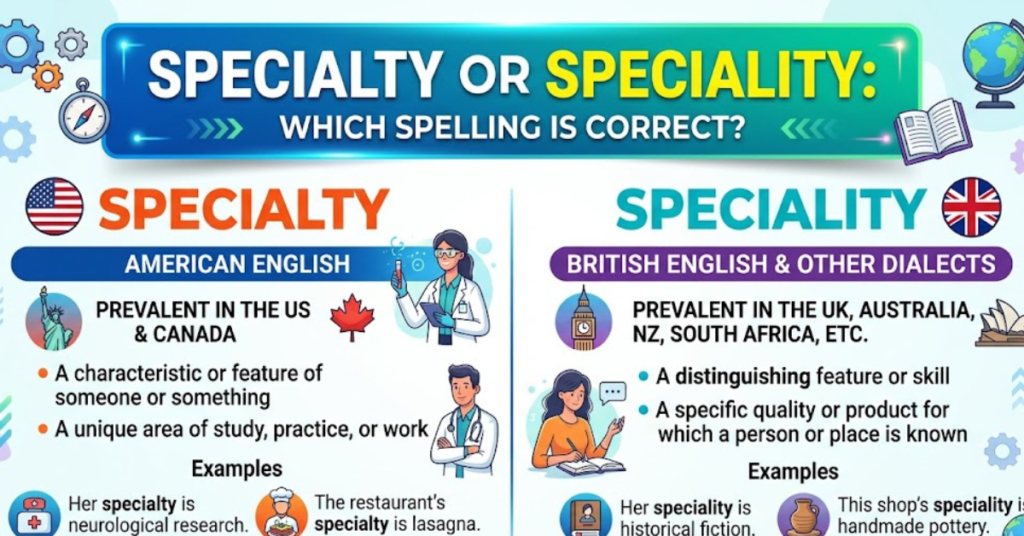
The primary distinction is regional spelling preference.
| Word | Common Usage |
| Specialty | American English |
| Speciality | British English |
If you’re writing for a U.S. audience, specialty is generally preferred.
If you’re writing for readers in the United Kingdom, Australia, New Zealand, or other regions that follow British English conventions, speciality may be more common.
Quick Example
American English:
- Orthopedics is his medical specialty.
- The restaurant’s specialty is barbecue ribs.
British English:
- Orthopaedics is his medical speciality.
- The restaurant’s speciality is seafood dishes.
The meaning doesn’t change—only the spelling.
The Origins of the Words
Understanding the history of these spellings helps explain why both exist today.
The word originates from:
- Latin: specialis (particular or specific)
- Old French: specialité
- Middle English adaptations
Over time, English evolved differently in various regions. American English often simplified spellings, while British English retained forms closer to traditional European spellings.
This pattern can be seen in many words:
| American English | British English |
|---|---|
| Color | Colour |
| Favor | Favour |
| Center | Centre |
| Specialty | Speciality |
The difference is therefore part of a broader linguistic trend rather than a unique exception.
Is Specialty More Common Than Speciality?
Yes.
Today, specialty is generally more common worldwide, largely due to the influence of American media, business communication, academic publications, and digital content.
Many international organizations and global companies also favor American English spelling standards.
However, speciality remains widely accepted and commonly used in British English publications and institutions.
Modern Usage Trends
You will often find specialty in:
- Medical journals
- Professional certifications
- Business reports
- Online content
- Marketing materials
You may encounter speciality in:
- British newspapers
- UK educational institutions
- British government documents
- Commonwealth English publications
Specialty in Professional and Academic Contexts
The word frequently appears in professional environments.
Medical Specialty
In healthcare, a specialty refers to a specific branch of medicine.
Examples include:
- Cardiology
- Neurology
- Dermatology
- Pediatrics
- Orthopedics
Example sentence:
“After medical school, she chose cardiology as her specialty.”
Business Specialty
Companies often describe their unique expertise as their specialty.
Examples:
- Software development
- Financial consulting
- Digital marketing
- Luxury travel planning
Example:
“Custom website design is our specialty.”
Academic Specialty
Universities and researchers may use the term to describe an area of study.
Example:
“His specialty is environmental economics.”
Specialty vs Speciality in Food and Hospitality
One of the most common uses appears in restaurants and food businesses.
Examples
- The chef’s specialty is handmade pasta.
- The bakery’s specialty is sourdough bread.
- Their seafood speciality attracts tourists from around the country.
Many restaurants use the term to highlight signature dishes that distinguish them from competitors.
How to Choose the Correct Spelling
The best choice depends on your audience.
Use “Specialty” If:
- You’re writing for an American audience
- Your company follows U.S. English style guidelines
- You’re creating content for international markets that prefer American English
- You’re writing SEO-focused content targeting U.S. users
Use “Speciality” If:
- You’re writing for a UK audience
- Your publication follows British English standards
- You’re producing content for British institutions or organizations
Important Tip
Maintain consistency.
Avoid switching between spellings in the same document unless you’re directly quoting a source.
Common Mistakes People Make
Mixing Spellings
Incorrect:
- Our speciality is marketing, and digital strategy is our specialty.
Correct:
- Our specialty is marketing, and digital strategy is our specialty.
- Our speciality is marketing, and digital strategy is our speciality.
Assuming One Is Wrong
Many people believe only one version is correct. In reality, both spellings are recognized by major dictionaries.
Ignoring Audience Expectations
Using American spelling in a British publication—or vice versa—can appear inconsistent and less professional.
Specialty and Speciality in SEO Content
For content creators, understanding regional spelling matters.
Search behavior often reflects local language preferences.
Examples
American users may search:
- medical specialty
- specialty coffee
- specialty insurance
- specialty products
British users may search:
- medical speciality
- speciality foods
- speciality services
- speciality training
When creating content, consider:
- Target country
- Audience language preferences
- Brand style guidelines
- Search intent
This helps improve both user experience and search visibility.
Examples of Specialty and Speciality in Sentences
Here are some practical examples.
Specialty Examples
- Cybersecurity is her specialty.
- The store sells specialty coffee beans.
- Their specialty products serve niche markets.
- Emergency medicine became his specialty after residency.
Speciality Examples
- Marine biology is her speciality.
- The hotel’s speciality is traditional cuisine.
- This region is known for its cheese speciality.
- His speciality lies in corporate law.
Key Takeaways
- Both specialty and speciality are correct spellings.
- Specialty is preferred in American English.
- Speciality is preferred in British English.
- The meaning remains exactly the same.
- Choose the version that matches your audience and remain consistent.
- For global or U.S.-focused content, specialty is generally more common.
Frequently Asked Questions
Is specialty or speciality correct?
Both are correct. “Specialty” is the preferred American English spelling, while “speciality” is more commonly used in British English.
Which spelling is more widely used?
Specialty is generally more common worldwide due to the influence of American English in business, media, and online content.
Is there a difference in meaning between specialty and speciality?
No. Both words have the same meaning and refer to an area of expertise, a distinctive characteristic, or a signature product or service.
Should I use specialty on my resume?
If you’re applying for jobs in the United States, use “specialty.” For applications in the UK or other British English regions, “speciality” may be more appropriate.
Do dictionaries recognize both spellings?
Yes. Major dictionaries such as Merriam-Webster, Oxford, and Cambridge recognize both versions as valid spellings.
Which spelling is better for SEO?
The best spelling depends on your target audience. Use “specialty” for U.S.-focused content and “speciality” for UK-focused content to align with local search behavior.
Conclusion
The question of Specialty Or Speciality comes down to regional language preferences rather than correctness. Both spellings carry the same meaning and are accepted by respected dictionaries and style guides.
If you’re writing for an American audience, specialty is usually the best choice. If you’re targeting readers in the United Kingdom or other British English-speaking regions, speciality may be more appropriate.
By understanding the difference and matching your spelling to your audience, you can communicate more clearly, maintain professional consistency, and create content that feels natural to your readers.