
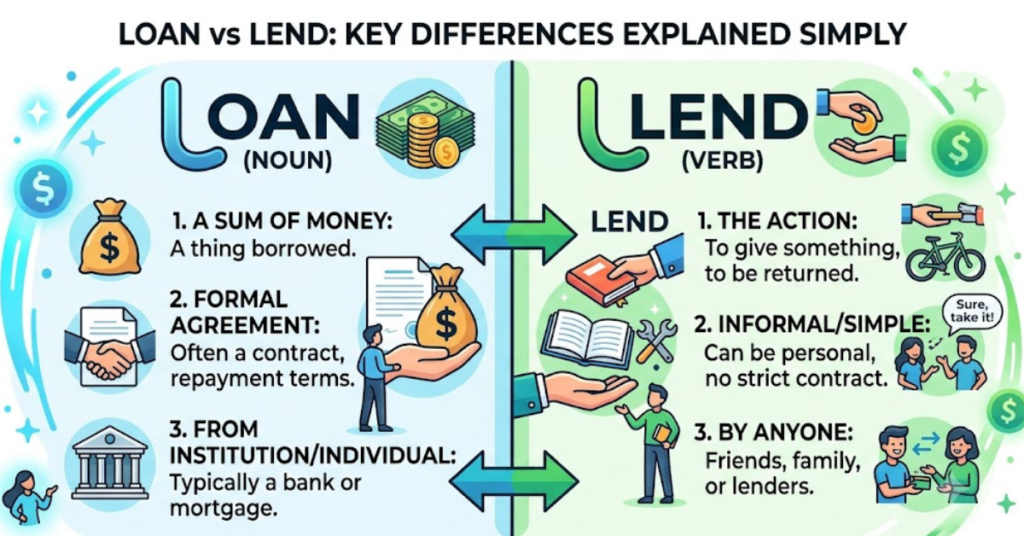
Have you ever wondered whether you should say “Can you loan me some money?” or “Can you lend me some money?” Many people use these words interchangeably, but understanding loan vs lend can help you communicate more accurately, especially in financial, legal, and everyday conversations.
Although both terms involve giving something temporarily with the expectation that it will be returned, they have different grammatical roles and subtle differences in usage. This guide explains the meanings of loan and lend, how they are used, and when to choose one over the other.
What Does “Loan” Mean?
A loan is typically a noun that refers to something, usually money, that is given to someone with the expectation that it will be paid back.
Examples of Loan as a Noun:
- She applied for a home loan from the bank.
- The company received a business loan to expand its operations.
- He took out a student loan to pay for college.
In the financial world, loans are formal agreements that often include terms such as:
- Interest rates
- Repayment schedules
- Loan duration
- Fees and penalties
Common types of loans include personal loans, mortgages, auto loans, and student loans.
Can “Loan” Be Used as a Verb?
Yes, particularly in American English, loan can also be used as a verb, meaning to give something temporarily to someone.
Examples:
- Can you loan me your calculator for the exam?
- The library loans books to members.
However, some traditional grammar guides prefer “lend” when using the word as a verb.
What Does “Lend” Mean?
Lend is a verb that means to give something to someone temporarily with the expectation that it will be returned.
Examples of Lend as a Verb:
- Can you lend me twenty dollars until Friday?
- I will lend you my car for the weekend.
- The bank lends money to customers who qualify.
Unlike loan, lend is almost always used as a verb and not a noun. It focuses on the action of giving rather than the thing being given.
Loan vs Lend: The Main Difference
The simplest way to remember the difference between loan vs lend is this:
| Loan | Lend |
| Usually a noun | Always a verb |
| Refers to the thing being borrowed | Refers to the action of giving |
| Common in financial agreements | Common in everyday conversations |
| Can be a verb in American English | Standard verb in all English varieties |
For example:
- Correct: I got a loan from the bank.
- Correct: The bank will lend me the money.
- Correct in American English: The bank will loan me the money.
Loan vs Lend in British and American English
The difference between loan and lend becomes more noticeable when comparing British and American English.
American English
In the United States, people commonly use “loan” as both a noun and a verb.
Examples:
- The bank loaned him $10,000.
- Could you loan me your pen?
British English
In British English, “lend” is generally preferred when referring to the action of giving something temporarily.
Examples:
- Could you lend me your umbrella?
- The bank lends money to homeowners.
“Loan” is mainly used as a noun in British English.
Common Mistakes People Make with Loan and Lend
Many English learners confuse these terms because they have similar meanings.
1. Using “lend” as a noun
I took a lend from the bank.
I took a loan from the bank.
2. Confusing the action and the object
The bank gave me a lend.
The bank gave me a loan.
Can you loan me money? (Incorrect in some formal British contexts)
Can you lend me money?
When Should You Use Loan or Lend?
Use this simple rule:
- Use loan when talking about the money or item being borrowed.
- Use lend when talking about the act of giving something temporarily.
Quick Memory Trick
Think of it this way:
Loan = the thing.
Lend = the action.
This easy distinction will help you avoid common grammar mistakes.
Loan vs Lend in Banking and Finance
In banking, the word loan is more common because it refers to a financial product. Banks provide loans with specific conditions and repayment terms.
However, banks also lend money, describing the action they take.
For example:
- A bank offers personal loans to customers.
- A bank lends money after checking creditworthiness.
Both words can appear in the same sentence:
“The bank lends a loan to a customer.”
More naturally, though, financial English usually says:
“The bank provides a loan to a customer.”
“The bank lends money to a customer.”
FAQs About Loan vs Lend
Is it correct to say “loan me money”?
Yes. In American English, saying “loan me money” is grammatically correct and widely accepted. In British English and more formal contexts, “lend me money” is often preferred.
Is a bank a lender or a loaner?
A bank is a lender because it lends money. It provides loans to borrowers.
What is the difference between borrowing and lending?
Borrowing means receiving something that must be returned, while lending means giving something with the expectation of return.
Is a loan always about money?
No. A loan can refer to other items, such as a loan of equipment, books, or tools, though money is the most common usage.
Why do people confuse loan and lend?
People confuse them because both involve temporary transfer and return. The main difference is that loan is usually the thing being given, while lend is the act of giving.
Conclusion
Understanding the difference between loan vs lend is essential for clear communication in both everyday conversations and financial contexts. A loan is usually the item or amount of money that is given and must be returned, while to lend means to give something temporarily.
Remember the simple rule: you get a loan, but someone lends it to you. By keeping this distinction in mind, you can use both terms naturally and confidently.
If you’re learning English or exploring financial topics, consider reading more guides on common financial terminology, borrowing, lending, and money management to strengthen your knowledge.