
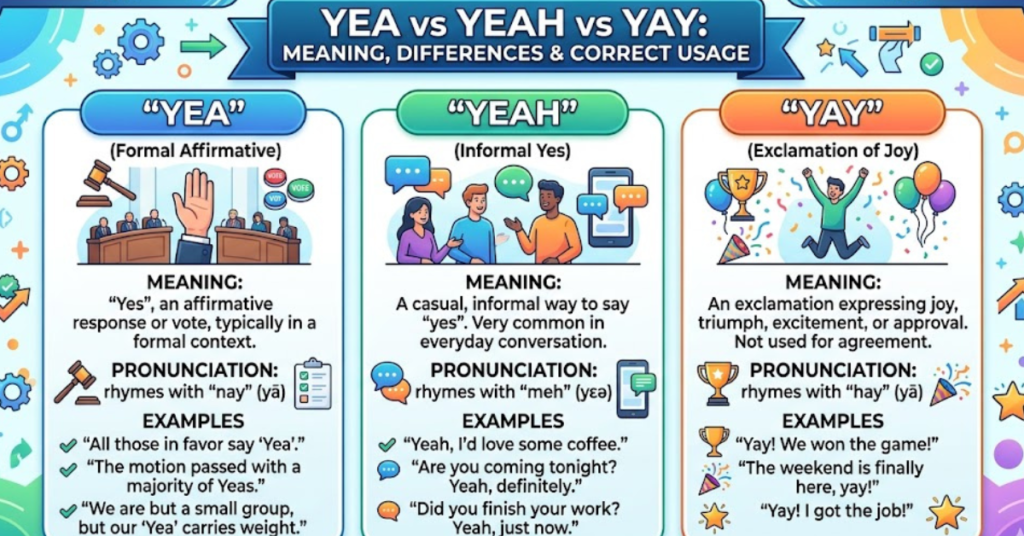
Have you ever typed “yeah” in a text, seen “yea” in a formal document, or shouted “yay” after good news and wondered whether they’re actually the same? The confusion around yea vs yeah vs yay is extremely common because the words sound similar but carry very different meanings and purposes.
Understanding the distinction between these three terms can improve your writing, communication, and grammar skills. In this guide, we’ll break down the meaning of yea, yeah, and yay, explain when to use each one, and provide practical examples so you never mix them up again.
What Does “Yea” Mean?
Yea is an old-fashioned or formal word that means “yes” or “in favor of something.” It is most commonly used in official votes, historical texts, and legal or governmental contexts.
Examples of “Yea”
- The council voted yea on the new proposal.
- The final count was 150 yeas and 30 nays.
- “Yea, though I walk through the valley of the shadow of death…” (a well-known biblical phrase)
In modern everyday conversation, people rarely use “yea” to mean yes. It usually appears in specific formal situations.
When to Use “Yea”
Use yea when:
- Referring to a vote or official approval
- Writing about historical or religious texts
- Using an old or poetic style of language
What Does “Yeah” Mean?
Yeah is an informal version of “yes.” It is one of the most common words used in casual English conversations, text messages, and social media.
Unlike “yea,” which has a formal tone, “yeah” is friendly and conversational.
Examples of “Yeah”
- Yeah, I’ll come to the party tonight.
- Do you like coffee? Yeah, I drink it every morning.
- Yeah, that sounds like a great idea.
When to Use “Yeah”
Use yeah when:
- Talking with friends or family
- Sending casual texts
- Writing dialogue in stories
- Having informal conversations
However, in professional emails or academic writing, it is usually better to use “yes” instead of “yeah.”
What Does “Yay” Mean?
Yay is an expression of joy, excitement, happiness, or celebration. It is not a substitute for “yes”; instead, it shows an emotional reaction.
People commonly use “yay” when something positive happens.
Examples of “Yay”
- Yay! We finally finished the project.
- I got the job offer—yay!
- Yay, it’s the weekend!
When to Use “Yay”
Use yay when expressing:
- Excitement
- Happiness
- Celebration
- Achievement or success
It is most often found in casual writing, social media posts, and conversations.
Yea vs Yeah vs Yay: Quick Comparison
| Word | Meaning | Tone | Common Usage |
| Yea | Yes; in agreement or approval | Formal, old-fashioned | Votes, legal, historical, religious texts |
| Yeah | Informal way of saying yes | Casual | Conversations, texts, dialogue |
| Yay | Expression of excitement or happiness | Enthusiastic | Celebrations, achievements, good news |
Common Mistakes People Make With Yea, Yeah, and Yay
Because these words are pronounced similarly, many writers accidentally choose the wrong spelling.
Mistake 1: Using “Yay” Instead of “Yeah”
“Yay, I understand what you mean.”
“Yeah, I understand what you mean.”
“Yeah” indicates agreement, while “yay” expresses excitement.
Mistake 2: Using “Yea” in Casual Conversations
“Yea, I watched that movie yesterday.”
“Yeah, I watched that movie yesterday.”
“Yea” sounds formal and is not commonly used in everyday speech.
Mistake 3: Using “Yeah” in Formal Voting Contexts
The committee voted “yeah” on the proposal.
The committee voted “yea” on the proposal.
Official voting language traditionally uses “yea” and “nay.”
Why Are Yea, Yeah, and Yay So Confusing?
The confusion between yea vs yeah vs yay mainly comes from their similar pronunciation. In many English accents, they sound nearly identical, making it easy to choose the wrong spelling.
The key difference is to remember their purpose:
- Yea = Formal approval or a vote
- Yeah = Casual yes
- Yay = A celebration or expression of joy
A simple memory trick is:
- Yea is for the “yea or nay” decision.
- Yeah is what you say to a friend.
- Yay is what you shout when you’re happy.
FAQs
Is it “yeah” or “yay” when agreeing?
Use yeah when you agree with someone.
Example:
- “Do you want to watch a movie?”
- “Yeah, that sounds fun.”
Use yay only when expressing excitement.
Is “yea” the same as “yes”?
Yes, yea historically means “yes,” but it is now mainly used in formal situations such as voting, legal language, and certain religious texts.
Is it correct to say “yay” instead of “yes”?
Not usually. “Yay” shows happiness rather than agreement.
For example:
- Correct: “Yay! I passed my exam.”
- Correct: “Yes, I can help you.”
- Incorrect: “Yay, I can help you” (unless you mean you’re excited to help).
Why is “yea” used in voting?
The term “yea” is part of traditional parliamentary language. It clearly indicates a vote in favor of a motion and is paired with the word “nay,” meaning a vote against.
Is “yeah” acceptable in professional writing?
“Yeah” is generally too informal for professional documents, business emails, or academic writing. In these situations, use “yes” instead.
Conclusion
Understanding yea vs yeah vs yay is simple once you know the role each word plays. Yea belongs to formal votes and historical language, yeah is a relaxed way of saying yes in everyday conversation, and yay expresses excitement and celebration.
The next time you write a message, post online, or prepare a formal document, choose the correct word based on your intention. For more grammar tips and word comparisons, explore related English language guides and continue improving your writing skills.