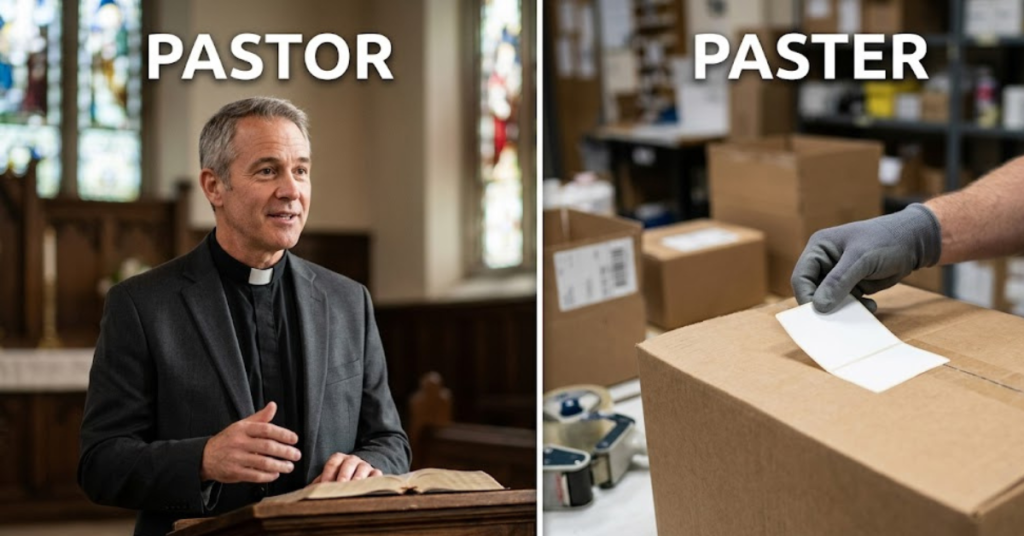
Have you ever come across the words “pastor” and “paster” and wondered whether they mean the same thing? At first glance, they look remarkably similar, differing by just one letter. However, their meanings are completely different, and confusing them can lead to misunderstandings in both writing and conversation.
The distinction between pastor vs paster is important because one refers to a religious leader, while the other describes a person or thing involved in applying paste. In this guide, you’ll learn the meanings, origins, examples, and practical tips for using each word correctly.
What Does Pastor Mean?
A pastor is a religious leader who provides spiritual guidance and care to a congregation, typically within Christian churches. The word comes from the Latin word pastor, meaning “shepherd.”
Just as a shepherd cares for a flock, a pastor is responsible for helping, teaching, and supporting members of a church community.
Common Responsibilities of a Pastor
A pastor may:
- Lead worship services
- Deliver sermons
- Provide spiritual counseling
- Conduct weddings and funerals
- Visit members of the congregation
- Offer guidance during difficult times
Examples of Pastor in Sentences
- The pastor delivered an inspiring message on Sunday morning.
- Our pastor visited the hospital to pray for community members.
- She spoke with the pastor about her concerns and received helpful advice.
In nearly all modern usage, the word pastor relates to religion and church leadership.
What Does Paster Mean?
A paster is a person, tool, or item associated with applying paste, glue, or adhesive material. While this word exists in English dictionaries, it is much less common than pastor.
Depending on the context, paster may refer to:
- Someone who applies paste professionally
- A machine that spreads adhesive
- A label or sticker attached to a surface
- An object used in manufacturing or packaging
Examples of Paster in Sentences
- The factory installed a new paster to improve production efficiency.
- The worker operated the paster during the packaging process.
- A small paster was placed over the damaged section of the document.
Because the word is uncommon, many people mistakenly assume it is a misspelling of pastor.
Key Differences Between Pastor and Paster
Understanding the distinction becomes easier when you focus on the context.
Pastor
- Related to religion
- Refers to a church leader
- Commonly used in Christian communities
- Derived from the idea of a shepherd
Paster
- Related to adhesives or industrial processes
- Refers to someone or something that applies paste
- Relatively uncommon in everyday language
- Often appears in manufacturing or technical settings
The simplest way to remember the difference is that a pastor leads people, while a paster applies paste.
Why Do People Confuse These Words?
The confusion arises mainly because the words:
- Look almost identical.
- Differ by only one letter.
- Have similar pronunciation in some accents.
- Are often encountered in writing rather than conversation.
Additionally, spell-check software may not always catch the mistake because both words are legitimate English terms.
Pronunciation Comparison
Although pronunciation can vary slightly depending on region, these words are generally pronounced differently.
Pastor
Typically sounds like:
PAS-ter
Paster
Typically sounds like:
PAY-ster or PAS-ter depending on context and dialect.
Because pronunciation differences can be subtle, context remains the most reliable clue.
Common Writing Mistakes
Many writers accidentally use one word when they mean the other.
Incorrect
- The church welcomed a new paster last month.
Correct
- The church welcomed a new pastor last month.
Incorrect
- The factory hired a new pastor to operate the adhesive machine.
Correct
- The factory hired a new paster to operate the adhesive machine.
Paying attention to the surrounding subject matter usually makes the correct choice obvious.
How to Remember the Difference
A few simple memory tricks can help.
Remember “Pastor” with People
Think of a pastor as someone who cares for people in a church.
Remember “Paster” with Paste
Notice that paster contains the word “paste.” This connection can remind you that it relates to adhesives rather than religion.
Use Context Clues
Ask yourself:
- Is the sentence about faith, worship, or a church? Use pastor.
- Is the sentence about glue, labels, or manufacturing? Use paster.
The Origins of Both Words
Learning where these words come from can make them easier to remember.
Origin of Pastor
The term originated from Latin and literally meant shepherd. Over time, it became associated with religious leaders who guide and care for their congregations.
Origin of Paster
The word developed from the verb “paste,” referring to the act of attaching or covering something with adhesive material.
Because their origins are unrelated, their meanings evolved in entirely different directions despite their similar spelling.
When Is Paster Used Today?
Modern English speakers rarely encounter the word paster in everyday conversation. It appears more often in:
- Printing industries
- Packaging operations
- Manufacturing environments
- Technical manuals
- Historical documents
By contrast, pastor remains a frequently used word in religious and community settings worldwide.
FAQs
Is paster a real word?
Yes. Paster is a legitimate English word, although it is much less common than pastor. It generally refers to a person, tool, or device that applies paste or adhesive.
What is the meaning of pastor?
A pastor is a religious leader who provides spiritual guidance, teaching, and support to members of a church congregation.
Why do people misspell pastor as paster?
The words differ by only one letter, making typing and spelling errors common. Since both words exist in English, mistakes can sometimes go unnoticed.
Which word is more commonly used?
Pastor is significantly more common in modern English because it is widely used in religious contexts. Paster is mostly limited to technical or industrial settings.
Can paster refer to a sticker or label?
In some contexts, yes. Historically, paster has been used to describe labels, stickers, or pieces of paper attached with adhesive.
How can I quickly remember the difference?
Associate pastor with people and churches, and associate paster with paste and adhesives.
Conclusion
Understanding pastor vs paster is simpler than it first appears. A pastor is a spiritual leader who guides a church community, while a paster is connected to applying paste, glue, or adhesive materials. Although the two words look similar, their meanings, origins, and usage are entirely different.
The next time you encounter either term, consider the context. If the topic involves religion or church leadership, pastor is the correct choice. If it involves adhesives, labels, or industrial equipment, paster is the word you need. Mastering this distinction will help you write more accurately and avoid one of the most common spelling mix-ups in English.