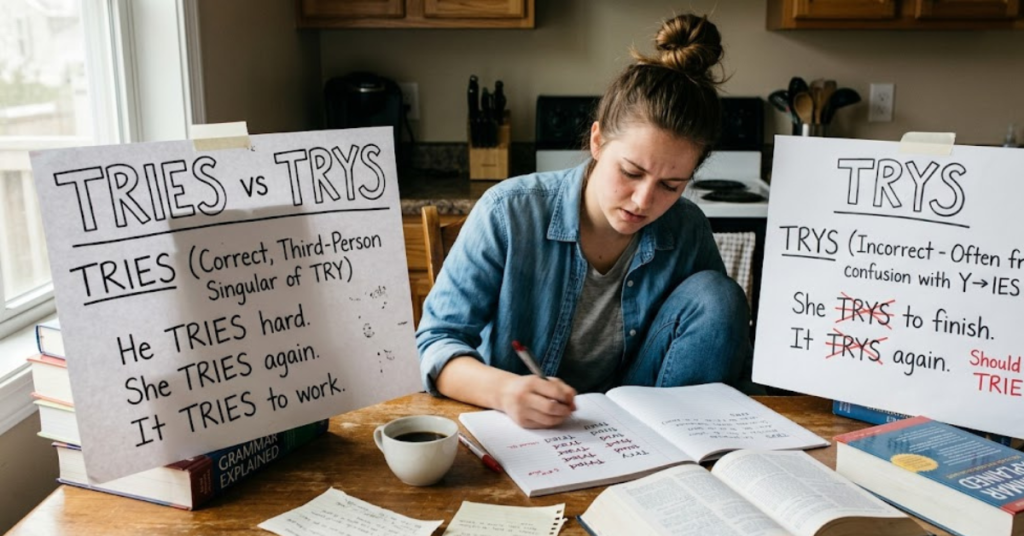
English spelling can be confusing, especially when a word looks like it should follow a simple rule—but doesn’t. One common example is the confusion between “tries” and “trys.”
At first glance, “trys” might seem right, but in standard English, it is incorrect. The correct form is tries. Let’s understand why and how it works in real usage.
What Does “Tries” Mean?
“Tries” is the correct form of the verb try in the present tense.
It is used when:
Talking about someone attempting something (he tries, she tries)
Referring to multiple attempts in general writing
Describing scoring in rugby (a “try” in sports)
Examples:
She tries her best every day.
He tries to solve the problem.
The team scored several tries in the match.
Why “Trys” Is Incorrect
“Trys” is a common spelling mistake, not a standard English word.
The confusion happens because many people assume verbs simply take an “s” in the present tense. However, English has a specific rule for words ending in -y.
The Spelling Rule You Need to Know
When a verb ends in a consonant + “y”, the spelling changes:
Change y → i
Add -es
Examples:
try → tries
cry → cries
fly → flies
study → studies
This rule explains why the correct form is always tries, not “trys.”
Usage in Grammar
1. As a verb (action)
Used when someone attempts something:
He tries to wake up early.
She tries again after failing.
2. In sports (rugby)
In rugby, a “try” is a way of scoring.
One try
Two tries
Several tries
Even in sports terminology, the spelling never changes to “trys.”
Common Mistakes
Many learners write the incorrect form because:
They assume English is always “add s”
They forget the y → ies rule
It looks correct when typed quickly
Incorrect:
She trys to understand the lesson.
He trys again and again.
Correct:
She tries to understand the lesson.
He tries again and again.
Simple Memory Trick
Remember this easy rule:
“Change Y to I and add ES.”
try → tries cry → cries fly → flies
This will help you avoid the mistake instantly.
Quick FAQs
Is “trys” ever correct? No, it is not standard English.
What is the correct spelling? The correct form is “tries.”
Does the rule change in sports? No, rugby also uses “tries.”
Conclusion
The confusion between these spellings comes from misunderstanding a basic English rule. Once you remember the y → ies pattern, the correct form becomes obvious.
So whether you’re writing about grammar, daily actions, or sports, the correct choice is always tries.