English spelling can be surprisingly inconsistent, especially when two versions of a word seem equally acceptable. One example that causes regular confusion is “protestors or protesters.” You’ve probably seen both spellings in newspapers, social media posts, headlines, and political discussions, making it difficult to know which version is actually correct.
The good news is that the answer is fairly straightforward. While both spellings exist, one is far more accepted in modern English and preferred by style guides, journalists, and dictionaries.
This article explains the difference, explores spelling rules, examines AP style and UK usage, and helps you understand which version you should use in professional and everyday writing.
What Does Protester Mean?
A “protester” is a person who publicly expresses opposition, disagreement, or support regarding a political, social, environmental, or cultural issue.
Protesters may participate in:
- Demonstrations
- Marches
- Rallies
- Strikes
- Public campaigns
The term is widely used in journalism, politics, law, activism, and everyday conversation.
Examples include:
- Protesters gathered outside city hall.
- Thousands of protesters marched peacefully through downtown.
Is It Protestors or Protesters?
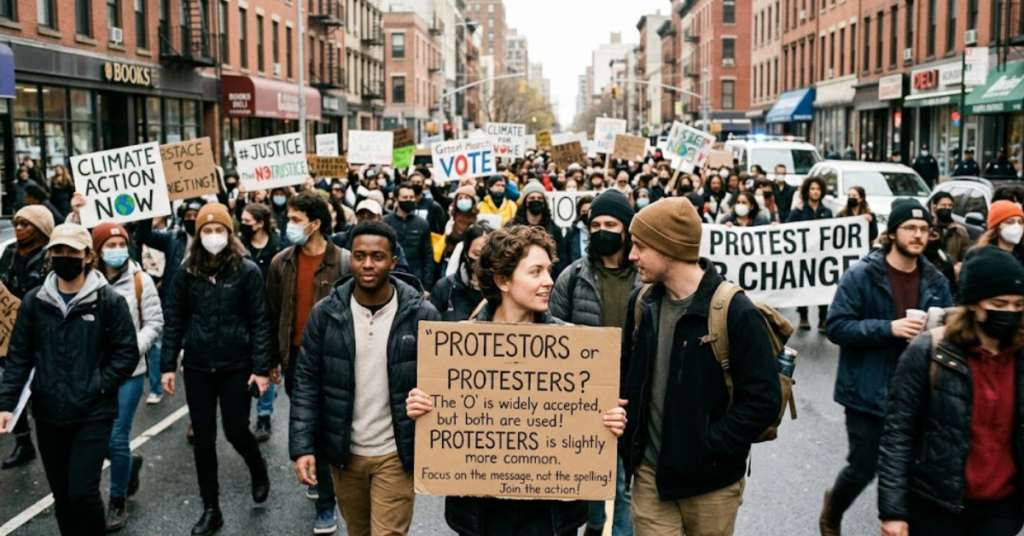
The preferred and most widely accepted spelling is protesters.
Although “protestors” does appear occasionally, especially in older texts or informal usage, “protesters” is considered the standard form in modern English.
So if you’re asking:
- “Is it protestors or protesters?”
- “Protestors or protesters spelling?”
- “Protestors or protesters which is correct?”
The answer is simple: protesters is the standard and recommended spelling.
Why “Protesters” Is More Common
English often forms nouns from verbs by adding “-er.”
Examples include:
- Teach → Teacher
- Work → Worker
- Speak → Speaker
- Protest → Protester
Because of this common grammatical pattern, “protester” sounds more natural and follows standard English word formation rules.
The “-or” ending is usually associated with words that came directly from Latin, such as:
- Actor
- Doctor
- Creator
Since “protest” developed differently in English usage, the “-er” ending became dominant.
Protestors or Protesters UK Usage
In British English, the preferred spelling is also protesters.
Major UK newspapers, broadcasters, and style guides overwhelmingly use the “-er” version.
You’ll commonly see it in:
- BBC reporting
- British journalism
- Academic writing
- Political analysis
- Government communication
So regarding “protestors or protesters UK” usage, there is no major regional difference. “Protesters” remains the standard choice on both sides of the Atlantic.
Protestors or Protesters AP Style
If you follow journalistic writing standards, AP style strongly favors protesters.
Associated Press style aims for consistency and clarity, and “protesters” is the spelling most commonly accepted in modern reporting.
News organizations generally avoid “protestors” because it appears less standard and less familiar to readers.
For example:
- Correct AP style: Protesters gathered outside the courthouse.
- Less preferred: Protestors gathered outside the courthouse.
Is “Protestors” Wrong?
Not completely. Some dictionaries acknowledge “protestors” as an alternative spelling. However, it is significantly less common and may appear outdated or inconsistent in professional writing.
Most editors and language experts recommend sticking with “protesters” unless there’s a very specific stylistic reason not to.
In practical terms:
- “Protesters” = standard modern English
- “Protestors” = uncommon variation
Why Spelling Consistency Matters
Using the correct spelling improves readability and professionalism.
This matters especially in:
- Journalism
- Academic writing
- Blog content
- Political reporting
Readers are more likely to trust content that follows standard spelling conventions.
Search engines also tend to favor commonly recognized word forms because they align better with user search behavior.
Common Contexts Where “Protesters” Appears
The word is frequently used in discussions involving public demonstrations and civil movements.
Political Demonstrations
People protesting government policies or political decisions are commonly described as protesters.
Social Justice Movements
The term often appears in conversations surrounding:
- Civil rights
- Equality campaigns
- Labor rights
- Climate activism
Campus and Student Activism
Universities frequently experience organized protests related to tuition, policy changes, or social causes.
Related Words and Similar Terms
Understanding similar vocabulary can make the distinction clearer.
Activist
An activist actively campaigns for social or political change.
Demonstrator
Someone participating in a public demonstration.
Dissenter
A person who disagrees publicly with authority or mainstream opinion.
Advocate
Someone who supports or argues in favor of a cause.
Although these words overlap slightly, “protester” specifically emphasizes public opposition or demonstration.
Common Grammar and Spelling Confusion
English contains many words ending in both “-er” and “-or,” which naturally creates uncertainty.
People often assume either ending could work because examples exist for both patterns.
However, standard usage ultimately determines which spelling becomes dominant over time. In this case, “protesters” clearly became the preferred version through widespread media and public use.
How Media Influences Language
News organizations heavily shape modern spelling preferences.
Because journalists consistently use “protesters,” readers become more familiar with that spelling. Over time, repeated exposure reinforces it as the accepted standard.
That’s one reason the “-er” version now feels more natural to most English speakers.
Tips for Remembering the Correct Spelling
If you struggle to remember the correct form, try this simple approach:
Think about other action-based nouns ending in “-er.”
Examples:
- Runner
- Builder
- Writer
- Speaker
“Protester” follows the same pattern.
This small memory trick makes the spelling much easier to recall.
FAQs
Is it protestors or protesters?
“Protesters” is the standard and most widely accepted spelling in modern English.
Is protestors incorrect?
Not entirely, but it is much less common and generally avoided in professional writing.
Which spelling does AP style use?
AP style prefers “protesters.”
Do British publications use protesters or protestors?
British English overwhelmingly uses “protesters.”
Why is protesters more common?
It follows the standard English noun-forming pattern using the “-er” ending for people performing actions.
Can I still use protestors?
You can, but many readers and editors may view it as unusual or outdated compared to the more accepted spelling.
Conclusion
When comparing “protestors or protesters,” the clear winner in modern English is protesters. It’s the preferred spelling in journalism, AP style, British English, academic writing, and everyday communication.
While “protestors” still appears occasionally, it remains far less common and may look inconsistent in professional content. Choosing “protesters” helps your writing appear clearer, more polished, and more aligned with standard language conventions.
If you enjoy learning about confusing English word pairs, exploring similar spelling debates can help strengthen your writing skills and improve your overall language accuracy.