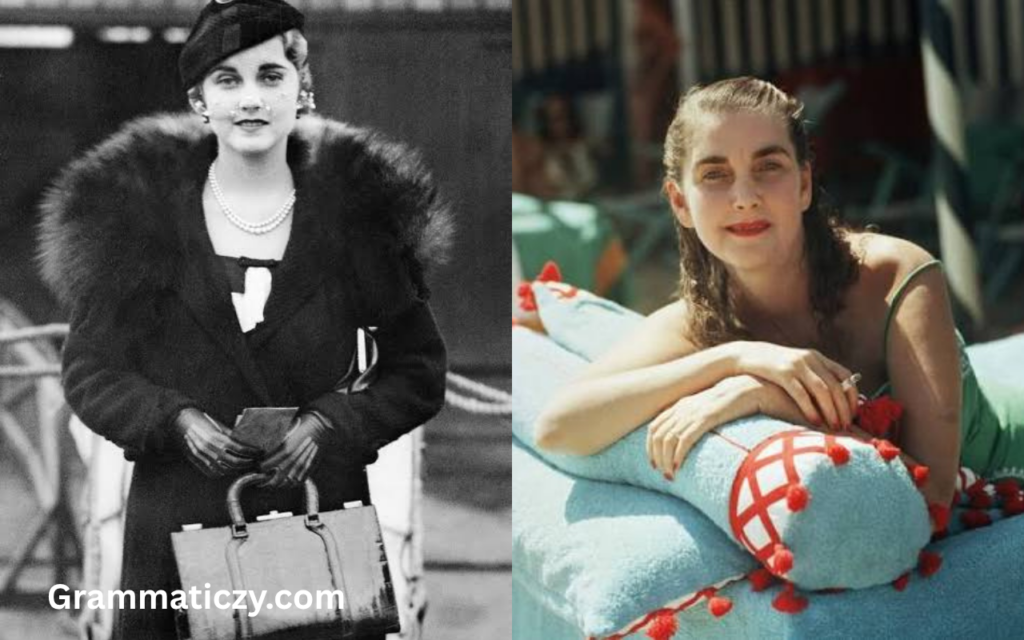
Barbara Hutton was born into a fortune so enormous that most people could scarcely imagine it, yet her life became a remarkable example of how money and happiness can exist on completely different paths. For much of the 20th century, her name represented luxury, international society, priceless jewelry and extravagant living. She was the granddaughter of retail magnate Frank Winfield Woolworth and inherited a vast fortune while still a child. Newspapers and magazines followed her every move, from lavish parties and European travels to her marriages, divorces and increasingly private later years. Behind the glittering public image, however, was a woman who experienced profound loss and spent much of her life searching for security and affection.
Hutton’s story became even more fascinating because of the extraordinary contrast between her financial position and her personal struggles. She could enter some of the most exclusive rooms in the world, purchase spectacular jewels and maintain luxurious homes, but she could not buy emotional stability. Her seven marriages, including her relationship with Hollywood legend Cary Grant, repeatedly placed her in the international spotlight. She also became one of the most important jewelry collectors of her generation, with pieces that remain famous and extraordinarily valuable decades after her death.
Today, Barbara Hutton is remembered as much for the story behind the fortune as for the fortune itself. Her life included childhood trauma, immense inheritance, high society, international romance, motherhood, philanthropy, art and jewelry collecting, financial decline and devastating personal loss. The nickname “Poor Little Rich Girl” captured the contradiction that surrounded her, but it only tells part of the story. To understand Barbara Hutton, it is necessary to look beyond the jewels and headlines and examine the woman who lived behind one of America’s most famous inherited fortunes.
Barbara Hutton Quick Facts
| Category | Details |
|---|---|
| Full Name | Barbara Woolworth Hutton |
| Date of Birth | November 14, 1912 |
| Place of Birth | New York City, New York, USA |
| Date of Death | May 11, 1979 |
| Age at Death | 66 |
| Nationality | American |
| Known For | Heiress, socialite, philanthropist, jewelry collector |
| Father | Franklyn Laws Hutton |
| Mother | Edna Woolworth Hutton |
| Maternal Grandfather | Frank Winfield Woolworth |
| Siblings | None; only child |
| Son | Lance Reventlow |
| Education | Private schools; graduated from Miss Porter’s School in 1929 |
| Marriages | Seven |
| Famous Husband | Cary Grant |
| Peak Fortune | Tens of millions of dollars in her era; some modern estimates place the value in the hundreds of millions |
| Social Media | No personal accounts; she died in 1979 |
| Nickname | “Poor Little Rich Girl” |
Barbara Hutton’s Early Life and Family Background
Barbara Woolworth Hutton was born in New York City on November 14, 1912, to Franklyn Laws Hutton and Edna Woolworth Hutton. Her mother was the daughter of Frank Winfield Woolworth, the retail pioneer whose five-and-dime stores developed into one of America’s best-known retail empires. Her father was associated with the world of finance and investments. From birth, Barbara therefore occupied an extraordinary position within America’s wealthy establishment, although the privileges of her family background were accompanied by expectations and pressures that would follow her throughout her life.
Barbara was an only child, and her childhood was marked by tragedy. Her mother died when Barbara was still very young, an event that had an enormous influence on the direction of her upbringing. Historical sources describe Barbara spending time with relatives, governesses and at private schools rather than growing up within the kind of stable nuclear family environment most children experience. The Woolworths Museum notes that her early life was deeply affected by the death of her mother and by the loss of her grandfather soon afterward.
Her relationship with her grandfather, Frank Woolworth, was especially important during her early childhood. He reportedly treated Barbara affectionately and surrounded her with the kind of luxury that reflected the family’s extraordinary wealth. After his death, however, Barbara’s childhood became increasingly fragmented. She was moved between relatives and schools, and the combination of enormous privilege and emotional uncertainty helped shape the complicated personality that later emerged in public life.
Education and the Making of a Young Heiress
Barbara Hutton received an elite private education that reflected her family’s social position. Her schooling included institutions in California and New York, and she eventually attended Miss Porter’s School for Girls in Farmington, Connecticut. She graduated in 1929, entering adulthood at precisely the moment when America was experiencing enormous economic and social upheaval following the Wall Street Crash.
Her education was not designed to prepare her for a conventional nine-to-five career. Instead, Barbara was being raised within a world where social etiquette, cultural sophistication, fashion, travel and relationships were extremely important. She was expected to understand the customs of America’s upper class and eventually move comfortably through international society. This background helped explain why she later appeared so naturally at home among European aristocrats, artists, actors and wealthy industrial families.
Yet education could not compensate for the emotional difficulties of her childhood. Barbara entered adult life with enormous financial resources but limited experience of ordinary family life. The combination proved unusual and sometimes dangerous. She had the freedom to make decisions on a scale few young women could imagine, but she also became vulnerable to people who recognized that her wealth gave them extraordinary opportunities.
How Barbara Hutton Inherited Her Fortune
Barbara’s enormous wealth came primarily through her Woolworth family inheritance. The Smithsonian records that in 1924, when Barbara was only 12 years old, she inherited a $28 million trust from her grandfather, Frank Woolworth. The Smithsonian’s modern calculation places that amount at approximately $387 million in today’s money, illustrating just how extraordinary the inheritance was for a child in the 1920s.
Her financial position was further complicated by family trusts and investments. Barbara did not simply receive a pile of cash that she could immediately spend. Much of her wealth was structured through trusts and investments, and her father played a significant role in managing financial matters. The Woolworths Museum notes that Barbara benefited from her father’s investment abilities even while other members of the family suffered significant financial losses during the Wall Street Crash.
The inheritance transformed Barbara into one of the most famous young heiresses in America. Wealth that should have provided security instead became a central feature of her identity. People knew her because she was rich before they knew her as an individual. That distinction would become increasingly important as she grew older because it affected friendships, marriages and even the way strangers approached her.
Barbara Hutton and Her Famous Debut
Barbara’s entrance into New York society became one of the defining moments in her transformation from private heiress to public celebrity. Her debut took place during the difficult economic period that followed the 1929 stock-market crash. The event reportedly cost around $80,000, an extraordinary sum for the era, and its extravagance attracted criticism because millions of ordinary Americans were struggling through the Great Depression.
The attention surrounding the event helped establish Barbara’s public image. Newspapers could not resist the contrast between a young woman surrounded by luxury and a nation facing unemployment and economic hardship. Instead of being known simply as Barbara Hutton, she increasingly became “the Woolworth heiress,” a label that reduced a complicated young woman to her financial status.
This was the beginning of a lifelong relationship with the press. Barbara’s clothes, parties, relationships and spending habits became subjects of fascination. The nickname “Poor Little Rich Girl” eventually became attached to her because journalists saw a compelling contradiction between her enormous fortune and her apparent unhappiness. The Woolworths Museum notes that public fascination with her wealth and private life continued throughout her adulthood.
Barbara Hutton’s Seven Marriages and Relationships
Barbara Hutton married seven times, and her relationships became one of the most publicized aspects of her biography. Her husbands included princes, aristocrats, a diplomat, a tennis champion, an artist and Hollywood star Cary Grant. Her first marriage was to Prince Alexis Mdivani in 1933, followed by marriages to Count Kurt Haugwitz-Reventlow, Cary Grant, Prince Igor Troubetzkoy, Porfirio Rubirosa, Baron Gottfried von Cramm and Raymond Doan.
Her marriages were often interpreted through the lens of her fortune. Because Barbara was extraordinarily wealthy, the press and public frequently questioned whether her husbands loved her or were attracted primarily to her money. This created a difficult environment in which genuine affection could be hard to distinguish from financial interest. Barbara herself later reflected on the complicated relationship between money, marriage and happiness.
Her personal life therefore became a cycle of hope and disappointment. She repeatedly sought companionship and emotional security, but her marriages rarely lasted. The pattern contributed heavily to the “Poor Little Rich Girl” narrative, although it is important not to reduce her relationships to a simple story of wealthy men exploiting an heiress. Each marriage had its own circumstances, and the historical record is considerably more complicated.
Barbara Hutton and Cary Grant
Among all of Barbara Hutton’s marriages, her relationship with Cary Grant remains the most famous. The Hollywood actor and the wealthy heiress married on July 8, 1942, creating an extraordinary pairing between the entertainment world and American high society. Cary Grant’s official historical website identifies Hutton as his second wife and records that their marriage lasted until August 30, 1945.
The press immediately focused on the enormous difference between their financial circumstances. Grant was a successful movie star, but Hutton’s inherited wealth was vastly greater. Their relationship became associated with the nickname “Cash and Cary,” a label that Grant reportedly disliked because it reduced their marriage to money. The narrative also contributed to speculation that Grant was marrying Hutton for financial reasons, something later accounts strongly complicate.
Despite their divorce, Grant remained an important figure in Barbara’s emotional history. The Washington Post reported after her death that Barbara once said Grant was the husband she loved most. Accounts also note that Grant did not pursue a financial settlement from her after their divorce. Their relationship therefore occupies a special place in Barbara’s story: it was relatively brief, but it remained one of the most emotionally significant relationships associated with her life.
Barbara Hutton as a Mother
Barbara Hutton had one child, Lance Reventlow, born during her marriage to Count Kurt Haugwitz-Reventlow. Unlike many aspects of her life that were dominated by social events and media attention, motherhood appears to have been deeply meaningful to Barbara. The Woolworths Museum describes Lance as someone she adored and portrays her as a supportive mother who gave him space as he became an adult.
Lance developed his own identity outside his mother’s celebrity. He became involved in motor racing and eventually used his inheritance to establish a successful racing operation. His career gave Barbara another source of pride and allowed her to watch her son build a reputation based on his own interests rather than simply being known as the child of a famous heiress.
The relationship ended in tragedy when Lance died in an airplane accident in 1972 at the age of 36. His death was devastating for Barbara and profoundly affected her remaining years. The Woolworths Museum states that she was devastated and never truly recovered from the loss. His death also marked a major turning point in her increasingly private and isolated later life.
Barbara Hutton and Her Extraordinary Jewelry Collection
Barbara Hutton became one of the most important jewelry collectors of the 20th century. Her collection included exceptional diamonds, pearls, jadeite and other precious stones, as well as pieces connected with famous European and Asian jewelry traditions. She worked with prestigious jewelry houses and developed a reputation for having an unusually sophisticated eye for rare and historically significant pieces.
The most famous jewel associated with her name is the Hutton-Mdivani jadeite necklace. The necklace consists of 27 graduated jadeite beads, accompanied by a clasp set with rubies and baguette diamonds. Sotheby’s describes it as one of the most important pieces of jadeite jewelry in auction history and confirms that it was formerly part of Barbara Hutton’s collection.
The necklace became a global sensation after it was sold at Sotheby’s Hong Kong in 2014 for approximately $27.4 million. The sale established a world auction record for jadeite jewelry at the time and also set a record for a Cartier jewel. Forbes reported that the necklace sold for more than twice its estimate and was ultimately acquired for the Cartier Collection.
The Hutton-Mdivani Necklace and Its Lasting Legacy
The Hutton-Mdivani necklace is significant not only because of its enormous auction price but because of its historical association with Barbara Hutton. The necklace was reportedly given to her by her father as a wedding gift in 1933 when she married Prince Alexis Mdivani. Hutton later commissioned Cartier to modify the clasp, giving the piece its distinctive combination of jadeite, rubies, diamonds, platinum and gold.
The necklace’s history illustrates Barbara’s approach to collecting. She did not merely purchase expensive objects because they were expensive. She was attracted to pieces with exceptional materials, craftsmanship, provenance and visual character. Sotheby’s described her as one of the most important jewelry collectors of the 20th century, and the necklace remains a powerful example of the taste she developed during her years in international high society.
Its extraordinary auction history has ensured that Barbara’s name remains relevant in modern luxury and jewelry circles. The necklace first attracted major attention at auction decades after her death, and its 2014 sale demonstrated that the cultural value of her collection could continue increasing long after her fortune itself had disappeared. In this respect, Barbara Hutton’s jewelry became one of the most durable parts of her legacy.
Barbara Hutton’s Lifestyle, Art and Philanthropy
Barbara’s lifestyle was defined by international travel, luxurious residences, couture clothing, fine art and exceptional jewelry. She moved through some of the world’s most exclusive social circles and maintained connections with aristocrats, artists, actors and wealthy families. Her homes reflected her fascination with European culture and luxury, while her collection of decorative arts and jewelry became increasingly sophisticated over the years.
Her relationship with luxury was not simply about showing off wealth. Barbara had a genuine interest in beautiful and historically important objects. Jewelry in particular became a form of self-expression. Her collection included pieces that reflected different cultures and periods, allowing her to build a personal aesthetic that was much more complex than the newspaper caricature of an extravagant heiress.
At the same time, Barbara could be extraordinarily generous. The Woolworths Museum describes a woman who frequently gave money to friends and acquaintances and spent heavily on other people as well as herself. Her generosity was sometimes financially imprudent, particularly because she did not develop the kind of disciplined wealth-management approach that might have preserved her inheritance.
Barbara Hutton’s Net Worth and Financial Decline
Estimating Barbara Hutton’s net worth is difficult because the value of her inheritance changed dramatically over her lifetime and because historical estimates are often presented without consistent methodology. What is clear is that she inherited an enormous fortune. The Smithsonian identifies her 1924 trust as $28 million, equivalent to roughly $387 million in today’s money according to its calculation.
Her wealth supported an extraordinarily expensive lifestyle, including residences, travel, jewelry, gifts, investments, marriages and international social commitments. The Woolworths Museum argues that her fortune was gradually consumed through spending, gifts, investment fees and other financial decisions. Importantly, Barbara did not operate the Woolworth retail company itself; her wealth came from inheritance and associated trusts rather than from running the business.
By the end of her life, her financial circumstances had changed dramatically. Some retrospective accounts claim that she had only a very small amount of money remaining when she died, but precise figures should be treated cautiously because estate valuations and historical reporting vary. The larger and more reliable conclusion is that a fortune once measured in tens of millions of dollars had been reduced enormously by the time of her death.
Barbara Hutton’s Final Years and Death
Barbara’s final years were increasingly distant from the glamorous world that had surrounded her during her youth. The death of her son Lance in 1972 was an especially devastating blow. At the same time, she experienced serious health problems and became increasingly isolated from the international social scene that had once followed her every move.
The Washington Post reported that Hutton died on May 11, 1979, at the age of 66. She had recently been hospitalized for pneumonia and had suffered from a number of serious health problems. She died after being taken to Cedars-Sinai Hospital from her suite at the Beverly Wilshire Hotel.
Her death brought renewed attention to the extraordinary arc of her life. She had begun as one of America’s most famous child heiresses and spent decades surrounded by enormous wealth and celebrity. Yet she ended her life far removed from the glittering image that had once defined her. Her story became a powerful reminder that material abundance does not necessarily provide emotional security or protection from tragedy.
Did Barbara Hutton Have Instagram, Twitter or LinkedIn?
Barbara Hutton did not have Instagram, Twitter/X, Facebook, LinkedIn or any other modern social-media account. She died in 1979, long before the internet and social networking platforms existed. Modern profiles using her name should therefore be understood as historical, fan-created, archival or commemorative pages rather than personal accounts operated by Barbara herself.
Her modern digital presence instead comes from museums, auction houses, historians, jewelry publications, documentaries and archival collections. Interest in her continues particularly because of her extraordinary jewelry collection and her connection to some of the most famous personalities of the 20th century.
This distinction matters for anyone researching Barbara Hutton online. Her name remains highly searchable, but modern social-media activity should not be presented as evidence of personal interaction or current projects. Her story is historical, and her legacy is preserved through documentation rather than through direct communication with an online audience.
Barbara Hutton’s Enduring Influence
Barbara Hutton’s influence can still be seen most clearly in the world of luxury jewelry. Pieces that once belonged to her continue to attract collectors and generate enormous auction interest. The Hutton-Mdivani necklace’s $27.4 million sale in 2014 demonstrated the continuing importance of her collection and helped reinforce her reputation as one of the great jewelry collectors of the 20th century.
Her life has also remained relevant to historians studying American wealth and high society. Barbara represented a generation of heiresses whose fortunes connected them to European aristocracy, Hollywood and international luxury culture. Her story shows how inherited wealth could provide extraordinary access while simultaneously making personal relationships more complicated.
Perhaps the most enduring part of her influence is the lesson contained in the contradiction of her life. Barbara Hutton had access to things most people could never own, yet she experienced losses and emotional difficulties that money could not prevent. Her biography therefore continues to fascinate not simply because she was wealthy, but because her life raises timeless questions about love, identity, loneliness, family and the meaning of success.
Conclusion: The Real Legacy of Barbara Hutton
Barbara Hutton’s life cannot be reduced to the phrase “Poor Little Rich Girl.” She was certainly one of the most famous heiresses of the 20th century, but she was also a mother, philanthropist, art enthusiast, jewelry collector and woman who repeatedly searched for lasting companionship. Her story moved from extraordinary privilege to profound personal loss, creating one of the most complicated biographies associated with America’s great inherited fortunes.
Her legacy lives on through the spectacular jewelry she once owned, the historical records documenting her extraordinary lifestyle and the continuing fascination with her relationships and family. The Hutton-Mdivani necklace, in particular, has become a lasting symbol of her refined taste and the extraordinary world in which she lived. Its record-breaking auction history shows that while her personal fortune disappeared, parts of her cultural legacy became more valuable with time.
Ultimately, Barbara Hutton’s journey offers a lesson that remains relevant far beyond the world of wealth and celebrity. Her life demonstrates that financial security is not the same as emotional security, and that possessions cannot replace meaningful human relationships. She inherited more money than most people could ever imagine, but her deepest struggles were profoundly human. As future generations continue to discover her story, Barbara Hutton remains a compelling reminder that a meaningful legacy is measured not only by what a person owns, but by the experiences, choices, relationships and lessons that survive long after the fortune is gone.