
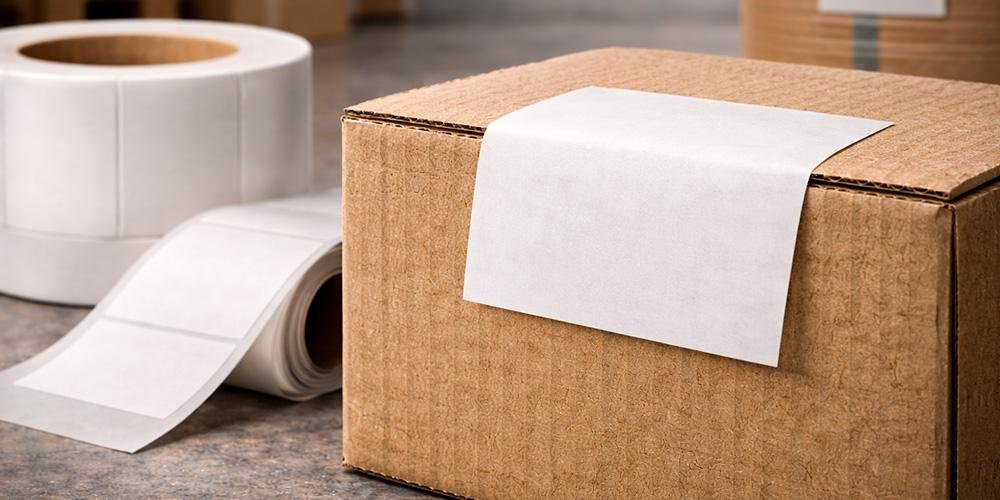
Choose permanent thermal labels when the label must stay attached throughout shipping, storage, sale, or the useful life of the item. Choose removable labels when the user must take the label off cleanly without damaging the product or leaving unacceptable residue. The correct choice depends on the surface, temperature, dwell time, removal method, and required label life.
“Permanent” does not mean impossible to remove, and “removable” does not mean weak. These terms describe designed adhesive behavior under stated conditions. Both types can fail when applied to dirty, wet, cold, textured, curved, or low-surface-energy materials without testing.
What Is a Permanent Adhesive?
A permanent pressure-sensitive adhesive builds a strong bond intended to remain for the application. Initial tack holds the label during placement, while adhesion commonly increases with time and pressure. Removing the label may tear the facestock, leave residue, or damage a delicate surface.
Use permanent labels for shipping cartons, inventory, product identification, warehouse locations, compliance information, and tamper-evident constructions where continued attachment matters. Select an adhesive formulated for the specific substrate and temperature rather than assuming every permanent grade is interchangeable.
What Is a Removable Adhesive?
A removable adhesive is designed to hold during use and release cleanly from approved surfaces. Different grades may be removable once, repositionable several times, ultra-removable from delicate items, or removable only within a defined period.
Use removable labels for shelf pricing, temporary inventory, reusable totes, glassware, rental assets, work-in-process identification, and products where residue would be unacceptable. Long dwell time, heat, UV exposure, plasticizers, cleaners, and surface aging can change removability.
Which Surfaces Are Most Difficult?
Corrugated board, recycled cardboard, textured plastics, powder coatings, and rough wood provide limited contact area. Polyethylene and polypropylene have low surface energy and may need a more aggressive adhesive. Glass and polished metal are smooth but can reveal residue clearly.
Flexible films stretch and small containers create lifting forces at the label edges. Paper packaging may tear during removal even when the adhesive releases cleanly. Test the label and the surface together, including any varnish, mold release, or cleaning chemical used in production.
How Does Temperature Change Adhesion?
Application temperature is the surface temperature when the label is attached. Service temperature is the range the bonded label can tolerate afterward. A label rated for freezer service may still need to be applied above freezing unless it uses a cold-application adhesive.
Cold reduces adhesive flow and initial wet-out; heat can soften adhesives and increase residue or edge movement. Test the actual sequence: label before freezing, label while cold, thaw and remove, or move repeatedly between temperatures. These are different requirements.
How Does Dwell Time Affect Removal?
Pressure-sensitive adhesives usually build bond over hours or days. A removable label that lifts cleanly after ten minutes may behave differently after six months. Heat, sunlight, and contact with plastic can accelerate changes in the adhesive or surface.
Define the minimum and maximum dwell time in the specification. Evaluate removal at both points and after environmental exposure. For reusable containers, test multiple cleaning and relabeling cycles rather than one new surface.
Does the Facestock Matter?
Yes. Paper can tear during removal and leave fragments even if adhesive residue is low. A synthetic film is stronger and may allow the entire label to peel away in one piece. Conformable materials also reduce edge lift on curved surfaces.
Direct thermal images have a limited environmental life, so a durable facestock does not automatically create a long-life label. Match the printing technology to the required readability. Select label material as a complete combination of facestock, thermal coating, adhesive, and liner.
When Should You Choose Permanent Labels?
- The barcode or instructions must stay with the item through distribution.
- Loss of the label would create a safety, traceability, or shipping problem.
- The package will be discarded rather than reused.
- The surface is rough, cold, dusty, or difficult to bond.
- Visible residue or surface damage during removal is not important.
Do not automatically choose the most aggressive adhesive. Excessive tack can create application problems, adhesive ooze, liner release issues, or damage during correction. Use the least aggressive grade that meets the real retention requirement.
When Should You Choose Removable Labels?
- The customer must remove pricing or instructions from the product.
- Containers, shelves, totes, or trays are reused.
- The label is temporary work-in-process identification.
- Residue would interfere with appearance, cleaning, or the next label.
- Repositioning during manual application is valuable.
Specify whether removal must be clean at room temperature, cold, or hot. Also define the removal angle and speed if the application is critical. A label can peel cleanly when warm and leave residue when removed directly from a freezer.
How Should You Test Adhesive Performance?
Apply samples to production surfaces after normal cleaning or handling. Use the same application temperature and pressure as the real process. Inspect initial tack, edge lift, sliding, and bubbling, then evaluate adhesion and removal after the required dwell time.
Include the hardest surface, smallest diameter, lowest temperature, and longest storage period. Record residue, staining, tearing, surface damage, and whether the label can be reapplied. Do not test only on a clean glass panel unless glass is the actual product.
Does Manual or Automatic Application Change the Choice?
Manual application allows an operator to reposition a label, apply extra pressure, and reject a contaminated surface. A removable or repositionable grade can therefore improve placement. Automatic equipment applies labels quickly with controlled but limited contact pressure, so initial tack, release force, stiffness, and consistent die cutting become more important.
Test the adhesive using the actual application method and line speed. A construction that bonds during a careful hand test may lift when applied automatically to a moving carton. Also check whether adhesive transfers to guides, peel plates, or applicator pads during an extended run.
What Should You Tell the Supplier?
Give the label supplier the surface material, texture, curvature, application temperature, service range, dwell time, moisture and chemical exposure, required removability, printer, roll construction, and monthly volume. Provide physical samples when coatings or recycled materials vary.
Approve a named construction and require notification before the adhesive, facestock, liner, or coating changes. The best decision is not permanent versus removable in isolation; it is the construction that stays attached for the required period and behaves predictably when removal is attempted.