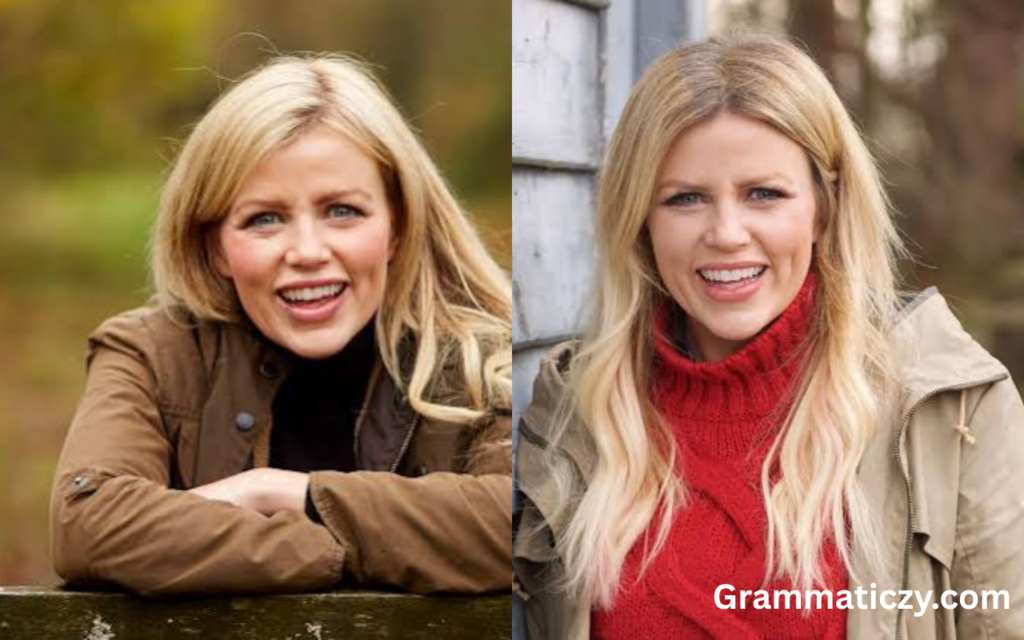
Ellie Harrison’s journey to becoming one of Britain’s best-known countryside television presenters was anything but conventional. Born and raised in rural Gloucestershire, she developed an appreciation for wildlife and the natural environment long before television became part of her life. Her childhood on a Cotswolds smallholding, academic training in geography and ecology, international wildlife experiences and eventual career in broadcasting all came together to create a presenter whose professional identity has always been closely connected with nature. For millions of viewers, she became particularly familiar through the BBC’s Countryfile, where she spent around 13 years reporting on rural Britain, wildlife, farming, conservation and the people who live and work in the countryside.
What makes Ellie Harrison’s biography especially compelling is that television was not necessarily the destination she had planned for herself. She once dreamed of becoming a country singer, but an unexpected opportunity at Channel 5 introduced her to broadcasting. What initially looked like a temporary change of direction eventually became a highly successful career in natural-history television. Her scientific education gave her credibility when discussing environmental subjects, while her warmth and curiosity helped make those subjects accessible to a mainstream audience.
Today, Harrison is best remembered for her long association with Countryfile, but her story did not end when she left the BBC programme in 2023. After more than a decade on screen, she chose to chart a different course, focusing more attention on her three children, her family business, her Cotswolds life and her own creative interests. Her career therefore offers more than a conventional celebrity success story: it is also a story about changing priorities, personal growth and having the confidence to begin a new chapter after achieving professional success.
Ellie Harrison Quick Facts
| Category | Details |
|---|---|
| Full name | Eleanor Harrison |
| Known as | Ellie Harrison |
| Date of birth | November 17, 1977 |
| Age | 48 years old in 2026 |
| Birthplace | Gloucestershire, England |
| Nationality | British |
| Profession | Television presenter, journalist and natural-history broadcaster |
| Best known for | BBC Countryfile |
| Countryfile tenure | 2009–2023 |
| Education | Sir William Romney’s School; Cirencester College; King’s College London |
| University subject | Geography with Ecology |
| Parents | Her father was a carpenter and her mother was a midwife |
| Siblings | No reliably documented public information |
| Partner | Matthew “Matt” Goodman |
| Children | Three |
| Home | Cotswolds, Gloucestershire |
| Major interests | Wildlife, conservation, countryside, cycling, wild swimming and music |
| Notable programmes | Countryfile, Michaela’s Wild Challenge, Country Tracks, Springwatch, Secret Britain and others |
| Net worth | No independently verified public figure |
| Social media | Has maintained a public social-media presence, although current verified account details should be checked before relying on older handles |
The information above combines details documented by Harrison’s own professional biography and established profiles of her career. Her own biography confirms a long television career that included Countryfile, Wild Challenge, The One Show, Daily Planet, Country Tracks, Springwatch and several other factual programmes. It also records awards and recognition connected with her broadcasting work.
Financial information is considerably less certain. Unlike some celebrities, Harrison has not publicly released a verified figure for her personal wealth, and celebrity-net-worth websites can be speculative. It is therefore more accurate to discuss her professional income sources than to attach an unsupported number to her net worth. Her career has included television presenting, writing, journalism, appearances and other professional projects, while her life after Countryfile has also involved family and business interests.
Who Is Ellie Harrison?
Ellie Harrison is an English television presenter and journalist whose work has focused heavily on wildlife, geography, rural Britain and environmental subjects. Her scientific background makes her somewhat different from presenters who enter factual television primarily through entertainment. She studied Geography with Ecology at King’s College London and developed practical experience of wildlife and conservation before establishing herself on television. This combination of academic knowledge and broadcasting ability became one of the defining characteristics of her career.
Her public profile grew substantially after she joined Countryfile in 2009. The BBC programme gave Harrison an unusually broad platform because its subject matter extended well beyond traditional farming. Episodes regularly explored wildlife, food production, rural communities, conservation, landscapes, outdoor activities and the changing relationship between people and the British countryside. Harrison’s ability to move comfortably between these subjects helped establish her as a familiar and trusted face of the programme.
Although her television career has been highly visible, Harrison has also developed a reputation as a writer and environmental communicator. Through her work connected with BBC Countryfile Magazine, she has written about subjects including wildlife, countryside access, birds, nature and the experience of spending time outdoors. Her writing reflects the same curiosity that characterised her television work: instead of treating nature as a distant subject, she often explores how people experience and interact with the environment around them.
Early Life and Family Background
Ellie Harrison was born on November 17, 1977, and grew up in rural Gloucestershire near Cirencester. Her childhood was strongly influenced by the Cotswolds, where her family lived on a smallholding and grew vegetables and kept chickens. Her father worked as a carpenter and her mother was a midwife. This was a very different upbringing from that of someone raised entirely in an urban environment, because the rhythms of seasons, animals, food production and the land were part of ordinary family life.
That early exposure to the countryside became particularly important later in Harrison’s career. When she eventually began reporting on farming, wildlife and rural communities, she was not approaching those subjects solely as a television presenter. She had personal experience of rural life and understood that the countryside was both beautiful and practical. It was a place where people worked, produced food, cared for animals and maintained traditions, while also facing modern environmental and economic pressures.
Harrison has subsequently described her relationship with the Cotswolds as complicated but deeply affectionate. Like many people who grow up in rural areas, she wanted to experience life elsewhere when she was younger and spent periods away from home. Yet the landscape remained important to her, and she eventually returned to the Cotswolds as an adult. Her own writing about the area shows that she sees it as more than a picturesque tourist destination; for her, it is a place connected with memory, family, identity and everyday life.
Education and Academic Background
Harrison attended Sir William Romney’s School in Tetbury and later studied at Cirencester College. She eventually went to King’s College London, where she studied Geography with Ecology. Her academic path is significant because it provided the scientific foundation for the environmental and wildlife subjects that would later become central to her television career.
Her university experience was not entirely straightforward. In a first-person account published by The Guardian, Harrison explained that she initially began university in Manchester but left after only six weeks because the course did not feel right for her. She also experienced a serious disruption when the halls where she was living burned down. Rather than allowing the setback to end her education, she travelled to Africa and continued working toward a different academic path, eventually interviewing for King’s College London while she was still abroad.
Her studies eventually took her toward Africa and conservation research. She received a scholarship associated with King’s College London to undertake research in Zimbabwe focusing on elephant conservation. Her professional biography also records her work and travels in Africa, including experience on a farm in Zimbabwe and wildlife trips involving countries such as Zambia and Zimbabwe. These experiences gave her first-hand exposure to conservation issues beyond Britain and strengthened the environmental perspective that later became visible in her broadcasting.
How Ellie Harrison Started Her Television Career
One of the most surprising elements of Harrison’s career is that she did not initially set out to become a television presenter. Her early ambition was reportedly to become a country singer. Her route into television began after she took a job as a secretary at Channel 5. A producer noticed her potential and suggested that she could work as a children’s television presenter. Harrison initially turned down the idea, but the producer continued to encourage her.
Eventually, Harrison was given an opportunity to cover Michaela Strachan’s maternity leave on Michaela’s Wild Challenge. The experience proved to be a turning point. The programme combined entertainment with wildlife and natural-history subjects, giving Harrison the opportunity to discover that her scientific interests and communication skills could work effectively together on screen. The programme later won a BAFTA, adding an important early recognition to the beginning of her television career.
From there, Harrison began building a broader portfolio of natural-history and factual television work. Her professional biography lists projects including The One Show, Daily Planet, Wild About Your Garden, Country Tracks, Britain’s Big Wildlife Revival, Nature’s Miracle Orphans, Dinosaur Britain, Britain’s Whales, Britain’s Sharks and Springwatch. This progression shows that Countryfile was not an isolated success but part of a much longer development as a factual television presenter.
Ellie Harrison and Countryfile
Harrison joined Countryfile in 2009, beginning the television chapter for which she would become best known. Her arrival came during an important period for the programme, which had developed into a broad exploration of rural Britain rather than a narrowly agricultural series. The programme covered wildlife, farming, food, environmental issues, landscapes, outdoor activities and the experiences of people living and working outside Britain’s towns and cities.
Her combination of rural upbringing and ecological education made her especially well suited to that role. She could talk about biodiversity and conservation while also understanding the practical side of countryside life. She could interview farmers, investigate wildlife projects, explore landscapes and participate in outdoor activities without losing the sense of curiosity that makes television engaging. Over time, her face became closely associated with the programme and with BBC environmental and countryside broadcasting more generally.
Harrison later reflected on her first decade with Countryfile and described the strange, unpredictable nature of filming the series. One memorable assignment involved harvesting shiitake mushrooms, cooking them on a gas stove and then taking a mountain railway toward the summit of Snowdon to deliver a mushroom sandwich to Matt Baker. The story illustrates the unusual mixture of serious reporting, food, travel and spontaneous outdoor adventure that became part of her working life.
Other Television Programmes and Achievements
Although Countryfile became her signature role, Harrison’s television career has included a wide range of factual and natural-history productions. Her work has crossed broadcasters and formats, from wildlife programming to live events and environmental documentaries. Her own professional biography records appearances on BBC, Channel 5, Discovery, ITV and other projects, demonstrating the breadth of her experience beyond one programme.
Her professional achievements have also included significant industry recognition. The Michaela’s Wild Challenge programme won a BAFTA Children’s Factual award in 2006, while Harrison’s biography records a Royal Television Society West award for Female On-Screen in 2014. She was also involved in Springwatch 2020, which received a BAFTA Live Event award. These recognitions provide evidence that her career has been acknowledged not simply by viewers but within the broadcasting industry itself.
Beyond awards, one of Harrison’s most meaningful achievements may be the longevity of her work. Remaining part of Countryfile for around 13 years required the ability to adapt continuously to changing stories, filming conditions and audience expectations. Her career demonstrates how specialist knowledge can become a long-term professional advantage when it is combined with strong communication skills and a genuine enthusiasm for the subject.
Why Did Ellie Harrison Leave Countryfile?
In 2023, after approximately 13 years on Countryfile, Harrison announced that she was leaving the programme. Her departure attracted considerable attention because she had become such a familiar member of the presenting team. Rather than presenting the decision as a dramatic break, she described it as a personal choice to move in a new direction after a major chapter of her professional life.
In her final Countryfile Magazine column, Harrison explained that she would miss many aspects of the programme but wanted to focus on her three children, her family business and her own creative calling. Her language suggested that leaving television was not about rejecting the experiences she had gained; instead, she wanted to use those experiences as the foundation for a different stage of life.
Her final episode was broadcast in December 2023, closing a remarkable 13-year association with the BBC series. The departure demonstrated a side of Harrison’s personality that had not always been visible during her television career: a willingness to reassess what success means and to make a significant professional change even after establishing a secure position in a popular programme.
Ellie Harrison’s Family and Personal Life
Harrison has generally kept her family life more private than many television personalities. Public profiles state that she lives in the Cotswolds with her partner, Matthew “Matt” Goodman, and their three children. Family has become increasingly important in her decisions about work, particularly around the time she left Countryfile.
Her return to the Cotswolds also represents something of a homecoming. She spent part of her adult life in London and elsewhere, but eventually returned to the landscape where she grew up. The connection is especially significant because the Cotswolds were not simply a professional subject for her; they were part of her childhood and personal history. Her later life has therefore brought together family, countryside and work in a way that reflects the themes of her entire career.
Outside broadcasting, Harrison has been associated with activities including cycling, wild swimming, singing and playing the banjo. Her interests reflect the active, outdoors-oriented personality viewers encountered on television. Rather than treating nature as merely a professional topic, she appears to incorporate outdoor experiences into her own lifestyle, reinforcing the authenticity that has been one of the strongest elements of her public image.
Conservation and Environmental Work
Harrison’s environmental interests extend beyond television presenting. Her academic training in ecology, her research experience in Zimbabwe and her years covering wildlife stories have given conservation a central place in her professional life. She has used her public platform to discuss issues including biodiversity, birds, wildlife habitats, countryside access and humanity’s relationship with nature.
Her writing for Countryfile has explored the idea that small individual actions can contribute to protecting wildlife. She has written about British birds, ancient paths, nature and the emotional benefits of being outdoors, showing that environmental communication does not always need to be framed around enormous global problems. Sometimes it begins with encouraging people to notice what is immediately around them.
This approach is particularly valuable because Harrison occupies a space between specialist science and popular media. She can introduce ecological ideas without requiring viewers to have a scientific background. Her work has consequently helped turn subjects such as habitat conservation, wildlife decline and landscape change into accessible stories about everyday British life.
Ellie Harrison’s Net Worth and Sources of Income
There is no reliable public documentation establishing Ellie Harrison’s exact net worth in 2026. Numbers sometimes published on celebrity websites should therefore be treated cautiously because they are often estimates based on assumptions rather than verified financial records. A responsible biography should not present a speculative figure as though it were an official fact.
Harrison’s professional income has historically come from several areas, including television presenting, factual programming, journalism, writing and related media work. Her long-running position on Countryfile would have represented an important part of her career, while her work on other programmes broadened her professional opportunities. Her specialist knowledge of wildlife and environmental subjects also gave her a distinctive position within British factual broadcasting.
Since leaving Countryfile, her financial circumstances have become even harder to measure from public information because her professional life is no longer centred on one high-profile weekly television role. Her family business and other projects form part of the new chapter she described when announcing her departure. For that reason, the most accurate conclusion is that Harrison has built a successful media career, but her exact personal wealth remains private and should not be guessed.
Social Media and Public Image
Social media has provided Harrison with another way of maintaining contact with audiences interested in wildlife, countryside life and environmental issues. Her public profile has historically included platforms such as Twitter/X and Instagram, where she has shared aspects of her work and interests. Because social-media handles can change or become inactive, older references should be verified before being treated as current official accounts.
Her online identity has generally fitted naturally with the public image established through television. Wildlife, outdoor experiences, landscapes and countryside stories are subjects that lend themselves particularly well to photographs and short updates. This means her social-media presence can extend the same relationship with nature that viewers developed through Countryfile and her other programmes.
The most important feature of Harrison’s public image, however, is not any particular platform. It is the consistency between her professional work and her personal interests. Her academic background, childhood in Gloucestershire, environmental writing, outdoor hobbies and television career all point toward the same central theme: a lasting curiosity about the natural world and the people who live within it.
Life After Countryfile and Future Direction
Leaving Countryfile did not mean leaving the countryside behind. In many ways, Harrison’s life after the programme has allowed her to become even more closely connected with the environment she has spent much of her career documenting. Her decision was influenced by a desire to raise her children, contribute to her family business and pursue her own creative interests.
Her future therefore does not need to be defined solely by another television presenting job. Harrison has already demonstrated that she can work across television, writing, environmental communication and other creative projects. The skills developed during her years on Countryfile—research, interviewing, storytelling, presenting and explaining complex subjects—can be applied to many different forms of work.
As of 2026, there is no single newly announced television programme that publicly defines her post-Countryfile career in the way the BBC series once did. That does not necessarily indicate a lack of activity; rather, it reflects a more private and varied chapter. Her departure statement made clear that she wanted to pursue a broader personal and creative direction, suggesting that her next phase may be measured less by television appearances and more by the projects and priorities she chooses for herself.
Ellie Harrison’s Influence and Legacy
Ellie Harrison’s influence comes from the way she has helped make environmental subjects understandable and engaging for a mainstream audience. Her work has demonstrated that discussions about ecology, conservation, wildlife and rural life do not have to remain confined to academic publications or specialist programmes. Through television and writing, she has brought these topics into ordinary living rooms and encouraged viewers to see the countryside as a living environment rather than simply a beautiful backdrop.
Her career also illustrates the value of combining education with communication. A degree in Geography with Ecology alone would not have guaranteed success in broadcasting, just as television experience alone would not have given her the scientific foundation behind many of her stories. Harrison’s distinctive strength came from bringing both worlds together. Her ability to understand environmental subjects and then explain them in an approachable way became an important part of her professional identity.
Perhaps her most lasting lesson is that professional success does not have to mean staying in the same position indefinitely. Harrison reached a point where she could have continued along a familiar television path, yet she chose to step away after 13 years and give greater attention to family, business and personal creativity. Her story demonstrates that a successful career can be a series of chapters rather than a single permanent destination.
Conclusion
Ellie Harrison’s biography is ultimately a story of curiosity, resilience and reinvention. From a smallholding in rural Gloucestershire to university study in geography and ecology, from wildlife research in Africa to an unexpected opportunity in television, she repeatedly followed opportunities that allowed her fascination with the natural world to develop. Her years on Countryfile transformed her into a familiar face of British countryside television, while her work on other factual programmes established her as a versatile natural-history presenter.
Her decision to leave Countryfile after 13 years provides perhaps the most important chapter of all. Rather than allowing professional recognition to determine the rest of her life, Harrison chose to make room for her children, family business and creative ambitions. That decision reflects the same independence that can be seen throughout her earlier journey, from changing university direction to accepting an unexpected opportunity in television.
As Ellie Harrison continues to build the next chapter of her life, her journey remains an inspiring reminder that meaningful success is not simply about how long someone stays in the spotlight. It is about using knowledge, passion and experience to create something valuable, recognising when circumstances need to change and having the courage to follow a new path. Her connection with nature has shaped almost every stage of her story, and that enduring relationship may ultimately prove to be her most lasting legacy.