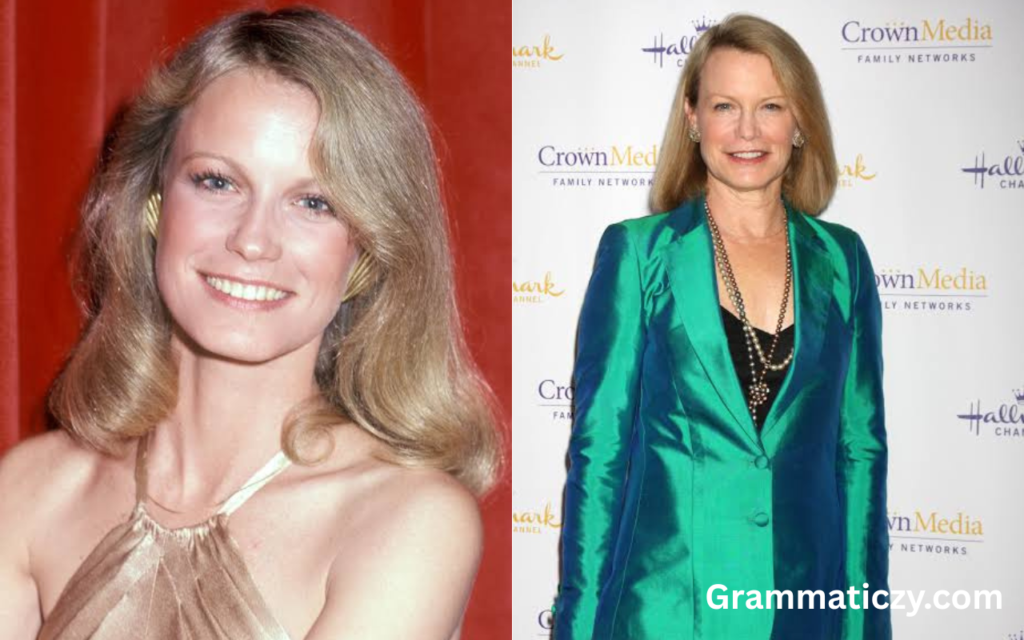
There are some Hollywood careers that are remembered for one unforgettable role, while others become interesting because of everything that happens after the spotlight fades. Shelley Hack belongs to the second category. To television audiences, she is best remembered as Tiffany Welles, the elegant and composed detective who joined Charlie’s Angels during its fourth season. To millions of consumers in the 1970s, however, she was already much more familiar as the face of Revlon’s Charlie fragrance, an advertising campaign that helped turn her into one of the recognizable faces of the era. Yet her story did not end when she left television. Hack gradually moved into production, business, international media consulting and political work, creating a professional life that was far more varied than her glamorous screen image might suggest.
What makes Shelley Hack particularly fascinating is the contrast between her public image and her education and ambitions. She was not simply a model who happened to become an actress. She studied history at Smith College, spent part of her college years studying archaeology at the University of Sydney, developed an international outlook and later earned an MBA. Her career eventually took her into media consulting and projects connected with international peacekeeping and political communication. That combination of entertainment experience, academic preparation and business knowledge allowed her to reinvent herself several times rather than remaining dependent on the celebrity identity created for her in the 1970s.
Today, Shelley Hack lives a considerably quieter life than she did during the height of her fame. Her rare public appearances have attracted attention precisely because she has largely stayed away from the celebrity spotlight. A 2025 report documented one of those unusual appearances in Connecticut, where the former Charlie’s Angels actress was seen during an ordinary grocery-shopping trip. Meanwhile, the 50th anniversary of Charlie’s Angels in 2026 has brought renewed attention to the original series and its changing cast, reminding audiences that Hack’s one-season contribution remains part of the show’s enduring television history.
Shelley Hack Quick Facts
| Category | Details |
|---|---|
| Full Name | Shelley Marie Hack |
| Born | July 6, 1947 |
| Age | 79 years old in 2026 |
| Birthplace | White Plains, New York, according to IMDb; raised in Greenwich, Connecticut |
| Nationality | American |
| Profession | Actress, model, producer, media consultant |
| Best Known For | Tiffany Welles on Charlie’s Angels and Revlon’s Charlie fragrance |
| Education | Greenwich Academy; Smith College; University of Sydney studies |
| College Degree | History |
| Advanced Degree | MBA, New York Institute of Technology |
| Father | William Hack, Wall Street financial analyst |
| Mother | Patricia “Patti” Hack, former model |
| Siblings | Five siblings; Shelley was the eldest |
| Husband | Harry Winer |
| Marriage | 1990 |
| Children | One daughter, Devon Rose Winer |
| Estimated Net Worth | Frequently estimated at around $20 million; not independently verified |
| Famous Role | Tiffany Welles in Charlie’s Angels |
| Years Active | 1970s onward, including acting and production work |
| No reliably verified official public account identified | |
| X/Twitter | No reliably verified official public account identified |
| No reliably verified personal public profile identified |
Early Life and Family Background
Shelley Marie Hack was born on July 6, 1947. Some modern databases, including IMDb, list White Plains, New York, as her birthplace, while biographical accounts have also described her as being born in Greenwich, Connecticut. What is clearer is that Greenwich, Connecticut, was the community in which she was raised. She was the eldest of six children, growing up in a family that combined finance and fashion: her father, William Hack, worked as a Wall Street financial analyst, while her mother, Patricia “Patti” Hack, had previously worked as a model. That family background gave Shelley exposure to both professional discipline and the world of fashion from an early age.
Hack attended Greenwich Academy before moving on to Smith College, where she pursued a degree in history. Her education is an important part of her biography because it challenges the assumption that her early modeling success was the entire foundation of her identity. During her junior year, she spent time at the University of Sydney studying archaeology, an experience that gave her the opportunity to live abroad and broaden her understanding of other cultures. Her time outside the United States also fitted naturally with the international perspective she would later bring to her media and consulting career.
Her academic path also suggests that Hack possessed interests well beyond entertainment. Rather than immediately pursuing Hollywood after becoming recognizable as a model, she completed her education and developed qualifications that could support other careers. She later pursued an MBA at the New York Institute of Technology, adding business training to her history degree and entertainment experience. Looking back at her career as a whole, this educational foundation helps explain why she was able to move comfortably between modeling, acting, media production, consulting and business.
Shelley Hack’s Modeling Career
Hack began modeling as a teenager, reportedly starting around the age of 16. One of her early professional opportunities involved Glamour magazine, helping her enter a fashion industry that was becoming increasingly influential in American popular culture. She eventually worked with Ford Models, and her combination of classic features, elegant presentation and natural camera presence made her particularly effective in advertising. Her modeling career was not simply a stepping stone toward acting; it became a major achievement in its own right.
The defining moment came when Hack became the face of Revlon’s Charlie fragrance in the 1970s. The Charlie campaign was particularly significant because it presented a modern image of femininity at a time when American attitudes toward women’s independence were changing. Hack appeared confident and self-possessed rather than simply playing the role of a traditional romantic beauty. The Smithsonian’s collection describing Charlie advertising highlights the campaign’s use of pantsuits and its association with a more independent image of women, helping explain why Hack became so closely connected with the cultural identity of the product.
The success of Charlie made Hack one of the highly recognizable models of the decade. She became associated with the era’s emerging idea of the “supermodel” as a celebrity in her own right, while her commercial agreements demonstrated how valuable a recognizable advertising personality could become. Her face became closely linked with a major beauty brand, and the phrase “Charlie Girl” became part of popular culture. That achievement established a level of public recognition before she had even reached the role that would eventually make her famous to television audiences.
Shelley Hack and Charlie’s Angels
Hack’s transition from modeling to acting began in the 1970s, with her film debut coming in Woody Allen’s Annie Hall in 1977. She followed that appearance with other screen work, including a leading role in If Ever I See You Again. Although the latter film was not a major success, these projects gave Hack an opportunity to establish herself as an actress rather than remaining known exclusively as a commercial model. Her later career would include both film and television appearances.
In 1979, Hack received the opportunity that would permanently connect her name with classic television. She was chosen to replace Kate Jackson on Charlie’s Angels, taking on the role of Tiffany Welles. Tiffany was portrayed as a sophisticated former police officer who joined the Townsend Agency, and Hack appeared alongside Jaclyn Smith and Cheryl Ladd. Her arrival was particularly notable because she was already famous through the Charlie fragrance campaign, meaning television viewers were encountering a performer whose face was already deeply familiar.
Hack’s time on Charlie’s Angels lasted only one season, but the short run should not obscure the importance of the opportunity. The series was one of the defining television hits of the late 1970s, and its concept of women working as private detectives became a lasting part of American pop culture. Later accounts have offered different explanations for Hack’s departure, while biographical sources describe the decision as a mutual agreement connected with the direction of the show. Whatever the precise behind-the-scenes circumstances, Hack’s Tiffany Welles remains an identifiable part of the program’s history.
Acting Career Beyond Charlie’s Angels
After leaving Charlie’s Angels, Hack continued working in film and television instead of disappearing immediately from the entertainment industry. Her later screen credits included appearances in productions such as L.A. Law, The King of Comedy and The Stepfather. Her role in Martin Scorsese’s The King of Comedy is particularly notable because it placed her in a film featuring Robert De Niro and Jerry Lewis, giving her a connection to one of the more distinctive films of 1980s American cinema.
Hack also demonstrated an interest in different types of performance rather than remaining tied exclusively to the glamorous image associated with Charlie. Her career included television appearances, film roles and other professional opportunities. IMDb’s current profile continues to identify her not only as an actress but also as a producer and executive, reflecting the gradual transformation of her career. This ability to move between different areas of the entertainment business became one of the defining characteristics of her professional life.
An important turning point came as Hack became increasingly interested in work outside acting. Her later education and professional experience helped her move toward media consulting and production, allowing her to use the communication skills she had developed in front of the camera in entirely different ways. Instead of competing indefinitely for acting roles, she began developing a professional identity that gave her more control over the projects and organizations with which she worked. That transition would ultimately become one of the most interesting chapters of her biography.
Education, Business and International Media Work
Hack’s decision to earn an MBA after establishing herself in entertainment demonstrated a willingness to keep developing professionally. The degree from the New York Institute of Technology complemented her earlier history education and gave her a business-oriented foundation. Her qualifications were particularly useful as she moved into consulting and production, where understanding organizations, communication strategies and financial considerations can be just as important as creative ability.
In the late 1990s, Hack became involved in international media consulting, including work connected with Bosnia-Herzegovina after the country’s devastating conflict. Biographical accounts describe her involvement with election-related media work, including voting-registration and polling-station supervision, as well as the production of televised presidential debates. This was a striking change from the Hollywood environment in which she had become famous. Her work was now connected with political communication and the development of media systems in societies undergoing major political transitions.
The significance of this chapter is easy to overlook if Hack is viewed only through the lens of Charlie’s Angels. Her international media work demonstrated that she had developed expertise in communication that could be applied outside entertainment. She was able to draw upon her experience as a performer, her academic background, her business education and her understanding of television production. In many ways, this period represents the clearest example of Hack creating a second professional identity rather than simply extending the first.
Shelley Hack as a Producer
Hack eventually returned to entertainment from behind the camera. Her work as a producer allowed her to become involved in the development and organization of projects rather than simply appearing in them. Her later credits include television films and other productions, and reporting on her career has highlighted her work as an executive producer on Hallmark movies during the 2010s.
Among the productions associated with her later career are Hallmark projects including Lucky Christmas, Perfect Match, A Bramble House Christmas, Falling for You, Holiday Hearts, Autumn in the City and Long Lost Christmas. These projects represent a very different kind of entertainment from the high-profile television world of Charlie’s Angels, but they also show the breadth of Hack’s professional evolution. She was no longer simply being cast into a character; she was helping bring stories to audiences from a production position.
This behind-the-scenes career also helps put her earlier fame into perspective. The same qualities that made Hack effective in advertising and television—presentation, communication, understanding audiences and an ability to work within a professional team—could be redirected toward production. Her career therefore became less about maintaining celebrity visibility and more about building a sustainable role within the entertainment industry. That shift is arguably one of the most important achievements of her later professional life.
Shelley Hack’s Husband and Family Life
Shelley Hack has been married to director and professor Harry Winer since around 1990. Their relationship has also included professional collaboration, creating an unusual overlap between Hack’s personal and working life. The couple have one daughter, Devon Rose Winer. Hack has generally kept her family life away from the level of public exposure that accompanied her career during the 1970s and early 1980s.
That preference for privacy has become increasingly noticeable in recent years. Rather than maintaining a constant celebrity presence through interviews, red-carpet appearances and social-media updates, Hack has largely remained outside the modern entertainment-news cycle. A 2025 report described her as living a much quieter life and drew attention to a rare public outing in Connecticut. The fact that an ordinary grocery trip became news illustrates just how private she has become compared with the period when her face was seen regularly in television commercials and magazines.
Her private approach also makes it difficult to make reliable claims about her daily routines, personal beliefs or current activities unless they have been documented by credible sources. There is value in acknowledging that limitation rather than filling gaps with speculation. What can be established is that Hack has maintained a long marriage, raised a daughter and gradually shifted away from the public-facing celebrity lifestyle that defined her early career.
Shelley Hack Net Worth and Sources of Income
Shelley Hack’s net worth is often estimated online at approximately $20 million, but that figure should be treated as an unofficial estimate rather than a confirmed financial disclosure. There is no public audited statement showing her complete assets, investments, property holdings and income, so precise claims about her wealth would be misleading. Celebrity wealth estimates can also differ substantially depending on which sources are used and what assets they include.
Her career nevertheless provides several plausible sources of long-term income. Modeling and her relationship with Revlon’s Charlie campaign established her financially during her early public career, while acting provided additional earnings through television and film. Her later work as a producer and media consultant created new professional income streams, allowing her career to continue even after she stopped appearing regularly on screen. This diversification is one reason her financial story is more interesting than simply attaching a celebrity salary to her name.
Property ownership and production work have also been discussed in connection with her finances, but the exact value of her current assets is not publicly established. A responsible biography should therefore distinguish between documented professional achievements and speculative net-worth calculations. The broader lesson from Hack’s career is clear: her financial longevity appears to have been supported by diversification rather than dependence on a single acting role.
Shelley Hack’s Social Media and Public Presence
Shelley Hack does not appear to maintain a clearly verified and highly active official Instagram, X/Twitter or LinkedIn account that can confidently be attributed to her. There are accounts using similar names across social platforms, but without reliable verification it would be inappropriate to label any particular profile as her official account. This is especially important in a biography intended to provide accurate information rather than simply repeat names found in search results.
Her limited social-media presence is consistent with the broader pattern of her later life. Hack became famous during an era when celebrities did not have to maintain a continuous online relationship with fans. Her public identity was built through magazines, television commercials, movies and television interviews rather than Instagram posts or short-form video. Her current reputation therefore exists largely through archival material, classic television coverage and retrospective articles.
That absence of a major social-media presence has not prevented renewed interest in her career. Classic television audiences continue to discuss her role as Tiffany Welles, while her appearance in the Charlie fragrance campaign remains an important part of advertising history. In 2026, renewed attention surrounding the 50th anniversary of Charlie’s Angels has further reminded viewers of the actresses who contributed to the show’s different eras.
Shelley Hack’s Recent Life and Career
In 2025, Shelley Hack attracted renewed media attention after being photographed during a rare public outing in Connecticut. The coverage emphasized how different her present lifestyle appears from the celebrity culture of her younger years. At 77 at the time of that report, she was described as living largely away from the public eye, making the ordinary nature of the appearance notable precisely because she has rarely sought attention in recent decades.
The renewed interest continued into the 50th anniversary period of Charlie’s Angels in 2026. The series premiered in 1976 and became a major pop-culture phenomenon, and anniversary celebrations have brought former cast members and the show’s history back into the spotlight. Hack was not part of the prominent 2026 reunion reported by the Associated Press, which focused on Kate Jackson, Jaclyn Smith and Cheryl Ladd, but her contribution remains part of the show’s history as the actress who played Tiffany Welles during the fourth season.
There is no strong evidence suggesting that Hack is pursuing a conventional return to acting or actively promoting a major new celebrity project. Her public profile instead reflects a quieter stage of life after decades of work. That does not make her career less significant; if anything, the distance from Hollywood has made her professional evolution easier to appreciate. Her story now stands as much for reinvention and privacy as it does for television fame.
Shelley Hack’s Legacy
Shelley Hack’s legacy begins with the image that made her famous but does not end there. As the face of Charlie, she became part of a major shift in advertising that presented women as confident, independent and professionally sophisticated. As Tiffany Welles, she became part of one of the most recognizable television franchises of the 1970s. Those achievements alone would have secured her a place in popular-culture history.
But the deeper legacy comes from what Hack did after those moments of fame. She pursued higher education, developed business expertise, became involved in international media projects and moved into producing. Her professional path demonstrates that a person’s most recognizable achievement does not have to become the limit of their identity. Instead, early success can become a foundation for learning new skills and entering entirely different fields.
Perhaps that is the most meaningful lesson in Shelley Hack’s story. Fame can arrive unexpectedly, disappear just as quickly and leave a person wondering what comes next. Hack’s answer was to keep evolving. From teenage model to advertising icon, from television actress to international media consultant and producer, her career shows the value of curiosity and reinvention. As audiences continue rediscovering her work through Charlie’s Angels and the enduring Charlie campaign, Shelley Hack remains a reminder that a meaningful legacy is not always built through the number of years spent in the spotlight—it can also be built through the courage to step beyond it.