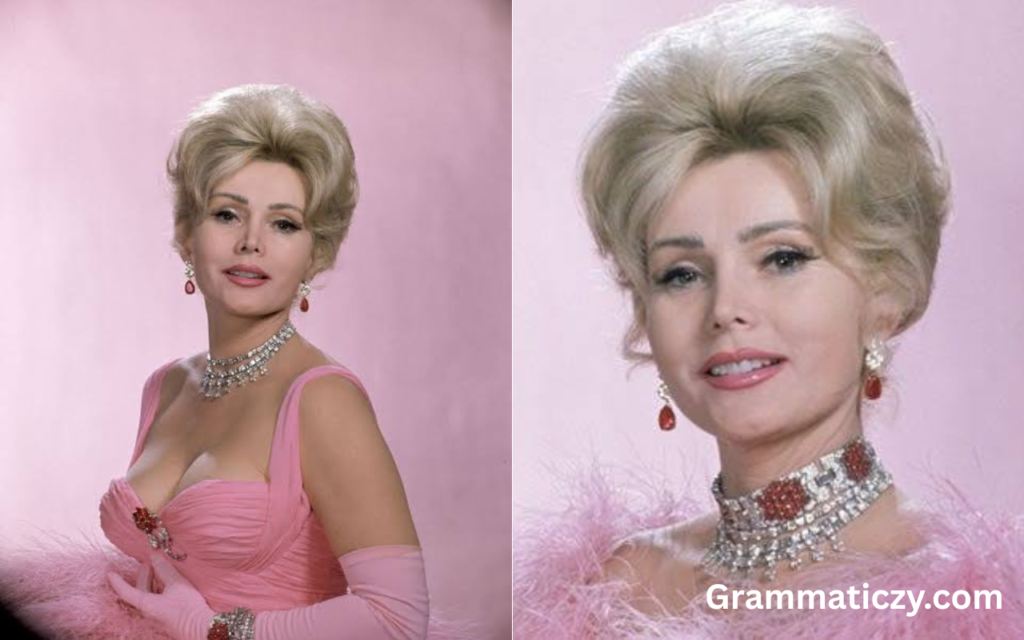
There are celebrities who become famous because of one unforgettable role, and then there are celebrities who become famous simply by becoming unforgettable themselves. Zsa Zsa Gabor belonged firmly to the second category. With her distinctive Hungarian accent, glamorous appearance, dazzling jewelry, sharp wit and extraordinary social life, she transformed herself from a young woman in Budapest into one of the most recognizable personalities of twentieth-century popular culture. Her name became almost synonymous with old Hollywood glamour, luxury, romance and celebrity.
Born Sári Gábor in Budapest on February 6, 1917, Zsa Zsa entered the world in a prosperous Hungarian family and grew up surrounded by European elegance and social sophistication. She eventually traveled from Europe to the United States, where she developed a career as an actress and television personality. Although she appeared in approximately 40 films and countless television programs, her fame ultimately grew beyond traditional acting. The Hungarian National Film Institute describes her as an actress and television personality whose celebrity was amplified by her husbands, diamonds, witty remarks and roles that often reflected aspects of her own public persona.
What makes Zsa Zsa Gabor’s biography particularly fascinating is the way she understood celebrity long before the modern age of Instagram, influencers and personal branding. She knew how to keep people interested in her life, her opinions and her relationships. Her nine marriages, glamorous homes, television appearances and famously quick comebacks became part of a larger public story that continued for decades. Even after her death in Los Angeles on December 18, 2016, at the age of 99, her name remains closely associated with an era when personality could become as powerful as professional achievement.
Zsa Zsa Gabor Facts at a Glance
| Category | Details |
|---|---|
| Full Name | Sári Gábor |
| Famous Name | Zsa Zsa Gabor |
| Date of Birth | February 6, 1917 |
| Birthplace | Budapest, Hungary |
| Date of Death | December 18, 2016 |
| Age at Death | 99 |
| Profession | Actress, television personality, socialite |
| Parents | Vilmos Gábor and Jolie Gábor |
| Sisters | Magda Gabor and Eva Gabor |
| Nationality | Hungarian-American |
| Education | Swiss boarding school; later studied at the Vienna drama academy |
| Only Child | Francesca Hilton |
| Marriages | Nine |
| Hollywood Walk of Fame | Television star, dedicated February 8, 1960 |
| Notable Films | Moulin Rouge, Lovely to Look At, Touch of Evil, Queen of Outer Space |
| Major Recognition | Hollywood Walk of Fame star; 1958 Golden Globe special recognition |
| Net Worth | Frequently estimated around $40 million, although exact estate value is difficult to verify |
| No verified personal account | |
| X/Twitter | No verified personal account |
| No verified personal account |
Early Life and Family Background
Zsa Zsa Gabor was born in Budapest as Sári Gábor, the middle of three daughters. Her father, Vilmos Gábor, was a soldier, while her mother, Jolie Gábor, was a strong and influential figure within the family. Her older sister Magda and younger sister Eva would later also become known in American society and entertainment, making the Gabor family one of the most recognizable groups of Hungarian-born women in Hollywood. The family belonged to the comfortable and socially connected world of early twentieth-century Budapest.
The environment in which Zsa Zsa grew up had a major influence on the woman she eventually became. According to the Hungarian National Film Institute, the Gabor family enjoyed an affluent lifestyle that included summers near Lake Balaton, elegant social gatherings and an atmosphere filled with music, fashion and sophisticated company. Her mother also placed considerable importance on etiquette, appearance, jewelry and social confidence. Zsa Zsa therefore learned from an early age that presentation could influence the way people perceived you.
Education was another important part of her upbringing. Zsa Zsa and her sister Magda studied at Madame Subilia’s girls’ school in Lausanne, Switzerland, where they were exposed to languages, European culture, etiquette and the social skills expected of women from their background. Her early experiences gave her a cosmopolitan outlook that later became one of her greatest advantages in America. She could move comfortably between different social environments, and her European accent eventually became one of the most recognizable elements of her celebrity persona.
From Budapest to the Entertainment World
Zsa Zsa’s interest in performance developed while she was still young. During a visit to Vienna, she met the famous tenor Richard Tauber, who recognized her potential and invited her to perform the soubrette role in his operetta Der singende Traum, or The Singing Dream. She subsequently attended courses at a drama academy in Vienna, giving her an early introduction to professional performance.
Her early public image was also connected with beauty competitions. She is often described in popular biographies as Miss Hungary 1936, but the historical record is more complicated. The Hungarian National Film Institute notes that she entered the Miss Hungary competition while still young and that although she was regarded as exceptionally attractive, she did not actually win the competition. This distinction is important because the “Miss Hungary” label has been repeated so often that it is now frequently treated as an unquestioned fact.
Her personal life also began changing rapidly during these years. She married Turkish diplomat and intellectual Burhan Asaf Belge while still a young woman and lived for a period in Ankara. The experience exposed her to diplomacy, international society and a culture very different from Budapest. However, the marriage did not become a lasting one. As Europe moved toward the Second World War, the political situation became increasingly dangerous, and Zsa Zsa eventually decided to leave Europe and follow her sister Eva to the United States.
Zsa Zsa Gabor’s Journey to America
Zsa Zsa arrived in the United States in 1941, a decision that dramatically altered the course of her life. Leaving Europe during the increasingly dangerous wartime period was not simply a career move; it was a major personal transition. She was leaving behind the familiar environment of Budapest and Europe and entering a country whose entertainment industry would eventually turn her into an international celebrity.
The transition was not effortless. Zsa Zsa had beauty, confidence and social skills, but Hollywood was highly competitive. She had to establish herself in an entertainment industry filled with experienced performers who were competing for the same opportunities. Rather than attempting to erase her European identity, she made it part of her appeal. Her accent, mannerisms, elegant clothes and continental sophistication differentiated her from many American actresses.
That decision proved enormously important. Instead of becoming just another beautiful supporting actress, Zsa Zsa gradually created a distinctive public identity. She understood that Hollywood rewarded people who could generate curiosity, and she became increasingly comfortable presenting herself as glamorous, sophisticated and slightly mischievous. By the 1950s, she was no longer simply a Hungarian immigrant trying to find work. She was becoming Zsa Zsa Gabor, a recognizable American celebrity.
Hollywood Acting Career
Zsa Zsa Gabor’s American film career began to take shape in the early 1950s. Her first modest film role came in Lovely to Look At in 1952, but her major breakthrough arrived the same year with John Huston’s Moulin Rouge. She played Jane Avril in the British production, which dramatized the world surrounding the famous Paris nightclub and painter Henri de Toulouse-Lautrec. The film became one of the most significant acting credits of her career.
Gabor continued appearing in films throughout the 1950s and beyond. Her credits included Death of a Scoundrel, The Girl in the Kremlin, Touch of Evil, Queen of Outer Space and other productions. In Orson Welles’s Touch of Evil, her appearance was extremely brief, but the fact that she was prominently credited alongside major performers demonstrated how much celebrity value her name had acquired.
Her acting career was unusual because her greatest cultural importance was not necessarily tied to the size of her roles. She was often cast in glamorous, sophisticated or exaggerated parts that complemented her public image. Instead of completely disappearing into characters, she frequently brought elements of her own persona to the screen. This approach helped make her instantly recognizable and eventually contributed to the perception that Zsa Zsa Gabor herself was her most famous role.
Television and the Rise of Her Celebrity Persona
Television became one of the most important platforms in Zsa Zsa Gabor’s career. During the 1950s, 1960s and subsequent decades, she appeared frequently on television, where her personality could become the main attraction. She was not limited to dramatic acting; she could appear as a guest, participate in comedy, discuss her personal life or simply entertain an audience with her distinctive delivery and humor.
Her television presence helped introduce her to people who may never have watched her movies. Programs such as Hollywood Squares, Laugh-In and other television appearances reinforced the idea that Gabor was more than an actress. She was a personality. Her accent and manner of speaking were instantly recognizable, while her willingness to joke about relationships, marriage and wealth gave television hosts plenty of material to work with.
This aspect of her career makes her especially interesting from a modern perspective. Today’s celebrities often build audiences by constantly sharing aspects of their private lives online. Zsa Zsa was doing something similar decades earlier, although her tools were television, magazines, newspapers and public appearances. She understood that audiences wanted to know the person behind the screen image, and she was exceptionally skilled at giving them an entertaining version of that person.
Awards, Recognition and Hollywood Walk of Fame
Zsa Zsa Gabor did not build her reputation around a long list of traditional acting awards. Her recognition came more from her cultural presence and her extraordinary celebrity status. In 1958, she received a special Golden Globe recognition for being one of the most glamorous actresses, an honor that reflected the characteristic for which she had become famous.
One of her most important official honors came in 1960 when she received a star on the Hollywood Walk of Fame. Her star is in the television category at 6915 Hollywood Boulevard, and the official Walk of Fame records February 8, 1960, as her ceremony date. This honor established her place within Hollywood’s permanent public history.
The significance of the star goes beyond a simple award. Gabor represented a type of entertainment personality whose influence extended across acting, television and popular culture. The official Hollywood Walk of Fame continues to list her among its honorees, preserving her name alongside generations of major entertainers. Her recognition demonstrates that celebrity influence can take many forms and does not always depend on winning major acting trophies.
Zsa Zsa Gabor and Her Nine Marriages
Perhaps no part of Zsa Zsa Gabor’s personal life attracted more media attention than her marriages. She married nine times, with husbands including Burhan Asaf Belge, hotel magnate Conrad Hilton, actor George Sanders, financier Herbert Hutner, Joshua S. Cosden Jr., designer Jack Ryan, attorney Michael O’Hara, actor Felipe de Alba and Frédéric Prinz von Anhalt. Her relationship history became so famous that marriage itself became part of her celebrity brand.
Her marriage to Conrad Hilton produced her only biological child, Francesca Hilton, who was born in 1947. Gabor’s relationship with her daughter was considerably more complicated than the glamorous public image surrounding the family might suggest. Francesca became an adult in her own right and eventually experienced financial and personal difficulties before her death in 2015, just one year before her mother.
Her ninth and final marriage was to Frédéric Prinz von Anhalt. They married in 1986 and remained together until Gabor’s death in 2016. During the final years of her life, when serious health problems limited her ability to participate in public life, he became an important figure in caring for her and communicating with the media. Their long marriage contrasted with the shorter relationships that had defined much of Gabor’s earlier celebrity story.
The Wit and Personality That Made Her Famous
Zsa Zsa Gabor’s greatest talent may not have been acting at all. It was conversation. She possessed an extraordinary ability to turn everyday experiences into humorous observations, particularly when discussing relationships, marriage, wealth and men. Her accent and delivery made her one-liners even more distinctive, and many of her remarks became permanently associated with her name.
Her humor was also a form of self-branding. Gabor understood that a memorable statement could keep a celebrity in newspapers long after a movie had disappeared from theaters. She was willing to joke about her marriages and public image rather than pretend that the gossip did not exist. By laughing at the expectations surrounding her, she gained control over the narrative and turned publicity into part of her entertainment career.
She even wrote books that expanded this personality-driven approach. Her 1970 advice book How to Catch a Man, How to Keep a Man, How to Get Rid of a Man presented her experiences and opinions through the humorous lens for which she was known. She also published autobiographical works, allowing audiences to see more of the woman behind the headlines. Her publishing career reinforced her reputation as someone who could turn personal experience into entertainment.
Luxury, Fashion and Zsa Zsa Gabor’s Lifestyle
Luxury was one of the defining elements of Zsa Zsa Gabor’s public image. Diamonds, elegant clothing, glamorous parties and impressive homes became almost inseparable from her name. She understood that visual presentation was a form of communication and frequently appeared in a way that reinforced her reputation as a sophisticated Hollywood socialite.
Her homes also contributed to that mythology. She became associated with prestigious properties in California and Palm Springs, and the Gabor family name remains connected with architecturally distinctive homes. One former Palm Springs residence associated with Zsa Zsa and her sister Magda was later restored and placed on the market, demonstrating that interest in the Gabor lifestyle continues decades after their peak years.
However, the glamorous lifestyle should not be mistaken for a simple story of effortless wealth. Real estate can be valuable while also creating significant expenses, and Gabor’s later years involved substantial medical and personal costs. Her financial circumstances became increasingly complicated as she aged. The contrast between the glamorous public image and the difficult realities of her later life adds a more human dimension to her story.
Zsa Zsa Gabor Net Worth and Sources of Income
Zsa Zsa Gabor’s net worth has often been estimated at approximately $40 million, but that figure should be treated cautiously. Celebrity net-worth estimates are rarely equivalent to audited financial statements, and the value of a celebrity’s estate can change considerably depending on property, debts, personal possessions, legal matters and other assets. Her financial story therefore cannot be reduced to one definitive number.
Her income came from several areas during her long career. Film and television work provided professional earnings, while books, public appearances and endorsements allowed her to monetize her celebrity beyond acting. Real estate also played an important role in her financial history, particularly because she owned or lived in valuable properties associated with the glamorous lifestyle for which she was known.
After her death, her belongings continued to attract attention. The sale and auction of items connected with her estate demonstrated the enduring value of her personal brand. Jewelry, furniture, clothing and memorabilia were not simply household possessions; many of them had become part of the historical image of Zsa Zsa Gabor. In that sense, her financial legacy was intertwined with her celebrity legacy.
The 1989 Beverly Hills Controversy
One of the most famous controversies of Gabor’s later career occurred in 1989 when she was stopped by Beverly Hills police. The confrontation escalated and Gabor slapped the police officer. The incident generated extensive publicity and eventually resulted in legal consequences, including a short jail sentence and community service.
For another celebrity, such an incident might have permanently damaged a career. Gabor handled it differently. She continued to appear in public and even incorporated aspects of the controversy into her entertainment persona. Her ability to turn an embarrassing event into another piece of celebrity mythology demonstrated how effectively she understood publicity.
The incident also revealed the complicated relationship between Gabor and the media. She was frequently portrayed as extravagant, demanding and dramatic, but she also understood that those characteristics generated attention. Rather than attempting to become completely conventional, she leaned into the larger-than-life identity that audiences already associated with her. That strategy helped keep her relevant even when her film career was no longer at its peak.
Health Problems and Final Years
Gabor’s later life was marked by serious health difficulties. A 2002 automobile accident caused significant injuries and contributed to years of declining mobility. She subsequently faced a series of medical complications, and her public appearances became increasingly rare as her health deteriorated. Her transformation from an energetic Hollywood personality into a largely private figure was a painful contrast with the image audiences had known for decades.
In 2011, doctors amputated her right leg above the knee following a serious infection. Her health challenges continued during the final years of her life, while her husband Frédéric Prinz von Anhalt remained closely involved in her care. These years were far removed from the glamorous parties and television appearances of her earlier career, but they also showed a quieter side of a woman who had spent most of her life under intense public attention.
Zsa Zsa Gabor died in Los Angeles on December 18, 2016, at the age of 99. The Hollywood Walk of Fame later recorded a memorial tribute at her star, where flowers were placed in her memory the day after her death. Her passing marked the end of a remarkable life that had crossed European society, wartime migration, Hollywood cinema, television, celebrity culture and old-fashioned high society.
Zsa Zsa Gabor’s Social Media and Online Legacy
Unlike contemporary celebrities, Zsa Zsa Gabor never had an official Instagram, X/Twitter or LinkedIn presence because the social-media era arrived after much of her career and after her death. There are therefore no legitimate personal social-media updates from Gabor herself. Accounts using her name should not automatically be considered official unless they can be independently verified.
Her online legacy instead exists through photographs, archived interviews, film clips, biographies and historical databases. Modern audiences can discover her through the same internet platforms that have revived interest in many classic Hollywood figures. Her memorable quotes and glamorous photographs have also circulated widely online, giving younger audiences an introduction to a celebrity who built her reputation long before digital media existed.
There is an interesting irony here. Gabor never had the tools of modern social media, yet many aspects of her career resemble today’s influencer culture. She marketed her personality, maintained public visibility, turned private experiences into entertainment and understood the importance of being memorable. In many ways, she demonstrated the power of personal branding before the phrase became part of everyday digital vocabulary.
Zsa Zsa Gabor’s Enduring Influence
Zsa Zsa Gabor’s influence is difficult to measure using traditional acting standards alone. She was not primarily remembered for winning major dramatic awards or delivering long series of critically acclaimed performances. Instead, she became a cultural symbol. Her name represented glamour, luxury, romance, witty conversation and a particular style of old Hollywood celebrity.
The Hungarian National Film Institute describes her as a genuine celebrity whose reputation was strengthened by her marriages, diamonds, sharp comebacks and numerous roles. That description captures why her career remains interesting. Gabor demonstrated that a performer could build a lasting legacy by becoming a recognizable personality rather than relying exclusively on conventional artistic achievement.
Her influence can also be seen in the modern entertainment industry, where celebrity personalities often operate as brands. Reality television stars, influencers and social-media personalities routinely turn their private lives into public entertainment. Gabor did something remarkably similar decades earlier, using television, magazines, interviews and public appearances rather than smartphones and social platforms.
Conclusion: The Legacy of Zsa Zsa Gabor
Zsa Zsa Gabor’s life was a remarkable journey from Budapest to Hollywood, from European society to American celebrity culture, and from a young performer searching for opportunities to an international personality who needed no introduction. Her career included films, television, publishing and public appearances, but her greatest creation was arguably the public character of Zsa Zsa Gabor herself.
She experienced extraordinary success alongside equally extraordinary difficulties. She enjoyed fame, luxury and social recognition, yet she also faced complicated relationships, family losses, controversy, health problems and the challenges of aging in the public eye. Her story therefore contains more than glamour. It is also a story about reinvention, adaptability and the ability to remain relevant as the entertainment industry changes around you.
Zsa Zsa Gabor ultimately left behind a legacy that cannot be confined to a filmography. Her Hollywood Walk of Fame star remains a permanent reminder of her contribution to television and entertainment, while her films, books, interviews and legendary personality continue to attract interest. As future generations rediscover the history of Hollywood celebrity, Gabor’s journey remains a fascinating reminder that perseverance, confidence, individuality and an understanding of one’s own identity can create a legacy that lasts far beyond a single career. Her story proves that sometimes the most memorable role an entertainer can play is simply being unmistakably themselves.