
Ever received a message that simply says “NTY” and paused for a second trying to decode it? You’re not alone. Internet slang evolves quickly, and abbreviations like this can be confusing if you don’t come across them often.
If you’re wondering about the meaning of NTY in texting, this guide breaks it down in a simple, practical way. You’ll learn what it stands for, where it’s used, and how to understand it in real conversations.
What does NTY mean in texting?
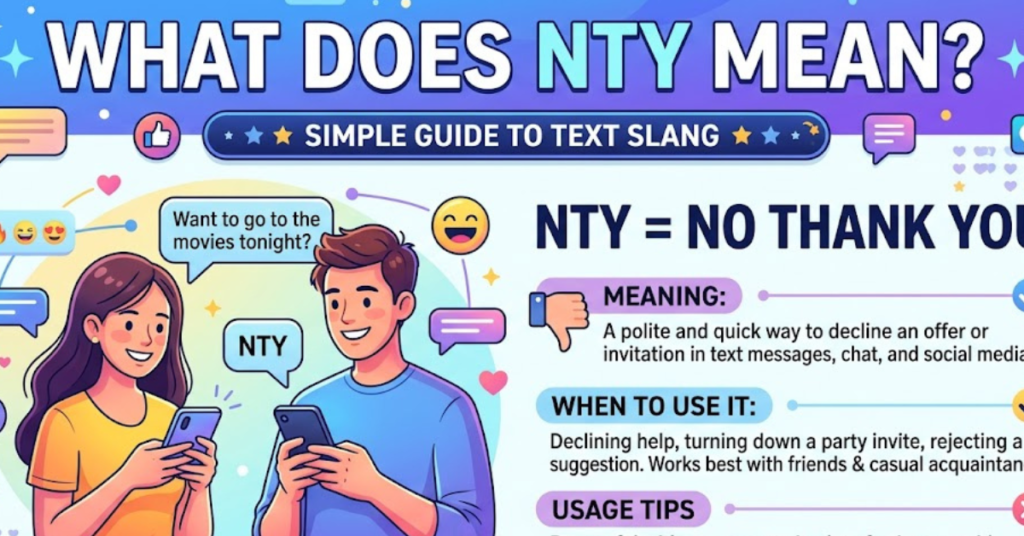
NTY is an internet abbreviation that stands for “No Thank You.”
It is commonly used in digital communication to politely decline something without typing a full sentence. Instead of writing “No, thank you,” people shorten it to NTY for faster chatting.
In most cases, it appears in:
- Text messages
- Online gaming chats
- Social media replies
- Messaging apps like WhatsApp or Discord
Why people use NTY in online conversations
The rise of texting culture created a need for speed and simplicity. That’s where abbreviations like NTY became popular.
People use it because:
- It saves time
- It feels casual and natural online
- It fits fast-paced conversations, especially in gaming or group chats
So when someone asks about the meaning of NTY slang, it usually comes down to convenience and tone.
Where you’ll commonly see NTY used
Understanding how NTY is used helps clarify its meaning in real situations.
1. Social media
Users may reply with NTY when they are not interested in a suggestion, trend, or offer.
2. Gaming chats
Players often use it to decline trades, invitations, or team requests quickly.
3. Messaging apps
In apps like WhatsApp or Discord, it’s a fast way to politely refuse something.
4. Online forums
People may use it when rejecting ideas, services, or recommendations.
Examples of NTY in real conversations
Here are some simple examples to make its usage clearer:
- “Want to join the match?” → “NTY, maybe later.”
- “Do you want this item?” → “NTY, I already have one.”
- “Try this app!” → “NTY, not interested.”
In all cases, it communicates a polite refusal without needing extra words.
NTY vs similar internet slang
To better understand this abbreviation, it helps to compare it with similar expressions:
- TY (Thank You): Expresses gratitude
- NVM (Never Mind): Cancels or withdraws a statement
- NOPE: Casual refusal, often more informal or playful
- NO THANKS: Full written version of NTY
Among these, NTY is one of the more polite and balanced ways to decline something in chat.
Is NTY rude or polite?
One common question about NTY meaning is whether it sounds rude.
In most cases, it is:
- Neutral
- Polite
- Short but not disrespectful
However, tone depends on context. In very formal situations, it may feel too casual or blunt. That’s why it’s best avoided in professional emails or workplace communication.
Tips for using NTY correctly
If you plan to use this slang in conversations, keep these tips in mind:
- Use it only in casual chats
- Avoid it in formal or professional writing
- Add emojis if you want a friendlier tone
- Make sure the person you’re talking to understands internet slang
Key Takeaways
- NTY stands for “No Thank You”
- It’s used in texting and online chats
- It helps people respond quickly and politely
- Tone depends on context
- Best used in informal conversations
FAQs about NTY
1. What does NTY mean in simple terms?
NTY simply means “No Thank You.” It’s a quick way to decline something in texting or online chats.
2. Is NTY’s commonly used in texting?
Yes, it’s frequently used in casual digital communication like messaging apps and gaming chats.
3. Does NTY’s sound rude?
Not usually. It’s generally neutral, but tone depends on how and where it is used.
4. Can I use NTY’s in formal communication?
It’s better not to. In professional settings, writing “No, thank you” is more appropriate.
5. What is the difference between NTY and TY?
NTY means refusal (“No Thank You”), while TY means appreciation (“Thank You”).
Conclusion
Now you clearly understand the meaning of NTY and how it fits into modern online communication. It’s a simple abbreviation for “No Thank You” used widely across texting, gaming, and social media.
Like many internet slang terms, it reflects how digital language prioritizes speed and convenience. When used appropriately, it helps keep conversations short, clear, and polite.
If you want, I can also:
- Optimize this further for a specific SEO tool (Yoast, RankMath, etc.)
- Add schema markup (FAQ + Article)
- Or create a cluster article like “100 Internet Slang Terms Explained”