Have you ever paused while writing and wondered whether undecisive or indecisive is the correct term? You are not alone. Many English speakers confuse these words because they seem to carry the same meaning. However, only one of them is considered standard English.
In this article, we will explain the difference between undecisive and indecisive, why one is preferred, how to use it correctly, and provide examples that will help you avoid this common grammar mistake.
Is It Undecisive or Indecisive?
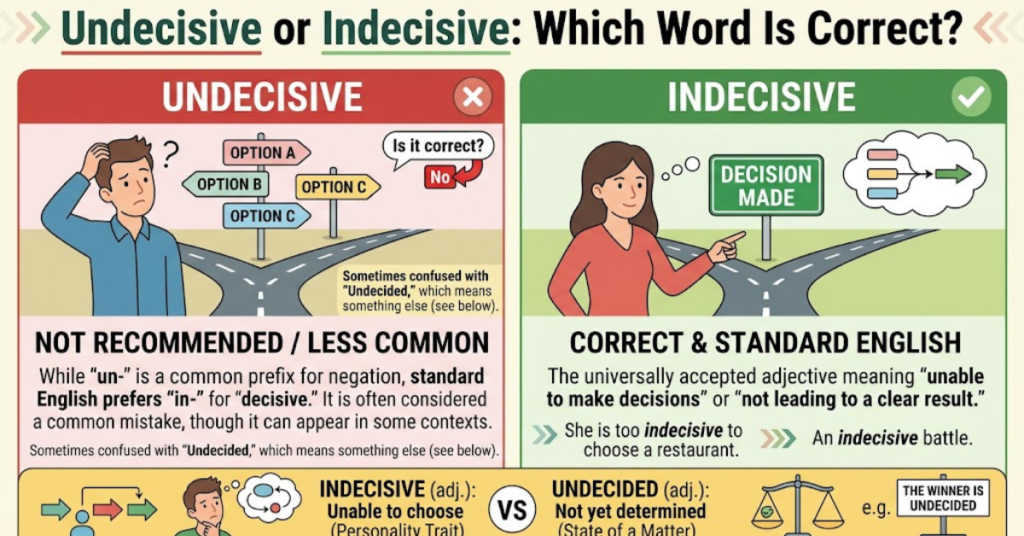
The correct word is indecisive.
Indecisive is a recognized adjective in English that describes a person who has difficulty making decisions or cannot choose between options. The word undecisive does exist in some dictionaries and has appeared historically, but it is extremely rare and generally considered nonstandard or incorrect in modern English.
Correct Usage:
- She is very indecisive when choosing what to eat at a restaurant.
- His indecisive nature made it difficult to finalize the plan.
- The manager was indecisive about which candidate to hire.
Incorrect or Uncommon Usage:
- She is undecisive about her future career.
In formal writing, academic work, and professional communication, indecisive should always be your choice.
What Does Indecisive Mean?
The word indecisive means unable to make a clear decision or showing hesitation between different choices. It can describe a person’s personality, a moment of uncertainty, or even an action that lacks a firm conclusion.
Some common meanings include:
- Having difficulty making choices
- Being hesitant or uncertain
- Lacking confidence in decisions
- Failing to reach a definite conclusion
For example:
“I’m so indecisive that I spent an hour deciding what movie to watch.”
The sentence shows someone struggling to choose between different options.
Why Do People Say Undecisive?
Many people use undecisive because it follows a pattern seen in English words with the prefix “un-,” such as:
- Unhappy
- Uncertain
- Uncomfortable
- Unfair
Because “undecided” is a common word, some speakers naturally assume “undecisive” must also be correct. However, English developed the adjective indecisive from the prefix in-, which means “not,” combined with the root related to decision.
This is why indecisive became the accepted standard.
Indecisive vs Undecided: What Is the Difference?
Another word often confused with indecisive is undecided. While they are similar, they are not exactly the same.
| Word | Meaning | Example |
| Indecisive | A tendency to struggle with making decisions | “John is indecisive and changes his mind often.” |
| Undecided | A decision has not been made yet | “I am undecided about where to go on vacation.” |
In simple terms, indecisive describes a person’s habit or character, while undecided describes a current situation.
Synonyms for Indecisive
If you want to avoid repeating the word indecisive, consider these alternatives:
- Hesitant
- Uncertain
- Doubtful
- Wavering
- Unsure
- Ambivalent
- Vacillating
- Hesitating
Each synonym carries a slightly different meaning, so choose the one that best fits the context.
How to Remember the Correct Word
A simple trick to remember the answer to undecisive or indecisive is this:
If you are talking about someone who struggles to make decisions, choose “indecisive.”
Think of common words like:
- Incomplete
- Inaccurate
- Inactive
Just like these words, indecisive uses the prefix “in-” to express the absence of something.
Common Mistakes to Avoid
When writing or speaking, avoid these mistakes:
1. Using Undecisive in Formal Writing
Although some people use it informally, it may be viewed as a spelling error in professional contexts.
2. Confusing Indecisive with Undecided
Remember that indecisive often describes a personality trait, while undecided usually refers to a temporary state.
3. Assuming All Opposites Use “Un-”
English has many exceptions, so the opposite form of a word does not always begin with “un.”
FAQs
Is undecisive a real word?
Undecisive has appeared in historical English and some dictionaries, but it is very uncommon and not generally accepted as standard modern English. The preferred word is indecisive.
Why is indecisive correct instead of undecisive?
The adjective indecisive developed through established English and Latin word formation and became the standard term for someone who has trouble making decisions.
Can I use undecisive in a sentence?
You may encounter it in casual speech or older texts, but it is better to use indecisive, especially in professional, academic, or published writing.
What is the difference between indecisive and indecision?
Indecisive is an adjective describing a person or action, while indecision is a noun referring to the inability to make a decision.
Example:
- “She is indecisive.”
- “Her indecision caused delays.”
Is being indecisive a bad thing?
Not always. Being indecisive can show careful thinking and a desire to consider all options. However, excessive indecision can make it difficult to take action or meet deadlines.
Conclusion
When comparing undecisive or indecisive, the clear winner in modern English is indecisive. While undecisive has historical usage, it is rare and generally considered nonstandard today. Understanding the difference between indecisive, undecided, and related terms will help you communicate more confidently and accurately.
The next time you hesitate over which word to write, remember this simple rule: choose “indecisive” for a person or situation involving difficulty making a decision. For more grammar guides and vocabulary tips, explore related articles to strengthen your English skills.